27 May 2011

If They're Committed To It, Don't Let Them Do It

"I don't have anything against gay people.  I just don't think they should be allowed to get married."


I'm sure you've heard someone say something like that.  A student of mine wrote it in her paper.


That in itself wouldn't raise my hackles:  I've heard and read all sorts of things.  


However, the student's rationale for her belief is one of the strangest I've ever heard.  Like many who oppose equality, she tries to empower her beliefs with her religious faith and her concern for the daughter she is raising by herself.  


She says that she doesn't want her daughter to grow up believing that a union between two men or two women is "normal" or "moral."  That argument is also nothing new.  But here's where things get weird:  She says the fact that the divorce rate is so high is reason enough not to allow marriage between two men or two women.i


I asked her to explain that.  This is what she said:  "Well, you know, a lot of these gay couples stay together for  a long time.  Actually, I have some friends who are gay and have been 'married' to other gay people for ten, fifteen or even twenty years."


"All right.  How does that relate to the topic of gay marriage and why it shouldn't be allowed?"


"If my daughter sees straight couples getting divorced while gay couples are staying together, it might give kids like my daughter the wrong message."


"Which is...?"

"That gay couples are more commited to each other and stay together longer than straght couples."


"And the problem with that is...?"


She told me that she is "sheltering" her child from all sorts of "evil" influences.  


I never knew that staying married was "evil"--or that it's something kids shouldn't know about.


I must say: It's the first time I ever heard someone's commitment to something as a reason for not allowing him or her to do the very thing to which he or she is committed.  


At the very least, it's the strangest argument Iv'e heard against gay marriage.

26 May 2011

Rain and Earthquakes

The semester is just about over.  I'll be teaching a summer class, but I will have a few days off in between.  Hopefully, it will be enough time to regroup, or whatever you want to call it.


Not that it's been a bad semester.  At least, not for teaching, anyway.  And people at my second job have been treating me well, for the most part.  I really wish it could be my full-time job.  


But that job has been unusual in some ways.  I guess that's inevitable, since it was the first place in which I was hired after my surgery.  And it's also the first place in which I'm working without my history as Nick.  I have his expereinces and abilities (such as they are), but I have not been talking about them as much as I had been.  And, at the new job, I have not talked about my gender identity to my students, though some know about it.  I mean, out of a few thousand students, faculty and staff, it's hard not to believe that at least one hasn't typed my name into a Google search bar and come up with this blog, among other things.


Has it made me a better or worse instructor?  I'm not sure.  Somehow I feel, though, that in not disclosing the fact that I lived as a guy named Nick, or discussing some of the experiences that were part of it, my life has become subliminal source material  for my teaching.


And even though some people on my second job have been very warm and friendly toward me, I still am scarred by some of the things that happened on my other job, where I've worked for the past six years.  I have experienced various betrayals and back-stabbings and, every day, I have to walk by the security guard who sexually harassed me.  


In the meantime, I've had three students in one of my classes whom I would swear were sexually molested or assaulted.  Actually, I know one was:  She told me herself.  But for the other two, I can sense the violence so intensely that I'd be willing to bet that something happened to them, probably when they were children.  One of them, whom I'll call Rachel, wrote her paper comparing Desdemona's relationship with Othello, and Emilia's to Iago, with that of an abused woman to her abuser.  


The thing is, she seemed to know, very intimately, what it's like to be a battered spouse, or anyone battered.    And she has the painfully diffident look and manner of someone whose sense of herself is debased daily by those with whom she lives.


Rachel uncannily reminds me of a girl I knew in high school.  I'll call her Norma.  She had that same look and manner Rachel has.  Another trait they have in common is their intelligence:  Sometimes I think it must be painful to be as smart as they are. 


I hope to see Rachel again.  In some way, I'd like to reassure her that things--and she--are going to be all right or that, at least, they can be.  


23 May 2011

Transgender Group Honors Former Governor

Yesterday the Transgender Legal Defense and Education Fund honored former Governor David Paterson. 

During his final year in office, he signed an executive order mandating some protections for transgender people in the workplace and in other areas.

Because he didn't serve a full term as Governor, and because he became Governor only because Eliot Spitzer resigned in the wake of a scandal, some say that Governor Paterson will be only a footnote in history.  However, I think that even if he doesn't become an icon, I think his time in office will be studied.  For one thing, he actually made more and greater efforts to advance the rights of transgenders, as well as others who have experienced discrimination.  For another, he did that at the same time he was cutting the State's budget. 

Now, I'm not an expert in these matters.  But I do believe that he is one of the few office-holders, if not the only one, in recent history who tried to expand civil rights at the same time he was shrinkng the budget of his government.  Most of the small-government conservatives (at least the ones I know about) see civil rights legislation as giving "privilege" to particular groups of people, and of costing the government--and society as a whole--lots of money not only to enforce the legislation, but also from the missed economic opportunities they claim to be the result of such legislation.

Of course, some will point out--rightly--that Patterson did what he did when he had nothing to lose (politically, anyway).  By the time he signed the executive order, he had already announced that he wouldn't stand for re-election.  Well, maybe there's another moral to that story.

22 May 2011

Looking At My Vagina Again

Early this evening, I got home from a bike ride I took to Point Lookout, via Rockaway Beach.  After feeding my cats and myself, I dilated.  


Nearly two years have passed since my surgery.  So I suppose I was expecting, to the extent that I was thinking about it, that my vagina to change in some way. I just wasn't sure of how it would.  


Maybe my memory of what my vagina looked like in the days and weeks immediately after my surgery has been distorted.  But I seem to recall it as more linear and vertical:  the folds surrounding the cavity seemed to cascade in layers of rosy-colored lines.  


So, perhaps it is only against that memory that my vagina seems to be taking on a more ovular shape, with the folds around it rippling and curving in arcs from it.  For all I know, the shape was more like that from the beginning and I just didn't notice or have any way of comparing it.  


Whether or not that has actually happened, I feel as if that part of my body has taken on the feminine shape I've always wanted.  It looks more and more like other vaginas I've seen.  No, I'm not going to say exactly how many I've seen, or how I came to see them. After all, this is, ahem, an educational blog!


I don't know whether or how my vagina will change again.  I suppose that it will, if for no other reason than I will.  It seems like the surgery, like taking hormones and everything else that came before it, was "just the beginning," as they say.

21 May 2011

Since We Last Met

On my way home last night, I bumped into someone I hadn't seen in at least a year.  Lucy was getting chicken-on-a-stick from a "street meat" cart next to the Capital One bank on Broadway.  So, I noticed, was a rugged-looking man who looked to be a couple of years older than her.

He's her husband.  He wasn't, the last time I saw her.  They met around this time last year, she said, and got married, in a very small ceremony, in September.  I'm not surprised that it happened so quickly:  I always figured that Lucy wouldn't have a long engagement after meeting "the one."  And, from what little I had seen of him, I wasn't surprised that he "fell" so quickly, either.  You know how it is:  those tough-looking biue collar guys can be, deep down, such softies sometimes.  Maybe that's the reason why the men who've mattered most to me in my life--save perhaps for Bruce--have all been blue-collar, in spirit if not in fact.  Somehow I think Lucy feels the same way.

It's a strange feeling, though, to meet a friend's spouse and realize that you've known that friend for longer than the spouse has.  You realize that, apart from the physical intimacy, there is something else that makes your friend's relationship with her husband different from her friendship with you or anyone else.  I'll describe it as best I can:   Although you are friends in this moment, your friendship is defined by its history.  On the other hand, if you are going to spend your life with someone, you have to be able to look toward the future, or at least forward from the current moment, with that person.  

I met Lucy some time during the first year I was living in Astoria.  I had just moved from Park Slope and the life I had with Tammy; I think she met me during the time when I was still going to work as Nick but was going to Manhattan and the LGBT Community Center whenever I could, as Justine.  I also believe it was just before I started taking hormones.  I'm pretty sure that I introduced myself to her as Justine, which would make her one of the very first people who would meet me that way.  


In any event, she recalled that she was nineteen years old then.  That sounds right; she was in her second semester of college--ironically enough, LaGuardia Community College, where I was teaching at the time.  Now she's twenty-seven and working with her husband, who is an independent electrical contractor.  


He talked about how he met Lucy.  The funny thing is that he said almost the same things I've said about her:  that she's pretty, but that's not what you notice about her.  It was "a light within her," he said.  And that, of course, is what I've always liked about Lucy:  that radiance from within.  "That's forever," he said.  "Someone who's pretty today might not be tomorrow."


Then, for no reason I could discern, he told me, "You must have been really beautiful when you were younger.  You're a beautiful lady now. But you really must have been something."


Lucy and I could only smile to each other.

20 May 2011

Near The Finish Line

Been so tired this week. I've been reading papers practically non-stop when I'm not in my classes.  None of it is really new: I have long known that I will have no life for much of May or December every year.  However,  I feel more tired than in years past.  Maybe it's just because I'm getting older.  Or it could be the long, cold, dreary winter and almost non-existent spring we've had.


But I feel something else is happening:  This fatigue I'm feeling is the kind that comes when you're near the end of something and you're hoping that you have enough left in the tank, so to speak, to get you there.

18 May 2011

Reading At The Doctor's Office

Today I went to my doctor for a follow-up.  His office is across the street from a high school.  


I'm thinking now of one of the first times I went there.  I had not yet begun to take hormones or to live full-time as a woman, though I was wearing a skirt and heels that day.  Well, I left the doctor's office around 2:30 on a Friday afternoon--which was, of course, when the students were leaving school for the weekend. Ok, i thought, here comes my first real-life test.


A throng of teenagers was walking toward me.  I simply walked straight ahead, without agression although with some trepidation.  The advancing wall of kids parted in front of me like the Red Sea did for Charlton Heston/Moses in The Ten Commandments.  I felt myself relax and my body motions becoming more fluid.  Some of the kids said "hello;" a couple even said "good afternoon."  I nodded with a smile and waved.


"Who is she?" one of the kids asked.

"I think she teaches here."


"Really?  What?"


"I think she's English."


He meant, of course, that I teach, not am, English.  His reply amazed me, and scared me a bit:  I wondered whether I had a sign on me that I didn't know about.  


And there I was, worried about being "read" as a man.  Well, I guess they read me as something.  I can only hope they read their books so well.

16 May 2011

Power Relations

Another of the mighty has fallen.  Or so it seems.


Dominique Strauss-Kahn is the Managing Director of the International Monetary Fund and was mentioned as a candidate for the French Presidency in next year's elections.

Well, it looks like the latter is out of the question.  Even the French, who are sometimes charitably called "tolerant" when it comes to the sexual behavior of public figures, are saying they can't abide a leader who's done what he's accused of doing.  And it also looks like his IMF career is fini. Even if he's proven to be innocent, it will be difficult, if not impossible, to restore his reputation.


That's because he's been arrested for sexually assaulting a worker in the posh New York Sofitel.  Even if he's cleared of charges, the questions will linger because sexual allegations stick to even the most Puritanical figures.  And Strauss-Kahn has a reputation, even among the French and other Europeans, as a philanderer.


But he's not likely to end up destitute as a result of this.  With his wealth and power come connections that will help him to continue his life in more or less the style to which he's become accustomed.  Those, of course, are the very things that would allow him to behave as he is alleged to have behaved.


One thing that the feminists got right is that sexual relationships are about power.  Or, at least, they come to that.  That is the reason why wealthy and influential men so often prey on women who work menial jobs or are otherwise economically vulnerable. Why do you think an American President had an affair with a White House intern rather than a woman in a policymaking position?  (Of course, his wife was one of said policymaking women.)  And why have I heard so many stories from women who were raped by the owners or managers of restaurants where they worked as waitresses?


I'm thinking again of Dr. Mark Weinberg, the fugitive plastic surgeon who had an affair with a transsexual woman while he was on living on the lam, under an alias.  I can't help but to think that he wouldn't have felt the same lack of compunction about lying had she been a wealthy cis woman rather than a transsexual clerk in a grocery store.  Likewise, if Monsieur Strauss-Kahn indeed committed sexual assault, I somehow doubt he would have committed it against a guest rather than a worker at the hotel.  And Bill Clinton wouldn't have gone to a woman who was anything like his wife for oral sex.


14 May 2011

Transploitation

After Sophie's comment on yesterday's post, I could not stop thinking about the ways we are dehumanized, wittingly or not.


The reason why so many otherwise well-meaning people turn us into "things" is that the act of identifying someone by a label strips that person of his or her humanness.  And that is the surest and easiest way to destroy that person's humanity, as well as one's own humanity.


Pardon me if I seem bitter in writing this post.  But I have come to realize that some people who might go and march for someone else's civil rights would think nothing of being manipulative, controlling or otherwise abusive with us.  And the perpetrators don't think they're doing anything wrong, much as previous generations of white people thought it was OK to be condescending, demeaning, abusive or even violent toward black people in ways that would get them thrown into jail if they so treated another white person.


To me, they're no different from the sorts of guys--like the fugitive doctor I mentioned in my previous post--who use us to satisfy their sexual curiosity, or simply their horniness.  Too many of us can recall at least one relationship like that.  It's almost as if they think they're doing us favors by being involved with us and that we are so starved for love that we'll serve as their mental (or, in some cases, physical) punching bags.


I was in such a relationship, and am still recovering from it.  As bad, though, are the ones who are not dating us but with whom we have to live or work, and do not let us forget that, and what wonderful people they are for not throwing us out like a carton of yogurt that's past its "sell by" date. 


They are the bosses who deny us pay, make demands on us they won't make on other employees and who look for reasons to get rid of us because we "don't fit in with the culture" of the workplace.  They are dismissive of our ideas, which they take for themselves or hand off  to some co-worker who gets credit for it.  Those co-workers are the ones who make spurious, false complaints--anonymously, of course--about us that are as likely as not to include some sort of sexual allegation or innuendo.  They may not know anything about us, but they know that attaching sex to our names yields a stereotype or cariacture that too many other people  are all too willing to believe and use as rationales for the things they do to us.


Isn't it ironic that the thing that, according to no less than Mark Twain, people care about more than everything else put together is the very thing that they will use against us?  Yet it is the very same thing for which they come to us--and, in some cases, react with violence when we don't give it to them, or when it turns out differently from what they expected.  Or, after getting it from us, they toss us aside like soiled napkins.


What's ironic is that I'm writing this post at a time when I'm meeting some people who are not treating me in the ways I've described, and when I'm in a different work situation from the one I've depicted. In my second job, my gender identity or transition doesn't come up.  Some know about it; a few have told me they've seen this blog and some of my other writings.  But they haven't pressed me to talk more about them, and I haven't.  On the other hand, on the job I've been working the past few years, I was "outed" by a faculty member a few weeks after I started there.  Then others goaded me into giving lectures and workshops; still others wanted me to be their "show-and-tell" exhibit for their classes in human sexuality or gender issues.  They people who asked--or, in some cases, coerced--me into doing those things are the very same people who used my doing those things (not to mention the fact that I am who I am) against me.


On that job--which I'd like to replace with my second job if and when I can become full-time in it--some other faculty members (Notice that I'm not calling them my colleagues.) and members of the administration seem to think they're entitled to not only knowing about the intimate details of me and my life, but to use them as they will.  If I were to do the same things, I probably would have been out of that job long ago. In fact, I might even be in jail or the target of a lawsuit.


The doctor I mentioned in yesterday's post definitely deserves to be in prison for the things he did to his patients and the way he abused the system.  But if I were the transgendered Dante, I'd have an especially tortuous circle of Hell set up for him and others like him.  

13 May 2011

First Love With A Fugitive

If you follow this, or any other, blog, you know that Blogger has been down for the better part of the last couple of days.  It's good to be back!


I've been very busy, as the semester is nearing its end.  It's that time of year when pieces of paper are like the brooms in Fantasia.  And I'm like the Sorcerer's Apprentice:  Every time I turn around, those papers multiply.


It's strange:  I've been sleep-deprived, yet people have been telling me I look "really good."  Hmm...Maybe the world really likes tired women!  I know that some men, anyway, are turned on by us!


Speaking of men and the women who turn them on:  When I got home tonight, I turned on the TV and caught part of Dateline.  Tonight's segment dealt with one Dr. Mark Weinberger, who defrauded patients (one of whom died as a result of his cavalier treatment) as well as Medicaid and, after dumping his wife, fled to the Italian Alpine town of Courmayeur.  


What's amazing is that he lived as conspicuously as he did, and was as careless about such things as his dealings with his rental agent, and went for as long as he did without getting caught.  And, while there, he fell in love (if someone like him is capable of love) with a clerk in a local store named Monica who, as it turns out, is transsexual.


He used a fake name and invented a past for himself--or, beyond a certain point, simply wouldn't talk about his past anymore.  Still, the clerk was charmed by her exotic American paramour--at least until she found out that he was on the lam.  In a rather nice twist of fate, she and his ex-wife have become Facebook pals.


What particularly intrigued me about that part of the story, though, was that he was Monica's first lover in her life as a woman.  In that sense, her story parallels mine, and that of some other transwomen I know.  To anyone else, those first loves in our new lives seem almost "too good to be true":  they're richer, more handsome, smarter or in some other way more than we imagined our first loves would be.  And we're all too ready to swallow their bait whole because, for many of us, that first new love validates who we are and what we want to be.  And that love, or whatever you want to call it, gives us a sense of security at a time in which, as happy as we are about finally living the lives we envisioned for ourselves, we are still very, very vulnerable.


So, as much as Dr. Weinberger deserves to be punished for the lives he ruined (or, in one case, ended altogether) with unnecessary or botched surgery, I have a particular ire over the way he, and people like him, manipulate other people through their vulnerabilities:  Something like that happened to me, too.

10 May 2011

Are We Trannies?

It had to happen sooner or later:  Some are suggesting we stop using the term "tranny." Others say it is "our" term, and that some of us use it affectionately with each other.


It's the same sort of debate that surrounds the use of "queer" and the "n-word." All of those terms have been used to denigrate the people denoted by them. And, of course, non-trans people wonder why they're wrong for using the term when we use it to refer to other trans people.


What's often forgotten is that "tranny" is most often used as a derogatory term against MTF transsexuals as well as drag queens and cross-dressers.  So, along with its debasement of transgender people, the term also has an element of misogyny, which would, by itself, be reason not to use the term.  At least, that's how I feel.  


What do you think?


09 May 2011

Becoming Chaz

Tomorrow night, Becoming Chaz will air on OWN.  I probably won't see it, as I don't have cable TV and, in any event, don't watch much TV.  


Even if I had cable or dropped in on a friend who has it, I'm not sure I'd want to watch Becoming Chaz, anyway.  To tell you the truth, I haven't been terribly interested in the story.  


Had he not been born to such famous parents, he would not be any different from other transgender people who have undergone gender transitions.  And, had he not been on screen, in front of millions of people, on his parents' show--back when he was a girl, named Chastity, in frilly dresses and Mary Janes--we probably never would have heard of him.


That is not to say, of course, that I don't care about what happens to Chaz.  Because I understand, at least more than most other people can, what he is experiencing and has experienced, I wish only the best for him.  And I do understand how he feels when he talks about some of the difficulties he's had with people, including some of the ones who were closest to him.


And I can even understand why his mother--Cher, a gay icon--has difficulty with her transition.  My mother has been as about as supportive as anyone can be, or can be expected to be, in my transition and new life.  Yet I know that it has not been easy for her.  After all, she has known me longer than anyone else in this world--and she knew me as Nick, her son, for longer than anyone else ever had, or ever will.  


Plus, she realizes that some relatives of ours, most of whom are long gone, would not have been happy, to say the least, over what I've done.  At least they, as we knew them, would not have been happy.   However, people do change.  Some do, anyway.  Would they have changed?  No one can say for sure, but I know that at least a couple probably wouldn't have.  Then again, the people who change aren't always the ones we expect.   I'm sure Chaz has noticed that by now.


So, while very little about the show would be news to me, Becoming Chaz might be useful and enlightening for other people.  And, I suppose, seeing such a famous person--even if he is indeed famous mainly because of his parents--having undergone a gender transition will probably cause some people to pay more attention to what we say about ourselves, and to perhaps revise their thinking about who and what we are.  So, in that sense, Becoming Chaz is probably a good thing.

07 May 2011

Now That Osama's Gone, Can We Get Our Papers?

Call me a conspiracy theorist.  Or a cynic.  Or whatever you want to call someone who doesn't believe a Navy SEAL killed Osama bin Laden almost a week ago.


Frankly, I think he died years ago.  What does this have to do with a transgender blog?, you ask.


Well...If that Navy SEAL did indeed shoot Osama, and if his body was tossed into the ocean (Was the President's Press Secretary watching Goodfellas?), shouldn't this country be in the process of bringing its troops home from the region?  After all, the ostensible reason for having all of those soldiers and airmen and Marines in Afghanistan was to capture bin Laden.  That, of course, begs the question of why that Navy SEAL killed him.  Folks who are more knowledgeable than I'll ever be about such issues say that he would have been the most valuable intelligence asset on the planet, if not in the history of the United States, or even civilization itself.  


Now I'll ask another rude question:  Now that bin Laden is gone, will all of those "security" measures be discontinued?  Will this mean the end of the PATRIOT Act?  The Homeland Security Administration?  Will I not get patted down the next time I wear a skirt in an airport?  (That happened to me on my way home from Florida.)  

Finally...Does the murder, er, extrajudicial execution of Osama mean that the process of obtaining or changing documents will be less onerous?  To be fair, some states have actually made, or are making, the process easier.  But about two years into my transition, I learned that  Federal offices were treating anyone who changed his or her name as if he or she were doing it to wreak havoc.  A clerk at the passport office told me as much.    He said that the government feared that anyone who changed his or her name--or gender--could have done so to wreak havoc.  However, when I asked, he admitted that neither he nor anyone else he knew in the State Department could recall any terrorist changing his name and gender.  


Meantime, you still have to submit proof that you've undergone GRS/SRS in order to change your Federal government IDs and records.

06 May 2011

Putting the "Lone" in "The Lone Star State"

Most states allow a transgendered person to get a court order to change his or her legal gender.  That court order can, in turn, be used to get a driver's license and other documentation with the person's "new" gender. It can also be used to get a marriage license.


Some states require that a person undergo Genital Reconstructive Surgery (GRS).  Others merely require certification from a doctor that the person suffers from Gender Identity Disorder (GID) or a related condition.  Here in New York, I was able to get such an order after obtaining letters from my doctor and therapist saying that I was receiving treatment, which included my therapy sessions and hormones.  That allowed me to get a non-driver's ID with an "F" in the space for "sex" before I had my surgery.


Texas was one of the last states in this country to provide such an avenue for transgendered people, having done so only two years ago.  Now some of that state's legislators are, in effect, trying to nullify it, at least in part, with a new piece of legislation.  


State Senator Tommy Williams and Representative Lois Kolkhorst have introduced a bill that would prohibit county and district clerks from allowing court orders recognizing sex changes to be used as part of the necessary documentation for obtaining a marriage license.  


If the legislation is passed, Texas would be saying, in effect, that a person's gender is assigned at birth and can never be changed, even if that person's mind and spirit are incongruent with it.   At least, that's what the state would be saying for the purposes of marriage.  And, because the Texas constitution defines marriage as being between one man and one woman, it would mean that, as an example, if I were living in Texas, I could marry only as a man, and that I couldn't marry anyone who is not a woman.  


Now, that may seem like an academic question for me, as I don't plan on getting married or living in Texas any time soon.  But, of course, that is a not-so-academic question for any number of transgender people living in the Lone Star state.  


But this development is most worrisome for an admittedly small (at least relatively speaking) group of transgendered Texans.  They are the ones who were married during the past two years.  If the bill is passed, what will happen to them?  Will their marriages be nullified?  


Ironically, Representative Kolkhorst authored the 2009 law that allows sex change documentation to be used in obtaining marriage licenses.  So far, she hasn't said why she wants to, in essence, reverse her own legislation.

05 May 2011

Workplaces

For a while, I thought about pursuing a full-time position at my second job.  In a lot of ways, the atmosphere is more pleasant than at my regular job.  However, it's not terribly stimulating.  I get the feeling sometimes they're getting along to go along when they're not going along to get along.  


At my regular job, people are dying of stress-related diseases.  Sometimes you can feel the corrosive acrimony on your skin, or so it seems.  But at the second job, some people do battle on the listserv, but are polite and even friendly to each other in person as if they were neighbors separated by a lawn and sprinklers.   Actually, some of them are.  And sometimes the campus seems to be set up that way.  


Could it be that I've spent so much time working in tense environments that I can't work in a friendlier one?  Or, perhaps, having worked around people I simply could not trust, I'm not so sure of what to do around people who have something resembling integrity--and are being hospitable to boot. That's what a friend seems to think.

04 May 2011

Avoiding the "G" Word

On my second job, I find myself avoiding the "g" word.  If you've been reading this blog, you know which one I mean:  gender.  


It's not that anyone there would be offended.  At least, I don't anyone would.  I've simply made it a point--at least to myself--not to talk about my identity, or the life I lived as male.  I simply didn't want to be known only for that or, worse, to have people encourage me to talk about it and have the same people use it, and the fact that I talked about it, against me.  Finally, I got tired of people trying to push me into doing another degree--in gender studies, a field most of them don't actually respect.


But it's getting harder not to talk about those things when I'm teaching.  When reading Othello, as my class at that college is doing now, the discussion always seems to get to the "g" word.  And I'm not the one who brings it up.


I guess students, particularly the younger ones, are accustomed to thinking about it.  They've probably had teachers and other professors who've taught them various subject from a women's, gay or gender studies point of view.  Plus, they all know they have gay friends, relatives and co-workers.  Some of them might even know trans people.   Certainly they know we exist, and some of them have even have see us without the blinders of the stereotypes that shaped the views of people from my generation, and earlier ones.


But I find now that I can say so much more about gender, and how gender roles and expectations shape the way we live and the things we read.  One student asked, "Professor, do you think this is a man's world?"  I could only tell her that she needs to answer that question for herself.  Then there is another student who continues to bring up the idea that Iago was not really trying to wrest Desdemona from Othello; instead, he really wanted Othello.  I don't disagree with that idea, but I try not to talk about it because there are just too many things I could say and that student, and others, would--rightly--want to know why I think what I think.  


Now, I don't think of myself as a transgender first and foremost. But I can't deny that it's shaped, wholly or in part, my views about many things.  There are times when I'm tempted to mention it, simply because it would make explaining some things easier.  But then I wouldn't be explaining those things anymore; I'd be talking about my past and my identity and answering all of those questions we get when people realize who we are.  


Sooner or later, I will tell my students.  Or I will stop teaching anything that might lead to a discussion about gender. That would include, oh, about 95 percent of the plays, poems and stories I've ever taught.  And it would probably include about 90 percent of literature.


Of course, if I follow that second course of action--censoring what I teach--I would eventually stop teaching, in fact or in effect.  


At times like this, I wish that I'd been a math whiz or a technical person.  A surprising number of male-to-female transgenders are engineers.  Why couldn't I have been one of them? I mean, how does gender come up when designing a circuit or writing code?


02 May 2011

To Tell Or Not To Tell?

Last night, while in a coffee shop, I saw the 60 Minutes segment in which correspondent Lara Logan recounted being sexually attacked and nearly killed while she covered the uprising in Egypt.

Having survived molestation during my childhood, I could empathize with her, at least somewhat.  Actually, more than somewhat, and not only because of my experience with a family friend (who was, by the way, straight and married with children of his own).

Hot tears rolled streamed down my face when she talked about her decision to publicly tell her story.  On one hand, she said, she wanted others who have been sexually assaulted to know they "aren't alone" and to help educate the public about sexual violence.  On the other, she wrestled with that "voice" that told her not to talk about it because some people, upon hearing about it, would take it as proof that women are not fit to do the sort of work she's doing. 

I might've added that every time one of us speaks up, some people brand us as "complainers" or imply--or say outright--that we brought the violence on ourselves or, worse yet, "had it coming" to us.

I speak from experience. During my second year of living as Justine, I was sexually harassed by a campus security officer.  I was new to the job--the main job I have now--and had no idea of where to turn.  So I went to the administrative offices and talked to someone--I don't recall his name; he was gone only a few months later and  hasn't been heard from since--who told me not to report it.  "This campus can't help you," he said. "And the police won't," he said.

Later, I realized this college administrator was simply trying to prevent negative publicity for the college, which had seen a nearly complete  administrative turnover, and three different Presidents, during the previous five years.

The interesting thing was that I didn't get pressure from other trans, or even L, G or B, people to keep quiet about my experience, as sexually assaulted women get form other women.  If anything, all of the LGBT people I know wanted me to speak about it publicly, and even to write about it.  All of the pressure I experienced to keep quiet came from the college's administration and my supervisor.  

Any such pressure is bad for the morale of the person receiving it, as if he or she weren't having a tough enough time.  Lara Logan seems like a tough woman, but even she needs support when she's been violated.  And, too often, that's what we don't get.  

At least I didn't have Ms. Logan's many injuries or fear of disapproval from my own community.  

28 April 2011

The Birthers and A Transgender President: Donald Trump Should Be So Proud!

Donald Trump is proud of himself.  He said so yesterday, after President Obama showed the world his birth certificate and Trump claimed that he forced the President to do so.

Of course, The Donald had to say something like that.  He is just smart enough to know how stupid he seemed in light of his claim that Obama was born in Africa.  Well, at least now we know that TD/DT is in the 25th percentile in intelligence:  One out of every four Americans still believes that the Obama wasn't born in the USA.

I guess I shouldn't be surprised.  After all, four centuries after Galileo and Copernicus, and five centuries after Columbus, we have a Flat Earth Society.  They might be jokers, but they're not kidding.

The whole (non-) controversy about Obama's birth certificate got me to thinking what might happen if we ever have a transgender President.  Let's say that person has been living "stealth":  His or her previous life is unknown even to his or her friends and closest work associates.  How long do you think it would be before someone with too much money and too much time on his or her hands finds out that Madame President had been a dude, or that Mister President had been a mistress?  

Would the President ignore the rumors, as Obama did about the birther's claims?  And, if he/she did, for how long?  Obama held out for two years?  Would our tranny president ignore the demand to know about his or her past?  

Would someone demand to see the original birth certificate of our great two-spirited leader?   Remember that in most states that issue new birth certificates (including Georgia, from which I got mine)  keep the original on file.  The original, of course, includes the gender to which the baby was assigned and the name he or she was given at birth.  So, even though my current birth certificate has the name by which you know me and an "F"  for sex, in Atlanta there is still a copy with the name I was given on the day I was born and an "M" where there always should have been an "F."  So, if I were to be elected President and someone who hasn't read this blog (How likely are both of those to be true?) heard about or suspected my past, would he or she demand that I show my original birth certificate?

Hmm...What if we were to re-fight the Civil War and I ran for President of the Union?  Would the fact that I was born in the Peachtree State make me ineligible?  

And would Donald Trump (or his future equivalent) be proud of him (or her) self for "forcing" me to show a birth certificate that indicates my birth as a boy named Nicholas in the state of Georgia?

I think he would.  I would let him be.  

25 April 2011

Not Our Kind Of Place

Here's one of the most disturbing videos you'll ever see:

http://www.worldstarhiphop.com/videos/video.php?v=wshhiHb913Lf4TpU4q5m

The next time someone tries to tell you that we're looking for "special privileges," show him or her this video.  How can anyone say we're trying to get "preferential" treatment when too many of us have to risk our lives to do something that every person--straight, gay, trans, cis or otherwise--needs to do every day? 

How safe are we when an employee of the McDonalds in which the beating took place cheers the attackers on?

And don't get me started on the rates at which we experience unemployment, poverty and homicide. 

24 April 2011

If You Watch Something With Your Mother, Does It Turn Into A "Chick Flick"

All right.  I'll admit it.  I actually watched Titanic tonight--well, the last 2-1/2 hours of the movie, anyway.

I first saw it not long after it came out.  Someone had asked me to get a copy, and I watched it before sending it off.  If I recall, that copy was a VHS and I got it on Canal Street. 

But tonight I watched it on a wide screen TV, on one of the cable channels.  And I watched it with Mom, who's seen it a few more times than I have.

When I first saw it, I made a point of sneering at it, at least when it was over.  Everyone, it seemed, gushed over it, and I, being the macho snob (Is that a contradiction?) I was, or was portraying myself to be, wanted no part of it.  But, deep down, I was enjoying the spectacle of it more than I admitted.

So, you ask, did I see the movie differently tonight?  I did, but first I'll mention something in my view of it that hasn't changed:  I was not impressed with the acting.  To be fair, Leonardo di Caprio was a baby, or so it seemed.  And his innocent cuteness is what, for many viewers, evoked the sadness they felt when his character sank to the bottom of the North Atlantic.  And Kate Winslet wasn't much older, though she looked it.   I think that was used to make the audience feel sympathy for her character:  a very young aristocratic woman who was following the imperatives of her milieu.  However, I felt that she was more of an objet d'art, or a model that might appear in one. 

They're like all those famous actors who always remind you that they're the Famous Actor playing the Important Character.  To me, most A-list Hollywood actors fall into this category.  If I'm not mistaken, their performances are examples of what Uta Hagen called "indicative" acting:  they indicate what you're supposed to see or feel, rather than embodying--or, even better yet, revealing--the essences of those characters.  (I still think one of the best examples I ever saw of the latter was Sean Penn's performance in Dead Man Walking.)

OK, I'll stop being a snotty critic and cut to the chase:  I took some not-so-guilty pleasure in watching the movie tonight.  Tears rolled down my cheeks as Leonardo di Caprio's character could no longer maintain his grip on life that was even more ironclad than the ship's hull, and disappeared into the icy darkness of the water.  And the trickle turned into a stream when I saw the old woman Kate Winslet's character becomes, and when one of the people who interview her says that there was no record of the young man who sank into the cold and darkness.

I know that the movie impressed lots of people with its special effects, as James Cameron movies tend to do.  And I know there was lots of emotion that is to the human heart as the stuff played by music boxes is to music.  But somehow it felt good to experience it as I did tonight.  Now I wonder:  Was it because of the hormones, the surgery, or simply being with Mom at what is now seeming more like a late stage in her life (as much as I hope and wish it isn't so!).

23 April 2011

Arriving To The Passage Of Time

I'm at my parents' house in Florida, having gotten here last night and almost immediately dozing off.  The latter is not so much a commentary on Mom or Dad as it is on how tired I was last night.

Anyway, today I went for a nice but familiar bike ride and had an equally nice and familiar dinner of Mom's lasagna.  Tomorrow is Easter Sunday; Mom is going to Mass and later we will have dinner.  The day after that, Mom and I are planning to have lunch with a friend of hers with whom we had lunch the last time I was here, at Christmastime.

Although this is all fine, and I enjoy it, I am feeling rather strange about it all.  Yes, Mom and Dad raised and supported me.  But who was that "me?"  And all those times in my I adult life I came to their house, wherever they were living, are among the reasons I am here now.  But who was that person who spent those holidays, those weekends and those days and nights with them?  That person had a different name from the one I now have, and made all sorts of choices and decisions I would not make now.  Some of that, of course, is a matter of what nearly everyone feels upon reaching the age I am now:  Nearly all of us have done things that, knowing what we know now, we wouldn't do.  I am sure both of my parents feel this way.  But, as you can imagine, for me everything was complicated by the fact that I was living, literally, as a different person from what I am now.

I can't help but to wonder whether they would be living the lives they're living, in this house, had they raised me as a girl--had any of us known that such a thing was even possible, as foreign as it would have been in the places and time in which we were living!  I can't help but to think--even if I can't explain why or how--there are things they might've done differently if they had been raising Justine rather than Nick, and those things would have affected other choices they made.  Perhaps I would have been better off, or at least I wouldn't have to learn the things I'm learning because I would have learned them earlier in my life.  But what of my parents, and my brothers:  Would they have been better or worse off?  Or would it have made a difference?


Maybe it's just the realization that they have less and less time left in this life that's causing me to realize how much time I lost or wasted.

21 April 2011

Diana Discovers The Real Tea Party Agenda

The other day, McDonald's took applications for 50,000 positions they plan to fill.  

Some are saying that's a sign the economy is "turning a corner."  Perhaps it is if you're a McDonald's executive, or perhaps the owner of one of its franchises.  However, I don't think that the people who waited all night outside those restaurants to fill out an application would tell you that things are getting better.  Granted, some of them are young people who've never had a job before. But there are many others who had jobs that paid well, or were even professionals of one sort or another.  Now they're lining up for jobs that pay minimum wage, or not much more.

I guess the economy is turning a corner.  Here in New York, turning a corner can bring you into an entirely different neighborhood--and world.  And it isn't always for the better.  

So what are we entering?  I am not an economist, historian, futurologist, sociologist or any of the people who get paid to comment on this sort of thing.  But I don't think it's an economy that's going to benefit very many people.

We've heard it all:  First the manufacturing jobs went overseas.  Then customer service went to call centers in India.  Now we're seeing lawyers', engineers' and other professionals'--not to mention clerks'--work sent to countries with low wages.  Those last jobs were thought to be the ones that would never be "outsourced."  

So are there any "safe" jobs or professions?  Some have mentioned health care and law enforcement.  The former (even the so-called private facilities) are largely paid for through public funds, i.e., taxes.  And law enforcement is almost entirely financed that way.  We're seeing the consequences of that now:  The other day, Paterson, NJ laid off one-fourth of its police force.  

I think that what we're seeing is the real Republican/Right/Tea Party agenda.  If people are willing to do anything to get on the lowest rung of the employment ladder, those who are hiring can demand just about anything from them.  So the would-be employers are creating a buyer's market for labor.  And guess who the buyers are?

There is, however, a far more insidious manifestation of the Tea Party agenda. In fact, it's been all but unnoticed.  But it goes hand-in-hand with reducing large parts of the workforce to wage slavery.

On her blog, Diana described an example of what is happening.  In Michigan, the Governor essentially gave himself the power to throw out locally-elected officials and appoint his own people.  Those appointees, in turn, can toss out other officials and, in essence, run their localities by edict. 

This scenario has already played out in one city.  It just happens that city is the poorest and blackest (Yes, even more so than Detroit!) in the state.  I'm talking about Benton Harbor, which has been the subject of a number of articles and a book ("The Other Side of The River" by Alex Kotlowitz) in which the city is depicted as a poster child for post-industrial decay.  

If that could happen there, it's not hard to imagine, for instance, Chris Christie doing something similar with Camden or even Trenton, the state capital.  Newark wouldn't be out of the question, either.  

That is a corporate fascist's dream:  Large portions of the population without money and without a vote, or any other form of recourse.  (Think of what they're really trying to accomplish by de-funding Planned Parenthood.  It's not, as they say, about "reducing government." )

Some days it's just unbearable to be teaching college students who still believe that their degrees are going to get them wonderful, high-paying jobs.  I just hope that I'm helping them to open their eyes and that it leads them to vision rather than disillusionment.  Otherwise, what is the point of their time in school?

18 April 2011

Nevada Assembly Passes Transgender Protections Bill

The Nevada State Assembly has just voted for a bill that would outlaw job discrimination against transgender people.


Now the bill has to go before the state Senate for a vote.  The bill's supporters believe they have the votes to pass it, but no one seems to know whether Governor Bill Sandoval will sign it.


One legislator tried to claim that there aren't legal barriers to employment for transgender people, and others pointed out that there haven't been any discrimination cases involving transgender people.  However, Paul Aizley, one of the bill's sponsors, says that the reason why there haven't been court cases because transgender people lack the legal standing to bring them.  To that, I would add that most of us also don't have the economic standing to do so.


Although I'm not a fan of big government and more legislation, I don't see how  else to make conditions equitable for transgender people who want and need to work.  While most people will do what is fair, others need incentives or sanctions to do so.  On the other hand, discrimination cases are notoriously difficult to prove.  A gay black man I know says that human resource offices hide behind claims that an applicant "isn't a good fit with the culture of the organization," or some such thing.   He is about half a dozen years older than I am, earned a PhD a long time ago and has published two books.  Yet he's still working as an adjunct instructor in a couple of different colleges.


One thing I find interesting is that a state like Nevada--which is actually quite conservative once you get out of Las Vegas and Reno--is basically on the same level, at least when it comes to transgender rights, as New York.  This State's anti-discrimination laws were passed with language to protect gays and lesbians, but not transgenders because, as more than one legislator said, "the upstate Republicans wouldn't vote for" the bill if it included protection for gender identity and expression.  And those same legislators who passed the bill claimed that once the bill became law, it could be changed.


That was almost forty years ago.  In the meantime, several other states and about 100 municipalities--including New York City and Rochester (which, believe it or not, was one of the first in the nation)--passed their own laws and ordinances aimed at protecting transgendered people.  Now it looks like Nevada might be next.  


For once, at least one group of people is hoping that something that happens in Vegas doesn't have to stay in Vegas!


17 April 2011

We Get The Storm

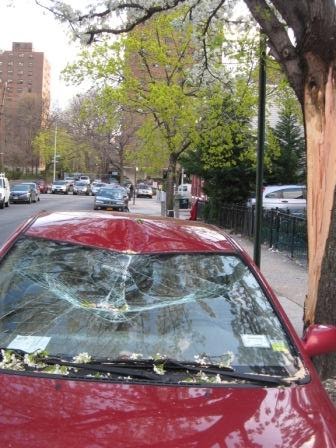
I know this hasn't much to do with being transgendered, or about changes in one's self.  But I want to show you something that happened only two blocks from where I live:


The same storm system that sent tornadoes tearing through large parts of this country gave us a storm that, while not quite as powerful, pounded us with heavy rain and hail, and slammed us with wind gusts over fifty miles an hour.  Those winds tore a side off the tree and left large limbs on the other side of the street.


I'm glad I'm not the owner or driver of this car!

16 April 2011

Amanda Gonzalez-Andujar, One Year Later

The other day, someone sent me a link to a site that displayed one of my posts on this blog.  


I was a bit surprised, as the post is a year old.  But I am glad, for one thing, that someone is reading something I wrote a year after I wrote it.  My writing may not echo through the eons, but knowing that someone else is thinking, when I'm not, about something I wrote is nice.  


However, as much as I want to be a famous writer and all that, there is a far more important reason why I'm happy someone is referencing a post of mine a year after the fact.  You see, the post has had more views than any other I've made on this blog.  I'm happy for that, though not the occasion that prompted the post:  the murder of  Amanda Gonzalez-Andujar.


She was a young and beautiful woman whose given name was Edelbuerto.  Her death was ruled, not only as a homicide, but as a hate crime.  And, thankfully, her killer was caught.  But that makes her case almost one in a hundred.  According to Interpol, more than ninety percent of all killings of transgender or other gender-variant people since 1975 haven't been solved.  Some are never investigated in the first place; worse yet, no one hears about many other killings of trans people because so many have been cast aside by their families, friends and other communities.


Amanda experienced some of that rejection, I'm sure.  But people who knew her have told me that she was an outgoing, friendly woman who had a number of friends.  Apparently, she had not become alienated or hostile, as too many other members of marginalized minorities become.  That should serve as a reminder that hostile people are, for the most part, made, not born.  


I just hope that wherever Amanda Gonzalez-Andujar is, one year after she was killed, her spirit is appreciated and she does not have to experience the violence--to her body or spirit--to which she was subjected at the end of her life here, in Queens, just a couple of neighborhoods away from where I live.

13 April 2011

Tranny Baiting

Yesterday I had one of those classes that made me wish I'd gone into business or something rather than education. 


I was showing a film version of Shakespeare's Othello, the Moor of Venice.  The class in which I showed it consists mainly of freshmen, the majority of whom are at or near the "traditional" age for students in their first year of college.  So, as you might expect, there are some who are very, very immature.


One of them showed up after missing more than a month's worth of classes.  Worse, she is one of those students who wants her instructors to "freeze" the class to bring her up to speed.  Worse yet, she hadn't read any of the play and insisted on sitting next to me and asking me to explain the play, characters and story.  


The cynic in me says that her claimed disabilities aren't real, and that she's using her claim to them so that her professors don't demand of her what they demand of other students.  I've had other disabled students, and none had the sense of entitlement she seems to have. 


And then there's a group that sits in one part of the room.  They are the most immature ones of all--though, I must say, one of them is very smart and would be even more so if he weren't always trying to sound smart.


Again, he's not the first student of that type I've had.  What I find troubling is that he and a friend (who was absent) are trying to bait me. Or, that's how I feel anyway.  They're gay, and though they'd turn purple with rage if anyone "outed" them, that's what they're trying to do to me.  They seem to be the sorts of gay men who think that all transwomen need are good boyfriends (like themselves) to disabuse us of the notion that we have of ourselves.  


How do I know?  I've run into that kind of man before.  In fact, one of them used to make jokes that would get a guy fired in another workplace. But this guy was a prof with tenure at a college in which I worked before my current schools.

Yesterday's class was at my "second" job.  I haven't talked publicly about my history and identity because, well, I got tired of doing so at my other job.  Also, I find that the very same people who encourage me to talk about those things, and to lead workshops on gender identity or some such thing, are the very same people who will use the fact that I'm talking about those things against me.  


I have to admit, though, that the class--and I--couldn't help but notice that one of those guys was eager to play Desdemona when we read two scenes aloud.  Some in the class giggled; I wanted to either use it as a "teaching moment" to reiterate something I'd said earlier about English theatre in Shakespeare's time--namely, that there were no actresses and the female parts were played by boys--or to take that young man aside and ask him something like "What's Up With That?"


I just might ask him that tomorrow.  


11 April 2011

They All Want To Write About LGBT Issues

One of the classes I'm teaching this semester is in research writing.  All students at the college in which I teach it have to take it when they are juniors, though some wait until their very last semesters.  


In that course, I assign some readings on a common topic and have them write two papers about them.  Along the way, I give them guidance about research, planning, writing a draft, revisions and documentations.   Then they can choose a topic, write a proposal and, after I approve the proposal--or after they revise it--they begin to write their papers.  I can't remember rejecting a proposal outright; I usually ask students to focus their topics more or suggest things they might want to research within that topic.


What surprises (in a good way) and fascinates me is that about a third of my students want to write on some LGBT-related topic.  Now, at that college where I'm teaching that class, my identity is known.  I always tell the students that I don't want them to choose topics or say what they say to get in my good graces; I just want them to choose something that interests them and that's doable in the amount of time we have.  But every one of those students insists that he or she has other reasons for wanting to write about LGBT-related topics.  Two students are doing so because they're gay; three other students are writing about homophobia in Caribbean countries. (Interestingly, a Haitian-American and a Nigerian student are writing about the homophobia in Jamaica, while a Jamaican student plans to write about the phenomenon as it occurs in other Caribbean countries.)  


While I'm happy to see them take on those topics, I wonder why a much greater portion of my students this semester than in previous semesters want to research and write about LGBT issues.  Is there something in the water? ;-)