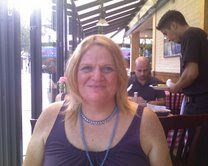
Some people suffer violent deaths. Worse yet, they suffer other kinds of violence after their deaths. Such is the case for too many trans people, like India Clarke.
Yesterday morning, a park employee found her battered body just outside of the University Area community center in Tampa Bay, Florida. While her death has been ruled a murder, officials are not calling it a hate crime.
Given the way, and by whom, most transgender murder victims are killed, it's hard not to think Ms. Clarke's death was motivated by bigotry. Still, I can understand why officials won't come to such a conclusion just yet: More than likely, they can't, until they at least have a suspect.
But I can't understand why, in this day and age, some journalists and public officials don't identify victims like India Clarke by the names they used and the genders by which they idenitified. In fact, some make it a point of misgendering victims or identifying them by the names assigned at birth.
The Tampa Bay Times--which proudly announces that it has won ten Pulitzer Prizes on its front page--identified India as Samuel Elijah Clarke and said "the victim was dressed in female clothing". And Hillsborough County spokesman says officials will not be identifying her as "transgender."
What most people don't realize is that referring to trans people by the names or gender assigned to them at birth doesn't only hurt the feelings of other transgender people. It can also impede an investigation.
I hope never to meet a fate like India Clarke's. But let's say someone was to find me lying on the ground somewhere, beaten up or otherwise hurt. If an investigation were to begin by identifying me as male and by my old name, some of my records wouldn't turn up, as all of my records now identify me as a female with my current name. Mis-identifying me could keep someone from accessing my medical and insurance records, which could result in my not getting care--or, if I were identified as male, in getting inappropriate treatments.
Misidentification could have even more dire consequences for those who are in the early stages of transition: Such people might be living in their true gender and chosen name, but their records might still be in the gender and name assigned to them at birth. I know: I was in that situation for about two years. But even then, some people knew me only by as a female named Justine; they did not know my former name or, in a few cases, even that I had lived as a man. Asking such people about me under my old name and gender would have drawn blanks--as they would from most people who know me now.
So, identifying us by the names and genders in which we live isn't just a matter of respect or dignity: It can also be a matter of our lives.
India Clarke, I hope that, wherever you are, you're getting the respect and dignity--and have the peace and security--you didn't experience in your death.
Yesterday morning, a park employee found her battered body just outside of the University Area community center in Tampa Bay, Florida. While her death has been ruled a murder, officials are not calling it a hate crime.
Given the way, and by whom, most transgender murder victims are killed, it's hard not to think Ms. Clarke's death was motivated by bigotry. Still, I can understand why officials won't come to such a conclusion just yet: More than likely, they can't, until they at least have a suspect.
But I can't understand why, in this day and age, some journalists and public officials don't identify victims like India Clarke by the names they used and the genders by which they idenitified. In fact, some make it a point of misgendering victims or identifying them by the names assigned at birth.
The Tampa Bay Times--which proudly announces that it has won ten Pulitzer Prizes on its front page--identified India as Samuel Elijah Clarke and said "the victim was dressed in female clothing". And Hillsborough County spokesman says officials will not be identifying her as "transgender."
What most people don't realize is that referring to trans people by the names or gender assigned to them at birth doesn't only hurt the feelings of other transgender people. It can also impede an investigation.
I hope never to meet a fate like India Clarke's. But let's say someone was to find me lying on the ground somewhere, beaten up or otherwise hurt. If an investigation were to begin by identifying me as male and by my old name, some of my records wouldn't turn up, as all of my records now identify me as a female with my current name. Mis-identifying me could keep someone from accessing my medical and insurance records, which could result in my not getting care--or, if I were identified as male, in getting inappropriate treatments.
Misidentification could have even more dire consequences for those who are in the early stages of transition: Such people might be living in their true gender and chosen name, but their records might still be in the gender and name assigned to them at birth. I know: I was in that situation for about two years. But even then, some people knew me only by as a female named Justine; they did not know my former name or, in a few cases, even that I had lived as a man. Asking such people about me under my old name and gender would have drawn blanks--as they would from most people who know me now.
So, identifying us by the names and genders in which we live isn't just a matter of respect or dignity: It can also be a matter of our lives.
India Clarke, I hope that, wherever you are, you're getting the respect and dignity--and have the peace and security--you didn't experience in your death.


 Posts
Posts