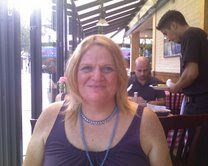
Sad news: Leslie Feinberg has died.
Of course, she is best known as the author of Stone Butch Blues, the first coming-of-age story about an LGBT person many of us read. But she also became the sort of scholar I admire most: an independent one. While her writings on gender identity and gender politics (Her last words were: "Remember me as a revolutionary communist!") are widely cited in academic circles, she herself was never affiliated with any university. In fact, she stopped attending school around the 10th grade, but would still receive her high school diploma.
Her life and work gave us important lessons on how we can, and how we must, evolve in our sexual identities and gender expressions. Though she, for years, lived as a "butch" lesbian, she later identified as a trans person, though not as a trans man. Near the end of her life, she said she had "never been in search of a common umbrella identity, or even an umbrella term, that brings together people of oppressed sexes, gender identities and sexualities". Instead, she believed in the right to self-determination for members of oppressed individuals, groups, communities and nations.
Her philosophy was encapsulated in her use of she/zie and her/her for herself. As far as I know, she did not try to convince other people that they should use the same pronouns, though which ones they use are important. Still, she pointed out, "people have been disrespectful of me with the right pronoun and respectful with the wrong one".
I find such comments particularly interesting because when I first read Stone Butch Blues, years before I began my own transition, I was struggling, as I had been for a long time, to find a language and other means to express my own gender identity and sexual inclinations. They didn't fit into the terms I'd been given--boy/girl, man/woman, marriage, even love--because such terms could only be hetero-centric because they were taught to me, however unwittingly, in hetero-centric ways. As Jess, the lead character (and, some would say, a stand-in for Leslie Feinberg herself) in SBB says, "I need 'butch' words to describe my 'butch' life". Jess's girlfriend, Theresa, understood as much but needed to hear it from Jess, who has shut herself down emotionally because of the brutality and violence she's experienced. To Jess, like others in the lesbian subculture of the time (early 1960's), that lack of emotion is her butch identity and what gets her "props" in that world. But it also led to the breakdown of her relationship with Theresa.
Even if you don't identify on the "spectrum", the book is interesting in all sorts of other ways. For example, the story begins in Buffalo, where--at the time Jess "comes out"--there were still many blue-collar jobs to be had, and butches like Jess worked in some of them. Jess would leave that city and move to the other end of New York State, to my hometown. Later, when she returned to Buffalo, she found that her lesbian friends had died, moved away or married men. There was no more blue-collar work; instead, her old friends were working as store clerks or night managers, or not at all.
Aside from the history lesson, SBB taught me (and many other readers) much else. When I read Christine Jorgensen's autobiography as a teenager, I was interested in, but not absorbed by it. Part of the reason was (what I felt) her very mannered way of telling her story. But more important, aside from feeling that I was male only in my genitalia (which I hated), I found little in common between me and her. Most important of all, I didn't get the sense of Ms. Jorgensen's evolution, much as I hate to use that term. I never had a real sense of how she came to see herself as the female she was, let alone how she explained it to herself or anyone else. What I couldn't articulate then was that she eschewing one proscribed role (that of a man of her times) and taking on another (a woman of the 1950's). Of course, it wasn't her job to instruct me or anyone else on how to perceive and express our self-identity. But I would not find any insight on how I could define, let alone express, what I knew to be true,--or intellectual or spiritual sustenance for the journey of becoming myself. Ironically, one of the first places in which I found such things was in SBB, the story of a butch lesbian who later comes to understand her own version of her trangender identity.
Then again, Leslie Feinberg and I were more alike than I ever could have realized. After all, we are both transgenders who are attracted mainly (actually, in Feinberg's case, entirely) to women. She identified as a transgender lesbian; I think of myself as a trangender bisexual with lesbian tendencies, though my lesbian tendencies are decidedly of Feinberg's butch variety.
And I'll admit that the one and only time I ever met her, I felt attracted to her. Yes, in that way. I mean, why wouldn't I be? She was smart: my first requirement. And she was--at least when I saw her--disarmingly warm. Perhaps her warmth disarmed me only because I was expecting to see the "stone" character she portrayed in her book. And, finally, I will never forget the way her face lit up I told her my name: One of her characters is also named Justine.
Of course, she is best known as the author of Stone Butch Blues, the first coming-of-age story about an LGBT person many of us read. But she also became the sort of scholar I admire most: an independent one. While her writings on gender identity and gender politics (Her last words were: "Remember me as a revolutionary communist!") are widely cited in academic circles, she herself was never affiliated with any university. In fact, she stopped attending school around the 10th grade, but would still receive her high school diploma.
Her life and work gave us important lessons on how we can, and how we must, evolve in our sexual identities and gender expressions. Though she, for years, lived as a "butch" lesbian, she later identified as a trans person, though not as a trans man. Near the end of her life, she said she had "never been in search of a common umbrella identity, or even an umbrella term, that brings together people of oppressed sexes, gender identities and sexualities". Instead, she believed in the right to self-determination for members of oppressed individuals, groups, communities and nations.
Her philosophy was encapsulated in her use of she/zie and her/her for herself. As far as I know, she did not try to convince other people that they should use the same pronouns, though which ones they use are important. Still, she pointed out, "people have been disrespectful of me with the right pronoun and respectful with the wrong one".
I find such comments particularly interesting because when I first read Stone Butch Blues, years before I began my own transition, I was struggling, as I had been for a long time, to find a language and other means to express my own gender identity and sexual inclinations. They didn't fit into the terms I'd been given--boy/girl, man/woman, marriage, even love--because such terms could only be hetero-centric because they were taught to me, however unwittingly, in hetero-centric ways. As Jess, the lead character (and, some would say, a stand-in for Leslie Feinberg herself) in SBB says, "I need 'butch' words to describe my 'butch' life". Jess's girlfriend, Theresa, understood as much but needed to hear it from Jess, who has shut herself down emotionally because of the brutality and violence she's experienced. To Jess, like others in the lesbian subculture of the time (early 1960's), that lack of emotion is her butch identity and what gets her "props" in that world. But it also led to the breakdown of her relationship with Theresa.
Even if you don't identify on the "spectrum", the book is interesting in all sorts of other ways. For example, the story begins in Buffalo, where--at the time Jess "comes out"--there were still many blue-collar jobs to be had, and butches like Jess worked in some of them. Jess would leave that city and move to the other end of New York State, to my hometown. Later, when she returned to Buffalo, she found that her lesbian friends had died, moved away or married men. There was no more blue-collar work; instead, her old friends were working as store clerks or night managers, or not at all.
Aside from the history lesson, SBB taught me (and many other readers) much else. When I read Christine Jorgensen's autobiography as a teenager, I was interested in, but not absorbed by it. Part of the reason was (what I felt) her very mannered way of telling her story. But more important, aside from feeling that I was male only in my genitalia (which I hated), I found little in common between me and her. Most important of all, I didn't get the sense of Ms. Jorgensen's evolution, much as I hate to use that term. I never had a real sense of how she came to see herself as the female she was, let alone how she explained it to herself or anyone else. What I couldn't articulate then was that she eschewing one proscribed role (that of a man of her times) and taking on another (a woman of the 1950's). Of course, it wasn't her job to instruct me or anyone else on how to perceive and express our self-identity. But I would not find any insight on how I could define, let alone express, what I knew to be true,--or intellectual or spiritual sustenance for the journey of becoming myself. Ironically, one of the first places in which I found such things was in SBB, the story of a butch lesbian who later comes to understand her own version of her trangender identity.
Then again, Leslie Feinberg and I were more alike than I ever could have realized. After all, we are both transgenders who are attracted mainly (actually, in Feinberg's case, entirely) to women. She identified as a transgender lesbian; I think of myself as a trangender bisexual with lesbian tendencies, though my lesbian tendencies are decidedly of Feinberg's butch variety.
And I'll admit that the one and only time I ever met her, I felt attracted to her. Yes, in that way. I mean, why wouldn't I be? She was smart: my first requirement. And she was--at least when I saw her--disarmingly warm. Perhaps her warmth disarmed me only because I was expecting to see the "stone" character she portrayed in her book. And, finally, I will never forget the way her face lit up I told her my name: One of her characters is also named Justine.


 Posts
Posts