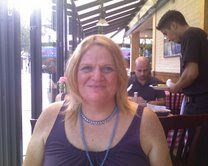
I began this blog on 7 July 2008 to recount some of my thoughts, feelings and actions, as well as medical events, of the year leading up to my GRS/SRS.
On 7 July 2009, Dr. Marci Bowers very successfully performed my surgery.
In the early days of my recovery, I decided to continue this blog to describe what I experience and learn as I begin to live as a "new woman."
Too many trans people face the dilemma of being defined by a document issued when they were born while they are living their lives their true selves.
I was in such a dilemma for several years: I was living as Justine, a woman, but my birth certificate still said I was a boy named Nicholas. That could have been problematic had I had a medical emergency or worse. After all, I could have been buried as a man. (On top of that, I don't think I want to be buried. But that's another story altogether.)
For too many trans people, the obstacles involved in changing their birth certificates are prohibitive. In some states and countries, the procedure is endless and expensive. And, in many jurisdictions, changing birth certificates for any reason is simply not allowed.
That is why I was gratified to read about this latest development from California:
Sacramento, CA – The Respect After Death Act (AB 1577), authored by Assembly Speaker-elect Toni Atkins and sponsored by Transgender Law Center and Equality California, passed the Assembly Health Committee today by a bipartisan provisional vote of 17-1. The bill is designed to help ensure transgender people have their authentic gender identity reflected on their death certificates. The Respect After Death Act will mean that death certificates reflect the authentic lived gender of the deceased, with various forms of proof accepted under the law, including written confirmation of the deceased’s wishes, updated birth certificates and driver’s licenses, or medical records of gender transition. “Transgender people deserve the same dignity and respect in death as everyone else,” said John O’Connor, executive director of EQCA. “This bill provides much needed legal guidance that “Every person deserves to be treated with dignity after their death, including having their death certificate accurately reflect who they are,” said Speaker-elect Atkins. “AB 1577 will provide direction to officials for determining the wishes of the deceased with respect to their gender identification. I am grateful for the strong bipartisan support of my colleagues on the Assembly Health Committee.” will make it easier for authorities to do their jobs. It also ensures that when California remembers transgender people who have passed, it remembers their authentic selves.” Current law requires death certificates to list personal data such as name, sex, and race, and there is no legal guidance about how the official filling out the death certificate should determine a transgender person’s sex. The lack of guidance sometimes results in cases where the information on the death certificate is not consistent with the deceased’s lived gender. This can put funeral directors and coroners at risk of liability if the friends and family of the deceased believe that they listed the incorrect sex. “Too often, the identities of transgender people are disrespected, especially when we are unable to speak for ourselves. Gender identity represents a core part of who we are as people and this identity should be recognized even upon our deaths,” said Masen Davis, executive director of Transgender Law Center. “When a loved one is not honored as their authentic self upon their passing it is extremely painful for the family, friends, and community.”
Sometimes it's hard to believe that four years have already passed since my gender reassignment surgery. It's even more difficult to wrap my head around the fact that I began to live and work full-time as a woman ten years ago last month.
Two months before embarking on my current life, I changed my name. Actually, I applied in June, and the process took almost a month. It actually wasn't as difficult as I expected, in part because of the help I received from Lambda Legal. Still, there was at least one anxious moment for me.
Here in New York, as in most places, the law requires that the name change be published in the legal notices section of a newspaper. In New York, that newspaper must have a circulation of 100,000 or more. I'd heard that some judges allowed publication in the Irish Echo or other ethnic newspapers. I hoped that I could do the same: Somehow I didn't think readers of such newspapers looked at the legal notices. Besides, few if any readers of those papers would know me. Also: It's less expensive to publish in those papers than in, say, the New York Times.
I didn't get to publish in the Echo or the Il Gazzetto or any of those papers. But I got what was probably the next-best thing: I was ordered to publish my announcement in the Village Voice. Not as many people read the its legal notices as those of the Times or even the Daily News, and it's less expensive to publish in the Voice than in either of those.
Even though I experienced no negative repercussions of publishing my name change, I know that other trans people have. Essentially, they're "outed" to all sorts of people who are, shall we say, not very understanding. Also, being so "outed" can make it more difficult to gain--and easier to lose-- employment and housing.
So, I applaud California Governor Jerry Brown for signing a bill that would allow a trans person to change the name on his or her birth certificate without getting a hearing in open court or publishing the request in a newspaper. Only a doctor's note indicating that the person has undergone a gender transition is necessary.
This law helps trans people in California in another way: Court-ordered name changes are necessary in order to change a person's name on a drivers' license and other legal documents. Also, a trans person needs only a doctor's note indicating that a gender transition has occurred in order to change the gender marker on his or her birth certificate.
Now, I hope the Governors of New York and other states will sign similar bills into law so that law-abiding trans people (the vast majority of us) do not need to fear for our safety and well-being when we undertake the changes we need in order to live with integrity and dignity.
I can just hear the bloviators at Faux News now...
Governor Jerry Brown has just signed AB 1266 into law. It means that transgender students will now be a "protected class."
It seems that any time a new law to protect trans people is passed, discussion goes into the toilet. I mean, literally: Somehow, it always ends up being about the bathrooms. So, to hear the right-wing sages, a kid could just one day decide he wants to be a girl--or she wants to be a boy--and use the bathroom he or she "chooses".
Let me tell you: It doesn't work that way. I know of no boy who wakes up one day and decides he's a girl--or any girl who begins a new day by trying on the guy thing. If anything, 99 percent of boys don't want, in any way, to be perceived as feminine (as they understand it), much less as girls. Even kids like the one I was will do whatever we can to avoid hearing that we run, throw, kick or do anything else "like a girl."
Girls, on the other hand, are less anxious about being perceived as boyish. Still, not many--if any at all--ever "decide" to be boys.
Those of us born with male bodies do not merely "believe" we are female or choose to be so; we know that is what lies at the essence of our beings. The same can be said for male beings born into female bodies. AB 1266 is not about allowing kids to use "whatever bathroom they want." It's instead a way of fostering an environment in which a kid can actually learn about who he or she is, and to be given the means (which others will also be given) of understanding it. When I was growing up, neither I nor any other kid--nor, for that matter, most of the adults--had the means of understanding--the language, if you will--gender identity and expression. One of my earliest school memories is of a hall monitor telling the boys to stand on one line and the girls on the other. If you're reading this, you know which line I stood on, and you can imagine what the consequences were. Telling that monitor--or, most likely, any teacher or the principal in that school--that I was indeed a girl was met by incomprehension, as if I'd spoken a dialect they'd never before heard, or hostility toward what they perceived as my insubordination.
What's really frightening for me to realize is that, in spite of my isolation and the alienation it would engender, I probably had an easier time than other kids with my predicament. What I hope is that AB 1266 and other initiatives will help to ensure that kids growing up today won't have similar experiences.
Today, California lawmakers approved a bill that would allow transgender K-12 students to decide which bathrooms they will use, and on which sports teams they will participate. As usual, some people worry that boys will pretend to be transgender in order to "sneak and peek" in girl's bathrooms. I can tell you that such a fear is unfounded. No boy who wants to see what a girl has under her panties would ever pretend that he's transgender. After all, most boys--at least those of a certain age--want to date girls. There's no way they'll get to do that if they're trans, or even if they are seen as "girly". Plus, almost no boy--not even the toughest--would subject himself to the bullying and worse he would experience for being perceived as "girly". Plus, I remember the bullying I experienced in boy's bathrooms, even though my clothing and other aspects of my appearance were completely congruent with what most people in this society (at that time, anyway) expected of boys. It would begin with a comment like, "I thought this was a BOY's bathroom!" and go downhill from there. I can only imagine what I would have faced had I dressed like a girl and manifested my mind and spirit in other ways. I hope that at least some kids--including, now, the ones in California--won't have such experiences.
If you were to ask most people to name a state that has progressive policies when it comes to transgender health care, many would mention California. After all, San Francisco was one of the first cities to include gender identity and expression in its anti-discrimination laws. It was also the first American city to offer to pay for gender-reassignment surgery, hormones and other necessary treatments for trans people who are City or County employees.
Now the California Department of Managed Health Care (CDMHC) has ordered all of the state's health plans to remove gender identity or expression as a basis for excluding or refusing coverage.
Why does that matter? Well, I can offer one example from firsthand experience: After I started taking hormones for two years, my doctor recommended that I get a mammogram. My breasts had grown somewhat, but more important, the fact that I was taking estrogen put me at somewhat greater risk of breast cancer. At the time, of course, I hadn't undergone gender reassignment surgery so, according to many insurers (though, thankfully, not the one I had) would have considered me a male. And, as others in my situation discovered, other insurers would not pay for a "man's" mammogram--or, worse, would accuse any transwoman or her doctor of fraud for claiming the procedure.
Or, let's say some insurer considered me female and I had a medical problem that was testicular in origin, or that had to do with my prostate. That insurer would have rejected a claim for any treatment involving those issues.
Then there are trans men who have been taking testosterone and who, perhaps, have had "top" surgery, but not bottom surgery. He might then need, say, a pap smear--which an insurer could deny if he is classified as male. On the other hand, if he is still classified as female, he might be denied treatment for high cholesterol or other conditions for which he is at greater risk as a result of taking testosterone.
What insurers may not realize is how risky it can be to deny treatments to people who are transitioning. As Masen Davis, the Executive Director of the Transgender Law Center said, "This one letter will save lives."
Today I saw Mom, Dad and Mike. They were all understandably tired: The last couple of days have been busy for them and the weather had bee...
Here I Am!
Crosby Street, NYC, 8 June 2010. By Bruce Kennedy
Welcome to Transwoman Times
On 7 July 2009, Dr. Marci Bowers performed male-to-female (MTF) gender-reasssignment surgery (GRS) on me.
One year before that, I began Transwoman Times to recount the medical, emotional, spiritual and other events of the year of my life leading up to my surgery.
The moment I was well enough to boot up my laptop, I decided to continue this blog. For the moment, I plan to describe my experiences during my "first" year of my "new" life. And, perhaps, I will continue this blog beyond that.
Most of what you read in Transwoman Times will be written by me. If I haven't written it, it will have come from a song, poem, or any other piece of writing ranging from a classic novel to a tabloid article. These references will be duly acknowledged: I might borrow, but I don't steal (or beg).
Although I started Transwoman Times for selfish reasons (i.e., I enjoy writing and I want an outlet for my feelings and a record of my experience.) , I hope you find this interesting, inspirational or of some other value. Maybe it will apall or simply bore you. In any case, please keep on reading and pass this along to friends, co-workers, in-laws and whomever else you want to read this. And, if you want to link this to your website, please feel free to do so, and just let me know. (Hey, I might be interested in your website!)
So, I hope this enlightens, entertains or moves you in some other way. If nothing else, you are reading about someone who is engaged by the process of her life. I hope you are, too!
After My First Month
By Regina Varin-Mingano. In Uncle George's restaurant, Astoria, NY: 7 August 2009
Search This Blog
Amanda Gonzalez-Andujar
Wherever you are, I hope you find love and acceptance.
A journey that neither I nor anyone else could have foreseen has brought me here today.
You can follow this journey on my blogs: "Mid-Life Cycling" and "Transwoman Times." I am also serializing a book on another blog, "Memories and Those Who Stayed."


 Posts
Posts