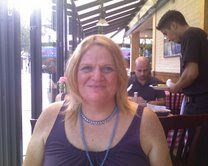
29 June 2009

More About What I Can And Can't Blame On The Hormones

Slogged through this day. Had a headache that started yesterday. The doctor says it's probably due to the reduction in my hormone dosage.

If any of you guys are reading this, just remember it the next time your wife or girlfriend says she has a headache. I suffered from migraines even before this change in my hormone dosage. And, if your wife's or girlfriend's hormones ebb and flow as I now suspect they do, she really will have headaches sometimes--yes, perhaps even at times when you want to fuck her. Really. It's not one of those "check is in the mail" excuses. And we certainly don't plan our headaches; they just come.

So what did I do? What any woman does: Try to get some rest, and do at least some of the things I'd planned to do. One of them was to take a bike ride, though later in the day than I'd intended. The weather was warmer and sunnier than it has been in some time, so I think that the sun bearing down on my fair skin probably tired me out, too.

Still, I had a good ride, even if I lingered at the Rockaway Beach and Coney Island boardwalks longer than I'd intended. I drank a coke while at Rockaway Beach, and I could swear that it was absinthe. Not that I've ever drunk absinthe. But I found myself lightheaded at the same time I had my headache, and the textures of the skins of sunbathers, volleyball players and swimmers filled, not only my eyes, but the pores of my skin. So did the colors they wore, the sea that's turning into a softer shade of blue-green than it's been and, of course, the sun. I felt as if I were beyond my senses, or that they were beyond me: All I could do was to be filled with impressions. Some may remain with me, like the one of the friendly husky pup whose eyes mirrored the sea and the young man, as friendly and as radiant lucent in his own way, who was walking him. The pup's name was Sam; I never did learn the young man's name.

At Coney Island, I sat on a bench about halfway between the Parachute Jump and Sea Gate. That part of the boardwalk doesn't get the throngs of people that fill the area around the Cyclone and the other rides. Usually, one finds other cyclists, older couples and teenagers, most of them black. I have always felt comfortable there: I can hear the hissing tides and feel the song of the sun lambenting on them about as much as such sensations are available in a large city.

And I encountered something that has been disturbingly frequent these days: a cat who wanted to go home with me. As far as I can tell, this one was female. A narrow white streak that began just under her nose widened as it swept down her neck and underside and tapered again back to her tail. Her legs were black, but her paws were white. And she had one green and one blue eye.

She had been sleeping or stalking under the boardwalk. After I propped my bike--my good ol' Mercian--against the railing, she bounded up the splintering steps to the boardwalk. I looked her way, she looked at me and tiptoed toward me. Without my even calling or gesturing toward her, she sniffed around my legs and ankles, and circled them. Then she jumped onto the bench and propped her front paws on my right thigh.

She didn't even flinch as I stroked between her ears and down her back with my fingers. For a cat who was living under the boardwalk, she was extremely clean, and her coat was very smooth--almost as smooth as Charlie's, one of the silkiest I've ever felt. I took out a piece an oatmeal cookie I had in my bag, broke off a piece and gave it to her. Then I gave her another piece. It certainly wasn't the best food for her, but I didn't have anything else on me. Besides, would a Nathan's hot dog, tasty as it is, have been any better for her?

Anyway, before I got on my bike, I bade her good-bye with a very long stroke from her ears all the way to her tail. She rolled over and wriggled to the rhythm, such as it was, of my fingers stroking her belly. I knew I wasn't getting away so easily and, truth be told, I didn't want to. And she knew it. But how do you tell a kitty who's probably been abandoned that you already have two, and your landlord--who lives directly above you--could have a seizure or worse if you brought in another?

As I got on my bike and began to pedal away, she followed me until she couldn't keep up with me. I wasn't trying to outrun her; indeed, I didn't want to leave her behind me. I felt the same way the other day after I had nearly the same scenario with another cat in the park at the foot of the Whitestone Bridge. The only difference was, that cat was male and orange--a dusty shade, like Max's--with stripes in a slightly darker hue. He, too, would have followed me home if he could have kept up, and I would have taken him, just as I would have taken her.

I wish I could say those cats, or the dog I found in the street on Thursday, were just hallucinations that I could blame on the hormones. Unfortunately, I've been reading and hearing reports that more and more people are abandoning animals. Some of those people cannot keep homes for themselves, so they cannot keep pets in them. Or those people are so overwhelmed with bills and such that they can't afford their pets anymore. Or, maybe, they're just stressed out and they don't want to take care of anything or anyone if they don't have to.

Whatever the case, I'm sure that more animals will tug at my heartstrings in the near future. Maybe, once I recover from my surgery, I should move to a farm or some other place with lots of space for animals. The only problem is, while I get along well with dogs and even better with cats, I have practically no other skills relevant to farming. Just because I milked a cow once, that doesn't mean I'm not a city girl to the bone.

I mean, didn't all of the humor of Green Acres derive from a proto-Material Girl trying to adapt to life on the farm? Zsa Zsa Gabor didn't even have to act in that one; just the sight of her in overalls was funny enough.

That show aired a long time ago. I wasn't even taking hormones back then!


28 June 2009

Pride

Here is an e-mail I've just sent to Sonia:

Howzya doin?

Looks like we have something in common...We're both getting ready to leave on the 4th! Of course, that's when I'm going to Colorado for my surgery, which is scheduled for the 7th.

It also just happens to be my birthday. If you're really good, I'll tell you how old I'm going to be!


Anyway...I walked in the Pride March. This is the first time I've done it in a couple of years, and I couldn't help but to notice a change: no hecklers. Other marchers, some of whom have been part of the movement for much longer than I've been, noticed the same thing. Maybe the would-be hecklers went to the beach because it's the first really summery day we've had. But I'd like to think that there's a sea-change happening in people's attitudes.

So it was very interesting for me to read the articles you sent my way. Like Frank Rich, I didn't hear anything about the Stonewall Rebellion until many, many years after it happened. I thought about that as we marched past the eponymous bar and found myself holding hands with and kissing fellow marchers as well as spectators whom I'd never before met. Those homeless teenagers, drag queens and lesbians who were in the bar that night forty years ago had only each other. Most of them had been ejected from their homes or left them because of the violence they experienced. I think of that midwestern teenager who called Harvey Milk, wondering what he should do next. Milk's advice (in the movie, anyway): Take a bus to any really big city. That was a few years after Stonewall; on the night the rebellion erupted, about the only places in the US where gay and transgendered teenagers could be themselves were the Village, the Castro district and the French Quarter.

The teenager who called Harvey Milk ended up in LA, where he found a community, which is to say a family. Fast-forward to today: The first generation of kids who were raised by same-sex (mostly lesbian) couples is coming of age. That, I think,is the reason why more people support LGBT rights and gay marriage has passed in all of the New England states except Rhode Island and in--Who would have guessed?--Iowa.

In other words, LGBT (perhaps Ts to a lesser extend than the Ls, Gs or Bs) have what African-Americans and women have: parents. I mean this in the literal as well as the metaphorical sense. Great minds can argue the morality or logic of civil rights for us or anyone else, but in the end, the public sees us as equal when they see us as their daughters, sons, or other family members. Every parent who accepts, and better yet shows support--as my parents, especially my mother, have done--for his or her LGBT child is one of the real heroes in our fight for equality.

And, I realized as I walked by the Stonewall Inn, that is the difference between me and those mostly young people who fought the cops who raided one of the few safe havens they had on that night forty years ago.

Oh well. Off another one of my soapboxes. I'll write again soon.

At the march, I met one of the librarians from the college in which I work. His gayness is an open secret: I've heard a few people mention it, and a few others asked me about it. Whenever anyone asks me, "Is so-and-so gay?," I respond with, "I dunno; maybe you should ask him." That is a surefire conversation-stopper.

Three other faculty members have also told me they're gay. Of course, I'm not going to reveal their idenities to anyone else. One is a long-tenured prof; another is a relative newbie who wants to get tenure.

So I am living in a very, very strange world: I'm in a world where at least some people are willing to accept LGBT people. In that world, I'm in a country in which, according to polls, the majority of people support gay marriage and an even larger portion of the population thinks the military should lift its ban on gays. But I work in a place in which all of the LGBT people are in the closet. In fact, it's the only college in the City University system that doesn't have an LGBT organization.

Yet people there know about me. Some, including the librarian, know about my upcoming operation. He has been very supportive; in fact, he even asked for the address of the hospital so he could send me a card. But to some of the faculty, and a number of people in the administration, I am the in-law to whom nobody wants to admit being related. And, sometimes, I am simply a thorn in their sides: I don't try to make them look like fools and hypocrites, but I do.

They're the sort of people who tell you not to call attention to yourself, but who call attention to you. In other words, they want to keep you "in your place" but want to make other people think that they're really on your side.

People, including me, have wondered how gay marriage could pass in a place like Iowa but not in New York. Well, I've never been to Iowa, but I think I might know why. It comes down to something someone told me early in my transition: That honest working people will like you as long as you're honest and true to yourself, and them. "It's the professors and those prissy office workers that are going to give you trouble," that person told me. And she's been right: The best friend I've made since I started my transition has been Millie, who goes to church every week and didn't finish high school. On the other hand, I've had run-ins with people who've mastered all sorts of arcane theory but can't understand these simple truths: I am the daughter of two people who love me. I am the sister of three men who are good providers, fathers, husbands and citizens. I am a friend--and I try to be the best one I can be--to people who are loving, caring and intelligent in all sorts of different ways. And I am a colleague of people who are respected in their careers. All I want is to be seen and treated as a human being.

I suspect that all of the people with whom I marched would say something like what I've just said. And I believe, or at least hope, that most of the spectators were there because they understand and believe it.

In all, it was a fine day. Only nine more till my surgery.


27 June 2009

No Gesture is Necessary, Only a Message

Now it's one week until I leave for Colorado; ten days till my surgery. Talk about "blink-of-an-eye" time frames!

I am thinking now of something Jennifer Boylan talked about in She's Not There. It was the day before, or a couple of days before, her gender-reassignment surgery. She wondered, in essence, how she should say "good-bye" to being male. If I recall correctly, she even thought about pissing against a tree one last time.

I can't remember the last time I pissed against a tree--or anything else that couldn't help but to stand erect in front of me. I also don't recall the last time I used a urinal or a men's room. Or a men's fitting room or locker room.

And I don't remember the last time I sat with a bunch of guys in a bar or cafe, celebrating some physical conquest, whether of a mountain or in bed. I haven't wanted to do any of those things again, so it wouldn't make any sense to "leave" maleness by doing any of them again.

Then again, it has been so long since I have lived as male that I couldn't do anything to "leave" it now, even if I wanted to. It's been nearly seven years since I last introduced myself as "Nick" to anyone: The last times I can recall doing that were with colleagues at LaGuardia Community College.

Although I started to live full-time as a woman on 8 September 2003--the first day I taught as Justine--I feel that my "exit" from maledom, my loss of citizenship in that gender, came two years earlier.

I may have told this story before, so you can skip over it or bear with me if you've already read it in one of my previous posts:

It was the summer of 2001. Tammy gave me the sort of birthday present she thought I would love: a bike trip in the Alps. Four years earlier, I ventured into those mountains, from France into Switzerland and back, and loved it. I knew that I could take an entirely different ride from that one. And, instead of starting in Paris and cycling through the Burgundy, Champagne and Franche-Comte regions before reaching the mountains, I would be flying into Lyon, with the Alps only a day's ride away.

Still, I was not eager to go on that trip. I had a premonition that it would change me and destroy the life I had at that time. I could not explain what that meant; Tammy, then in law school, dismissed it as an irrational fear.

So I went, and climbed as many mountains as I could. It gave me some bragging rights, I suppose, especially because I made those climbs on a bike loaded with my clothing and day-to-day essentials for a month. And, my ride intersected with the Tour de France at several stages: I got to see the peloton starting one stage and ending two others, and a time-trial up a mountain at Chamrousse.

Well, near the end of my trip, I pedalled up le Col du Galibier, one of the most famed Tour climbs. More than one Tour was decided wholly or in part on that mountain.

I was feeling good: The air was as clear as the nearly-cloudless sky; flowers turned into fields, trees multiplied into forests and mountains spread into ranges as I pumped my way up that road.

Finally, I reached the peak and munched on a crepe--still suprisingly warm and fresh--I'd brought with me from the inn where I'd stayed the night before. I took a few gulps from my water bottle, which I'd laced with jus d'abricot, and filled myself with the pristine sunlight that would become a field full of wildflowers shortly after I began my descent.

Just after that field passed behind me, something--not a physical sensation, not even an inner voice--told me "You will never have to do this again!" Of course, that did not make any sense to me at that moment, though, for some reason I couldn't explain, I felt a not-so-vague sense of relief.

As that mountain receded behind me, I took a route departmental that hugged the curves of a river valley to a town where I stopped, ostensibly to cash a traveller's check, but really to spend time in a cafe seemingly for no particular reason. I ordered a cafe au lait, then another, then a mineral water with some sort of non-alcoholic blackcurrant extract, and a few other non-alcoholic drinks. I couldn't say that I was trying to sort out what I'd expereienced because, well, it didn't even make enough sense to me to sort out, even though at the most intuitive level I knew exactly what it was. I knew it wasn't just about climbing that mountain, or any other, again.

About an hour later, I would learn the answer when I came into the town of Saint Jean de Maurienne. That is where I would stop at a traffic light and see the woman who, merely by walking home from work, would show me by the way she negotiated time and space, spiritually as well as physically, that I could no longer take another step in this world as male.

So I guess you could say that, unlike Jenny Boylan, I did not have the choice of making, nor did I need to make, some voluntary final gesture to leave the male race. For that matter, she didn't need to make such a gesture, either: Neither of us actually belonged to the world of men.

But both of us had to leave the trappings of maleness in which we'd clothed ourselves. And she needed to do what she did, and I need to do what I'm doing, so that we can more easily and readily move about in this world as the women we are.

Tonight I talked to my mother again. "Can you do something for me?," she asked.

"Of course."

"Could you ask Dr. Bowers to call me when the operation is done, to let me know you're fine."

"I'll call Monday and ask her."

"Do you think she will?"

"I don't see why not. I'm sure other people have asked her to do that."

"Good."

Of course Mom always wants to know that I'm safe. Any time I've travelled, I've called her when I've arrived at my destination, and at least once during the trip.

"I've arrived and I'm safe." That's what she wants to know. That's what I'd want to know, too. For that, one doesn't need grand gestures. Only a message is necessary.


26 June 2009

Hallucination? Blame the hormones!

One more week and one more day till I get on the plane to go to Colorado...and go mountain biking and snowboarding! ;-)

It seems to have rained for the past few months. A few times, we were deluged with downpours, but most of the time, curtains of steady rain have cascaded from gray ceilings of clouds. However, tonight, thunder snarled and barked as lightning glowered and torrents of rain battered the streets.

And after the rain, the air turned into the strangest kind of light. It touched the street on which I live: While the skies grew darker than the ocean brimming with an oncoming storm, the brick buildings across the street from my place smoldered with the burnished light of a sun that could not be seen.

I walked alongside that trompe l'oeil inferno toward the avenue that intersects my street. I turned left, toward the bodega. Along the way I could see, to my right, our friendly neighborhood skyscraper--The Citicorp Tower (http://www.flickr.com/photos/wallyg/152451822/), like a square soda bottle full of flourescent light. The red and white neon Citibank sign near the top made the building's veridescence even eerier against the deepening opaque sky. I rarely have anything good to say about a company like Citicorp, but I don't think that's the reason why that vertically elongated glass cube looked like some kind of sickly omen: like something that could cause my head to detach itself from my body and sink into a primordial pool of radioactive light.

I'm tempted to call Dr. Bowers: I'm wondering if this has anything to do with my reduction in hormones. I've had one of those crying jags Robin warned me about, and was about to have another last night when I was riding my bike home and I saw two cars skid and narrowly avoid running over a little dog in the street.

The dog, who had obviously never been on the streets before, had no idea of how to get across an interesection. She wandered into a yard at the corner of that intersection. The kids who were playing there asked some male adult whether they could keep the dog. He shook his head; they shooed the dog and she wagged her tail as she waddled toward me.

She licked my left ankle and leg. I got off my bike and sqatted toward her. Without hesitating, she came to me, propped herself on my knee and licked it. I petted her; that made her even happier.

No one seemed or wanted to recognize her. She wore a collar but no tag; obviously, she escaped from her home or--egad!--someone dumped her. She continued to lick my knee, my leg and then my hand after I petted her.

I picked her up. She didn't weigh much more than Charlie or Max. I got back on my bike (At moments like that, I'm glad I bought a women's bike for my errand/commuter vehicle!) and, with her propped on my left arm and sprawled over my chest and shoulder, steeered with my right.

I'd hoped to find a veteranarian's office or an animal hospital. No such luck. So I took her to the police precinct station on 118th Street in Richmond Hill. Do you enjoy seeing cops go all mushy? Then you would've loved to have beeen there, when I brought in that dog. But I can only imagine what they were thinking when they saw me bringing her in: Me, a middle-aged woman carrying the kind of wriggling little mop of hair that Posh Spice would keep as an accessory.

I would have kept her, too. Except that she wouldn't have been just an accessory, as she was so friendly and sweet. But I don't live in a big place, and I don't know how Charlie and Max would have reacted.

I just hope she gets home safely, and that I get to sleep soon.


25 June 2009

A Scandal and Two Tragedies

OK...Today we have two tragedies and one scandal to choose from. First, the scandal: Mark Sanford, the Governor of South Carolina, disappeared for a few days. Upon returning, he said he was hiking the Appalachain Trail; the truth is that he was in Argentina with his Buenos Aires bonita. And he apologized to his wife and the public.

Now to the tragedies...Farrah Fawcett and Michael Jackson, of course. Everyone knew that Farrah wasn't long for this world; her cancer outgrew her outsized will to live. But no-one saw Michael's death coming.

Maybe it's because I'm getting on in years, or maybe it's because I'm blonde, but I don't recall any scandals surrounding Farrah. Now, I'm not saying that she lived the life of a Carmelite nun. But I don't think she did anything in her love life that one might expect of a very attractive woman of her age and time. And she was much more than very attractive: She was one of the most beautiful and, at one point, one of the most famous women in the world. Sure, she had a divorce. I think it was only one divorce, anyway. For someone on whom the limelight shone as glaringly as it did on her, that ain't bad.

Now, Michael Jackson never should have dangled that baby off a balcony. And he probably should've been more careful of whom he brought to his mansion. I mean, if you're a bachelor and your place is secluded, tongues will wag if you bring in 13-year-old boys. But I wonder whether he really did even half of the things he was rumored to have done.

As for Mark Sanford: Well, he makes Sarah Palin look good. But, although I'm not a Republican (I tried to be one; couldn't do it.), I don't think that his behavior is a reason to bash the party. Of course, we just had eight years of a Republican President who was easily the worst President of my lifetime, if not since Grant. But I think that lots of Democrats in Congress and elsewhere contributed to the mess we're in, by supporting the Iraqi and Afghanistani invasions and legislation that allowed CEOs to raze the pillars of the economy and take the marble home with them.

No, my beef with Sanford is that he disrespected a woman he promised to love. In other words, he committed exactly the same crime as Eliot Spitzer, a Democrat. Funny, how they were such moral crusaders--Sanford with the right-wing Evangelical Christian organizations in his state, and Spitzer during his days as New York State's Attorney General, when he cracked down on prostitution. I always used to think he wasn't so different from all those Immorial Minority types who tried to dictate other people's behavior.

Bill Clinton was no model of marital fidelity, either. But at least he didn't go around telling other people how they should and shouldn't conduct their lives. Still, I can respect him only a little more than Sanford or Spitzer.

They are hypocritical cads, pure and simple. They are in marked contrast to Ryan O'Neal. Over the years, I've mocked his over-the-top acting performances, especially the one in Love Story. But he stood by Farrah, marrying her during her last days. For that, he has my respect, even admiration. And, of course, so does Farrah, for how she fought her illness and made more people aware of its prevalence and effects.

Now to Michael Jackson. By the time he was in his early 30's, he did more powerful, creative and innovative music than most artists do in a lifetime. Thriller changed pop music not only because it's still the best-selling album of all time, but also because it made pop music more multi-dimensional: It made dance more integral to the experience of the music people were listening to, and its video made that medium not only legitimate, but also integral to the way people expereinced the music. And, of course, it put MTV on the map, in part by showing that the videos were not merely promotional materials for the music, as trailers are for movies; they were worth watching and listening to unto themselves. If people never came to see videos that way, MTV would have had no raison d'etre. But even if another artist had made a video that was a work of art unto itself, MTV might not have lasted more than a couple of years: One of the complaints about it (a legitimate one) was that Black and Hispanic artists weren't featured. And, let's face it: Where would music in this country be without African-Americans and Latinos? Even country music couldn't have happened without the blues. (In fact, whenever I hear Hank Williams or Patsy Cline, I think of their music as white people's blues.)

OK, so you aren't reading this blog for cultural criticism. I think a lot about Michael Jackson now because I've long thought quite a bit about him. Even though he hasn't done any relevant music in nearly two decades, he's still a cultural icon. Plus, I cannot help to think about him because of a comment someone made to me as I was preparing for my transition.

Someone I met at the LGBT Community Center just before I started my transition compared what I wanted to do to what Michael Jackson did to himself. In other words, this man--gay, by the way--likened my wish to start taking hormones and to have SRS to Michael Jackson's cosmetic surgeries and whatever else he was doing. This man said that Michael "mutilated" himself through "self-hatred." (And, this man pronounced, I was doing the same thing to myself.) What that man said about MJ may be true, though I suspect that the truth is much more detailed than that.

At that moment I resented, not only the last part of his statement, but his comparing me to Michael Jackson at all. By that time, Michael seemingly had become a grotesque parody of himself--or of something. I was astounded that anyone, especially that man, could liken what I wanted to do to "cosmetic" surgery. If anything, I was not trying to polish the outsides; I was trying to bring out who I really am.

Then again, for all I know, Michael was trying to do the same thing. Or, he may have simply wanted to preserve his youth, or at least the image of it. He certainly was a handsome boy back in his Jackson Five days, and was still not half-bad looking by the time he did "Thriller."

Now, I hope someone doesn't think I'm a racist for what I'm about to say. OK, here goes: According to the standards of beauty in much of Western Culture, it's easier to keep one's youthful--and therefore "beautiful'--appearance if one has fine facial bones and skin. It just happens that whites have finer facial bones than most other races have. Also, the standards of beauty are based on whiteness in just about every other way you can think of. In other words, by the standards to which much of the world has grown accustomed, youth=beauty and beauty=white. So one has to become whiter to be more youthful.

Now, I'm not saying that I subscribe to these standards. I think Halle Berry and Denzel Washington are two of the most physically beautiful people on the planet right now. And, if I'm not mistaken, both are in their 40's now. So it will be interesting to see how they look ten, twenty, or even forty years from now. Of course, being celebrities, they will probably have cosmetic surgeries. But whatever they do, I don't think they can look the same in twenty years as they do now. Who can?

I think that one of the problems is that blacks who are celebrities in mixed audiences is still a fairly new phenomenon. Of course, decades ago, entertainment, like so much else in life, was segregated de jure in much of this country. It's still segregated in other ways, but Chris Rock and Eddie Murphy are much better known among white audiences than Moms Mabley and Pigmeat Markham were.

This meant that prewar black celebrities like Mabley and Markham were judged by the standards of their audiences. So were black actors and dancers. So, if they aged as other blacks did, that was all right: That was what the people expected.

Once audiences integrated, the standards for black beauty, as well as so much else, changed. Black performers had to succeed in terms of white standards, and had to age by those standards as well. Lena Horne's ageless beauty is still celebrated past her 80th birthday. But, if you look at her, she has aged more like a white woman, mainly because she has a caucasoid facial stucture and other features.

And that, I think is what Michael wanted to do. That in no way compares with my reasons for transitioning.

So I'll let him rest in peace and be grateful for the great music he left us.


24 June 2009

On Leaving, And An Open Letter to My Brother

My students had their final exam today. After they finished, I went to my office and began to read a few of them. The truth is, I didn't want to leave, at least not right away.

That exam was my last time in a classroom with students until my surgery. As they finished their exams, I watched each of the ones who remained. At one end of the room, to my left, sat Ayesha, a young Bangladeshi woman who has a very interesting outlook. Toward the front and center of the room was Cadnuel, a gentle Haitian man with whom I practice what remains of my French. To his left, Ange--the one whose husband picks her up and who, according to her, would accuse her of being a lesbian if he knew she were hanging out with a female prof. Behind her, at the back of the room, Sharon was finishing her essay. Like Ange, she has a conspiratorial sense of humor and a penetrating intelligence. And, at the right end of the room, by the windows that do not open onto the trucks and the drivers whose skills and cars aren't quite nimble enough to maneuver around them, tall, meticulously-dressed Glenna was getting ready to hand in her paper.

As each one of them left, I felt one step further removed--or, more precisely, one step closer to being on my way from--the past three weeks, the past few months, the past year, the past years, the years that are long past. I was yet another moment beyond that person my brother, Elizabeth, Jay (the male one) and Tammy believe I took away from them. I could not any more bring him back than I could even be the person who, in their minds, took him away or destroyed him. And I was yet another world from that angry young person who could not get rid of his rage, not through religion, through relationships (much less marriage), through abusing alcohol and drugs or foreswearing them, through pushing my body to its limits on the bike or in the gym--and for whom the appreciation of students and others and the love of friends and partners served as more fuel for that inferno of rage that I could just barely keep at bay.

I could feel those people--the ones I've been--leaving, just as my students were, although, of course, the circumstances and outcome were entirely different. Back in the day, I wanted to drive people away as soon as they came, by whatever means, into my life. I even warned people with whom I got in relationship that they were making a mistake: I would turn into an emotional werewolf, and there was nothing I could do about it. Just don't be here when it happens, I'd tell them.

And, now, tonight, I didn't want those students to leave. After they were gone, I didn't want to leave. After spending some time reading exams, I called my mother and father. I wanted to know how they were doing, and how the visit of my brother (the one who isn't speaking to me) is going.

My brother took Dad to his appointment with the doctor. Near the end of the day, they and my mother went to the boardwalk at Flagler Beach as a cool wind was starting to blow off the ocean. I would've liked to be there, because I grew to love that spot during my last two visits to Mom and Dad--and, of course, because I'd like to see my brother again--not to mention his kids.

I have not seen or spoken with him since I "came out." That was almost six years ago, just as I was about to begin my life as Justine. Although I knew it was unlikely to happen, I hoped I'd get a chance to talk with him, however briefly, when I called.

If we were to talk, I'd thank him for what he did for Dad--and Mom. Dad's condition has been wearing on Mom, anything that makes him better even for a moment restores her, even if only a little. I really am happy that he took them out. I know that's who he really is, not the person who cut off contact with me. That, of course, is the reason I want to talk to him again. I really don't care about the others who've tossed me aside. Between Elizabeth and Jay, they threw away more than forty years' worth of friendship with me. I've made other friends; perhaps one or more of them will give me so many years worth of companionship. But, at my age (or, more accurately, my parents' age), I don't think I'll get replacement siblings.

Can I tell you something, brother? I don't mean this disrespectfully to you, but I always wanted a sister who could love me in the way only a sister could. I think you'd like that. Really. I know we're different, but do you remember how, when you were a child, you used to confide to me what you wouldn't tell Mom, Dad or anyone else in the family--or to your teachers? Mom even said as much: that you listened to me, and I to you. Well, now you know why. You felt like a misfit, though for different reasons than I did. You knew I was different--not better, just not like other people--and that I understood.

You didn't want to be that misunderstood kid who couldn't help but to disappoint and get into trouble. So was I. But when you were young, you were more diffident and quieter than I was, so people assumed you weren't smart or that you weren't trying. I knew better, and defended you--not from the blows of other kids, but from the sarcasm and other jabs of adults.

And because you were the kind of brother you were, it was a little easier--though never easy--to be who I was, to become who I'd become. I think that, deep down, you understand that and know that I have always appreciated you for that.

Besides...Do you remember how happy your daughter and I used to be when we spent time together? The very last time we were together--that weekend I "came out" to you--your wife remarked on how much she liked to do things with me. And I know you love your kids--I can hardly think of any other man who loves his kids as much as you love yours!-- and like seeing them happy. I'm sure you give them lots of happiness. But why not allow someone in who can add to it?

To sum it all up: You're a fine brother and a good man. A very, very good man. I really hope that we'll see and talk with each other one day soon.

Soon I will no longer be, in some sense, the person you used to know, or even the one who "came out" to you. Maybe you will never again approve of what I am. That's all right. Think what you will of me. But at least think of me as your sister--or sibling--and your children's aunt, or whatever you want them to call me. Do they ask about me? What do you tell them?

All right. I am one step further from whatever answers you might've given them. Here I am now. You can catch me as I'm leaving or meet me when I return. For now, I've got some papers to read. But you can interrupt that, if you want to.


23 June 2009

Drugs and Other Changes

Now my surgery is only two weeks away. Fourteen days...each one seems to go faster than the previous one.

Today's also the day my medical regimen changes. A few days ago, I mentioned that my hormone dosage would be reduced to one-eighth of what I had been taking. For nearly six years, I've taken two 1.25 milligram Premarin pills twice a day. Starting today, I take only one-half of one of those pills, once a day.

And I no longer take Spironolactone, my anti-androgen. So it's good-bye Spiro; it's been nice knowin' ya. No more Spiro. Boo hoo.

Robin, who is Dr. Bowers' office secretary, warned me that I could lapse into a crying jag, or that I could have any number of other kinds of mood changes. As if that's anything new. I guess I should warn people about that. I mean, if I start making unreasonable demands (Just ask my students--I never, ever do that!), they should at least know why. Right?

At some point my body will have to adjust itself to the new, lower dose of hormones: This will be my dosage after the surgery, too.

Another thing: I can't take aspirin or ibuprophen. It's pretty weird: My hormone dose has been lowered because they're coagulants (and because my body won't need as much after the surgery). But I can't take aspirin or ibuprophen because it thins the blood.

My blood has to be just the right consistency and texture. Sounds like Dracula is in charge of quality control. Ahh, yes. Zees ees Chateau Justine, 2009 vintage. A fine texture, a full body, aroma of vanilla, bouquet of cherries and berries, and an undertaste of chestnuts and oak.

What did I just write? I haven't drunk any wine in almost 23 years. Do they still write wine reviews that way? And what in the world am I doing, comparing my blood to wine? I guess I accomplished something: I've offended every Christian in the world. As non-religious as I am, I didn't mean that. Really, I didn't. Oh, well. I guess my Muslim, Buddhist and Jewish friends will still talk to me. Let's see...There are about equal numbers of Christians and Muslims in the world. So I guess this is neither a net loss or a net gain.

Good thing I only took one statistics course, eh? Imagine what silliness I could create and havoc I could wreak if I knew more!

Back to my drugs: On my way home from the college, I had to stop at the Duane Reade in Woodside--the only drugstore that I knew for sure would still be open at that hour--for a bottle of Tylenol. I can't remember the last time I took it. I just hope it's as effective as aspirin or ibuprophen if I should get a migraine between know and my surgery.

I've been taking aspirin for my headaches mainly because, as I understand, it has the added benefit of helping to prevent heart attacks. Back when I was riding my mountain bike with Crazy Ray and his crew--actually, hopping rocks and streams and bounding off ledges and cliffs is more accurate--I used to take Ibuprophen because it seemed to work faster than anything else on my pain. I guess I was a sissy: Crazy Ray never used to take anything.

If he could see me now...

Actually, I had to be in a pretty fair amount of pain before I'd take the ibupro. Otherwise, I never took medications unless my doctor prescribed them. Sometimes, not even then. Once, I had an excuse: Back when you needed a prescription to get Claritin D, the doctor ordered a bottle for me. I took one pill, and it kept me awake for three nights. And I could see my heart pulsing throughout my body. The doctor said he'd never seen a reaction like it.

As with every doctor I'd ever had until seven years ago, I never told him what I really felt--only what ailed me at that moment. But that wasn't his--or their--fault, really. Well, maybe with the exception of one really awful doctor I had. Fortunately, I went to him only once.

That incident with Claritin D strengthened my resolve, which began the day I became clean and sober, not to take any sort of drug unless my life was at stake. When I went into therapy over my childhood sexual molestation, the doctor wanted me to take anti-depressants. I never filled the prescription he gave me and, of course, I lied about taking them. At some point, my resolution not to take unnecessary drugs mixed with my natural stubbornness. Not taking the antidepressant became another way of saying "F*** you" to "the system," whatever that meant.

Now I've just ended almost six years of taking a medicine--for that is what the hormones have been for me--every day, twice a day. Now I'm down to a quarter of my previous dose, once a day. In two weeks, that's all my body will need.

In two weeks, I'll be going to a place where I've never been before. In the hospital, I'll see people I've never met before. And, after I'm released from the hospital, I'll spend two nights in their "day after" house with other people who've had the surgery, but whom I haven't met.

Then I'll return to people, places and things I know.


22 June 2009

The Right to be Sexual; The Need to Be

Yesterday, my friend Sonia Pressman-Fuentes forwarded me a Times article about the leadership of the gay-rights movements. You can read it here:


Essentially, the article says that the ever since the Stonewall Revolution of 1969, there has been no singular dominant leader of the LGBT rights movements in the way that Civil Rights had Martin Luther King, Jr. and Women's Rights had Gloria Steinem. The article makes sense, although it quotes one scholar making what I think is a not-completely-accurate statement. Dudley Cleniden says that one of the reasons the LGBT rights movement hasn't had that sort of leader is that the movement is "fundamentally about the right to be sexual" and because of that, "it's hard for the public to see it as a moral issue."

I agree on his second point. But on the first, I wrote this to the editors of the Times:

Dear Editor,

In "Why The Gay Rights Movement Has No National Leader," author Jeremy W. Peters includes historian Dudley Cleniden's claim that the gay-rights movements is fundamentally "about the right to be sexual."


I think that what Professor Cleniden described is the way much of the public perceives the gay rights movements. That perception reduces homosexuality, or any sort of gender non-conformity, to a mere "lifestyle choice" and insinuates that if people like me simply put on a pair of pants or "butches" got lessons on wearing make-up and skirts, all would be well.

Rather, the struggle is about our rights to express ourselves and love other people as we are. Frankly, I don't care what most people think about my sex life (such as it is!); what I want is the right to live the kind of life I want and can fashion for myself as the person I am. In other words, if I want to marry someone who wants to marry me, why should it matter whether or not I've had my gender-reassignment surgery yet, what the gender of the other person is or which state we live in? And, if we were to hook up, why shouldn't we have the rights (e.g., in declaring taxes and such) other couples have?


It comes down to this: What right does any government or any other institution (or individual) have to tell someone whom he or she can or can't love? And, whatever our love is, why can't we express it as other people do? Why is it that other people can have pictures of their spouses and kids (or boyfriends or girlfriends) in their offices, but we can't? That, to me, begs another question: Why should someone be forced to submit to an institution (heterosexual marriage) that will not work for him or her simply to stay in the favor of one's employers or country? (Yes, there is a "glass ceiling"--or the door--for people who aren't in M-F couples.)


But I think Professor Cleniden and others are right when they say that for much of the public, gay rights doesn't have the same moral imperative that the racial equality and women's moments have had. So, it is harder to find a leader like MLK whom most people are willing to respect. And that, I believe, is the reason why the modern civil rights and feminist movements, which started within a decade before Stonewall, had until recently made considerably more progress than the LGBT rights movements.


Let's see whether the Times publishes it. Maybe it's too long; maybe they won't like my tone; perhaps it's not quite their style. Or maybe...who knows?

Once, a loong time ago, I wrote a letter or an op-ed article--I forget which--that they didn't publish. I think I was drunk or high or both when I wrote it; I don't even remember what I wrote about. I recall only getting a very polite rejection letter that was probably more skillfully written than what it was rejecting. It was the sort of document that expresses gratitude for your interest in their institution but leaves absolutely no room for interpretation (or misinterpretation) of the letter's intention. In other words, it was seemingly airtight. In This Boy's Life, Tobias Wolff describes a letter like it he received from a prep school to which he'd applied.

Back to the business about LGBT leadership: I think one thing Cleniden implied is that most straight people, even the more open-minded ones, simply can't or won't identify with a gay, lesbian or transgendered leader in the same way they can relate to someone who's of a diffrent race or birth gender from themselves. Many religious people could, in Martin Luther King, see someone who shared their values. And, of course, plenty of women identified with Gloria Steinem and Betty Freidan. Sonia never became quite the public figure that either one of them became (She didn't want that.)but many women can see something of their own struggles in hers. I know I can. Now, if only I had her intelligence....

This year's Pride March will take place on Sunday the 28th, which is the 40th anniversary of the Stonewall Rebellion. I was almost eleven years old on that day in 1969; I don't recall hearing anything about it back then. I would not learn about it until much later. I guess I feel a bit like those women who were young girls when the modern feminist movement started or all those African-Americans who were children when MLK led the march on Washington. All you can do is to be thankful that those events happened at all, and adopt them as part of your own history and heritage.

Now I see there is an odd synchronicity in my life as a trans woman. As I was going to a therapist and support groups, working with Housing Works and holding on for dear life to my life with Tammy, I breifly met Sylvia Rivera. She's supposedly the one who threw her red high-heeled shoe at the cops who surrounded the Stonewall Inn. Shortly after I met her, she died. I attended her wake and funeral and was welcomed as if I were an old friend by people who didn't meet me until that day. Another irony is that in that funeral's guest book, I signed my name immediately below Charles King's. He's the co-founder and president of Housing Works and, shall we say, had a bit of a history with Sylvia. And there I was, with the only people in this world to whom I was "out" at that moment.

Then, when I came out for good---that is, when I started to live and work full-time as a woman--Sonia reached out to me. I'd written an article about "coming out" at work for Women's eNews. Of course Sonia, as one of the co-founders of NOW, reads that site every day. So, you can only imagine my surprise when I received a very warm and affirmative message from her.

Sometimes I think that maybe movements don't always need leaders. But I am certain that each of us needs our own leader or leaders, if you will, no matter how self-directed we may be. For me, they are women who have shown me how it's possible to be a woman. Of course Sonia is such an example for me. Sylvia's tactics may not have been the best, but she did show how possible and necessary courage are for us. Millie's kindness has not only helped me through a few situations; it has provided me with yet another example. And, of course, I have my mother.

I wonder whether I'll be such an example for someone. Of course, no one ever sets out to be one. It just happens when one who has integrity does what she needs to do for herself and her world. Sonia certainly had dreams of an education and career that few women could attain in her time, but I don't think she grew up thinking she'd help to start NOW or draft workplace policies that are used as models. Sylvia, as near as I can tell, was thinking only about surviving her abusive father and the Times Square streets on which she found herself at age 11. That is, until she and other trans people, cross dressers and gays were harassed by cops. As for Millie and Mom: Does--Can--any woman ever imagine some of the sacrifices miracles she will be called upon to make and perform, sometimes simply to sustain her husband, her children--or herself?

Really, all I've done so far is to keep myself--my true self--alive. For me, it hasn't been about being sexual or even of one gender or the other. It's been all about my spirit and loving and being loved as the person I am. I guess, in the end, there really isn't anything else.


21 June 2009

Time, Again

Am I looking forward? Biding my time?

Rain again this morning, and late this afternoon. Officially, it's the first day of summer. But the weather is as it's been for so much of the past three months: gray, damp and cool.

That's how it was during the spring of 2003, my last in boy-drag. At least, it was my last working in male costumes and using official documents with my old name. Cool and damp, right up to the summer--and well into it.

Sometimes I feel as if it was the way it should have been. It's as if I wanted to operate undercover while I was "coming out." When I had to perform as Nick, I didn't want to be too visible, much less noticeable. So the clouds and gray air gave me the cover I needed, or wanted, so that I could layer enough clothing over myself to protect Justine, who was so close to the surface that at times I couldn't contain her at all.

By the time I started "coming out"--first to friends, then to family members and work colleagues--I had been taking hormones a few months. The effects of them were becoming visible, although no one seemed to have an inkling as to what was causing those effects until I revealed what I'd been doing.

I think the fact that I had been living a "double life" in which I was attending everything from support groups to political rallies as Justine surprised people even more than the fact that I had been taking hormones, much less having the feelings I had for so many preceding years. To borrow a cliche, I had been hiding in plain sight. I even ended up (unintentionally) on a couple of the networks' evening news programs and was doing a community-access cable TV show as Justine, something I never would have anticipated.

All of that, under the cover of clouds and behind a curtains of fog and rain: the way I have spent this weekend. If time moves through such mists, it's hard to imagine how it can be forward. Time stands still on sunny days, at least ones that are remembered, as in dreams and childhood; only moments are frozen in clouds. But I see the days marching forward now, at the end of this penultimate weekend of my current life. Two weeks and two days until my surgery: time can only move forward, the rain and clouds and fog notwithstanding.

And I've realized something else: For all that I've criticised my body, I don't hate it. At least now there's hope for it. But more important, I am not even thinking about whether or not I'm "passing." That I can see myself as a woman who's put on some weight and otherwise could look better is an advance from simply hating who I was. I wore my rattiest clothes and no make-up, and I felt like the person I truly am--even if I'm under the cover of clouds and rain.

What I find interesting is that neither Millie nor my mother is surprised that I'm not afraid of the surgery. Mom says she could never imagine doing anything like it, mainly because she never wanted to undergo surgery of any sort. But she sees why I'm doing it, and understands why I haven't thought of turning back. Today Millie says she can't see how I could consider anything but what I'm doing, and that she would be surprised if I ever had any thoughts of returning to my old life.

Forward--in curtains of mist and rain. Whether there's more rain or the sun ahead, there's no other way, and I'd want it no other way, now. If you're looking forward and moving ahead, you're not biding your time, are you?


20 June 2009

The Face Of A Woman With An Umbrella

Today my dry-cleaner made the same joke my friends have been making: that she's moving to Seattle for the weather. Well, there's a silver lining in that: She speaks English, which is her third language, well enough to tell the joke convincingly.

Even if she'd botched the joke, it would have been charming because she is so cute and sweet. I know of at least a couple of guys who've expressed disappointment that she's married.

Yes, it rained again today. I guess I'm getting my feminine umbrella-holding technique down pretty well. Actually, it's more or less the same as holding or carrying a lot of things: I hold it with my fingertips and make it seem as if I could twirl it at any moment. I try to make it as lithe as my middle-aged-guy-body-with-pubescent-girl-boobs can make it.

It seemed to be working. I was walking up 21st Street, toward the dry-cleaner when, I passed an auto repair shop staffed by South Asian men. They were all staring at me; one of them yelled, "Come here, honey." And another said, "Can I see you tonight? Can I have your phone number?" Mind you, a much younger and prettier young woman passed before me, and they didn't give her the kind of attention they gave me.

The funny thing is that, aside from the way I was carrying my umbrella (which is printed with a reproduction of one of Monet's water lilies paintings), I was pretty frumpy, or is it dumpy? What's the difference? I tossed my clothes, which were from hunger, onto my body, which certainly isn't showing any signs of recent hunger. As I walked out of the house, I felt too fat, old, and anything else negative you can think of, although my face in the mirror, if not pretty, at least reminded me of why I have been making my changes: It reflected vulnerability, and even a kind of tenderness, along with a certain kind of radiance which, people tell me, I cannot suppress even if I want to.

In other words, at the risk of seeming vain, I can say that I now have a face I am not ashamed to show. All I have to do now is work on the body.

But, let me tell you, there's something about being a woman with an umbrella. It seems that men are always looking at you when you're holding one. I was also carrying a handbag with me; there's something about the combination of it and an umbrella that seems to get attention. Maybe they think of Pariseiennes or London girls strolling the boulevards on a showery or drizzly spring day.

Now I'm recalling a photograph: one of the few I took that I liked. In it, a woman is standing under an umbrella at a bus station. As I recall, I shot that photo from the rear, and the woman's backside is visible all the way up to her shoulder blades, onto which her brown hair cascaded. Someone suggested that I enter it in a competition; I have no idea of whether or not I still have the print, or even the negative. Any time I have looked for photos I've taken, I'm surprised at which ones I still have and which ones I don't.

What's even odder is which ones I remember, and how I remember them. If I ever do find that photo, I wonder if it will look anything like the what I've described now, which is to say the way I remember it. Maybe if it wasn't impressionistic, I made it so by describing it.

Then again, even if I had their talents, I don't think I could have made anything like the paintings Monet and others created. Or even a film. Well, maybe that. What would I call it? Les Demoiselles d'Avignon Sous Les Parapluies de Cherbourg? Well, I've been called a putain, but I'm certainly not one of Picassos Demoiselles. And I ain't in Cherbourg. All I am is a woman with an umbrella. At least I think, if nothing else, I'm carrying it with some grace.


19 June 2009

Memory and Nervousness, Or Lack Thereof

Tonight I was talking with Aunt Nanette. Actually, she's my mother's aunt, but I have always referred to her as my own aunt. My father had no siblings and my mother had three brothers (one of whom, Joe, is still living), so I didn't have a lot of aunts to choose from. Uncle Joe is still married to Gen; Uncle Sonny divorced Aunt Pat (whom I still call "Aunt") when I was in high school and Uncle Nick split with his wife before I could develop any memory of her. And, as much as I love my uncles, being who I am, I always wanted more female relatives. Aunt Nanette does fine.

Anyway, she turned 85 yesterday. She'd called the other day to thank me for the card I sent her. "That was very thoughtful of you," she said. "I'm touched." I've never known her to be sarcastic, so I accept what she says at face value.

Although we've talked often, we still haven't sat face-to-face since I began my transition--or well before it. In fact, now that I think of it, I don't recall having seen her since Uncle Nick's funeral. That was almost twenty years ago. And my most vivid memories of her are a good bit earlier than that--from my Rutgers years and earlier. So the image I have of her is of a woman who wasn't much older than I am now. And the picture of me that's affixed inside her mind is most likely of a young man with a beard and a scowl.

Elizabeth used to refer to me as Homo Scowlien: Scowling Man. Other people had similar impressions of me. Maybe Aunt Nanette does, too--although she never fails to call me "Justine" or use feminine pronouns when referring to me. On the other hand, I think Elizabeth preferred Homo Scowlien. (OK, so her Latin wasn't so great in those days. Mine never was.)

Anyway...Enough about Elizabeth. Aunt Nanette is much more relevant and interesting than she'll ever be. Tonight Aunt Nanette was asking about my upcoming surgery. I talked about the doctor, the things I've been doing to prepare for it, and the things (like the course I'm teaching) I'm doing so that I don't think about it 24/7: After all, I think being so occupied with anything, no matter how good, is unhealthy. At least it's never been good for me.

She asked me a question other people have asked: Are you nervous about it? I replied, honestly, that I'm not. I've always had the feeling that the closer I came to the date of my surgery, the more uneasy I'd feel about it. Hmm, maybe eighteen days isn't near enough.

I explained that I've done a lot to prepare myself mentally for that day, between all the time (and money!) I've spent on therapists and such, and the exchanges, in person and on-line, I've had with other transgendered people. I've been in good hands, I've said, and I feel that I'll be in good with Dr. Bowers and her staff. And, of course, Mom and other people have been supportive.

She didn't express surprise over my explanation. However, I must confess that I'm surprised that I'm not nervous about this. I mean, I'm glad that I'm not. But does that make me well-prepared, or simply insane? Maybe both, and a bunch of other things.

It's really strange: I've been absolutely terrified of asking people for dates or help with anything. And of job interviews. And of starting new jobs. And, strangest of all, I was more scared as I embarked on the last bike tour I took in France than I was on my first. Then again, I had a premonition that I wouldn't come back from it. In a sense, I didn't--at least, I didn't come back as quite the same person who left, and I knew it that day when I hugged Tammy so desperately when she met me in the airport.

I know that, in some sense, I will be a different person after my operation. But somehow it doesn't scare me: I've been envisioning it for many, many years. I also know that there's still much that, no matter how much I've prepared, I can't anticipate. That's true of any change we make in our lives. The difference is, I know that now; when I made other major changes, I didn't understand that.

Still...I wonder why I was nervous about such things as job interviews or asking someone on a date. The potential outcomes were--at least, after I reached a certain age--more predictable than what I could experience. When you ask for a job or date, or almost anything else, the worst thing you can envision is that the person says "no." Most of the time, that's where it ends. And, even after having more rejection than I ever wanted to experience--although, most likely, about as much as most people encounter--the prospect of facing it again still struck fear in me.

Now I'm facing a future--both immediate and distant--that is potentially far more complex and complicated than the outcome of simply asking another person for something. And I am not nervous. At least, not yet: I still have eighteen more days to go.


18 June 2009

The Weight of a Secret

Rain again today. We had a reprieve for all of two days, during which it was overcast. People I know are thinking of moving to Seattle--or London--for the weather.

Or maybe it'll be better in Trinidad. Only seventeen more days until I go there; nineteen until the surgery.

Another week has ended in the class I'm teaching; it resumes on Monday and finishes on Wednesday. Robin, who is Dr. Bowers' office manager was right: The time is moving even more quickly than I ever imagined it would. It's odd: In the class I'm teaching, I feel that I've gotten to know the students rather well over the course of only three weeks. I guess that's what happens when you meet four nights a week instead of two, and for three hours a class instead of one or two. And I feel that I learned even more about the students who are in this class and took the composition class with me during the spring semester than I did during that semester.

I may have some of those students again in other classes, but I already feel as if I will miss them. In spite of my resolution to myself that I would not make more of that class or this time than I would of any other class or time, I am developing a particular attachment to them. Maybe it has to do with the fact that they're my last class before my surgery, and next week's class sessions will be the last ones until I return from the procedure.

And I have talked with them about it, and about some aspects of my life up to this point. Some of it is funny, even though I'm not trying to make it so. I mean, how else can it be when you've been an altar boy, Boy Scout, soldier and husband? If nothing else, I think Theatre of the Absurd has nothing on my life. The difference between me and the ones who wrote those plays is that I have something like a sense of humor about it.

If I were to meet any of those students again, say, five years from now, I wonder what we would say to each other? Would they want to talk to me again? Or will I be just another terrible English prof who traumatized them?

Now I'm wondering again about what my younger self and I would say to each other were we to meet. I'm thinking about that day--on this date, if I remember correctly--just after my penultimate semsester of graduate school ended. That would be in 1992. I was teaching college freshmen on a graduate assistantship. I supplemented that by doing poetry workshops with kids in public schools, as I had done during the previous five years, with the Teachers and Writers Collaborative.

If I recall correctly, I was doing my very last residency, in an elementary school in the South Bronx. I had been working with very young children: second graders, as I remember. Well, one of them--a girl with big brown eyes who was all circles and ovals--asked if she could talk to me "alone" while the other kids were having lunch. Of course, I agreed.

I should have known what was coming next. Other kids in other schools made that very same request. And they all talked about the same thing: Sexual abuse from a family member. Of course, they didn't use those words to describe it. But, even though they may not have known that what their family members were doing to them was a crime, they felt uneasy about it, and obviously needed to talk to someone. I always wondered why those kids came to me.

Until that day, that is. As Maritza told me that her two older brothers and father followed her whenever she went to the bathroom--which didn't have a door--I felt a mudslide of my own blood and of something else--a kind of gooey fire--descending through me. I don't think I said anything to Maritza, and I just barely made it through the two workshops and the conference I had with two teachers and an assistant principal after lunch.

Then, in spite of the driving rain and the unusual cold for that time of year, I shuffled almost aimlessly to the subway station. And, for no reason I could discern at that moment, I boarded a train headed in the opposite direction from the way home. Yet somehow I felt I couldn't do anything about it: Something beyond my own volition was commanding my steps.

The train rattled and rumbled through tunnels and a couple of underground station before clattering up a sharply curved ramp of track to a series of above-ground stations. Then it descended to tracks that were just below ground level yet open to the sky above them.

Those open-air tracks were punctuated by wide, cavernous stations. At one, Morris Park, a dark-haired white teenaged girl and an older woman who might have been her mother or grandmother disembarked the train. Somehow I took that as a signal that I was supposed to exit there, too. But I could not. Cold air rushed in; the train closed its doors; somehow I felt even colder than before. And I knew somehow that I wouldn't be getting off at the next stop, or the one after it. In fact, I knew that I would be on that train for a long, long time. Yet I could do nothing about it: I could not even lift my hands or move my lips to speak.

The next morning, I woke up on a park bench near Gracie Mansion--about halfway between that school and my place. The last thing I could recall was those train doors closing at Morris Park. A woman asked me if I was OK; I stared at her.

"Can I get you anything? A cup of coffee?"

I shook my head. That was the first voluntary motion I boarded the train. She looked at me, pursed her lips as if a question were going to come out, then thought better of it. Then, after a long pause: "Can I call somebody for you?"

Again, I shook my head. I wasn't even thinking of how I looked or how long since I'd eaten or showered, but I knew I wanted to go home. She said, "Can I get a taxi for you?" I nodded.

She hailed a yellow cab and asked where I was going. Finally, my first words since I left that school in the South Bronx: my address in Brooklyn.

Inside my apartment, I dialed Bruce's number and described, as best I could, what I'd just experienced. I assured him, even though he already knew, that I hadn't been drinking or taken any drugs: It had been several years since I did either. He listened patiently and asked whether I wanted to meet him. I said I would, after I made one more call:

"I need to come down and talk to you. It's something I've got to talk about in person."

"When?," my mother asked.

It was a Friday afternoon. By the end of that weekend, she, Bruce and Elizabeth would hear about something that I hadn't talked about , because I couldn't, since I expereinced it when I was nine years old: molestation by Mike Spinnato, a close family friend.

About twenty-five years later, my body felt like a mass of nerve endings with a cold wind strafing me from the front and something immolating me from within. On the day Mike unzipped his pants in front of my face in a bathroom stall of a White Tower restaurant near the Bronx Zoo--and, I realized later, the Morris Park station-- I had no words to describe what he'd done, much less what I felt about it, and I feared talking about him in the same way I feared talking about any other adult to my parents, or to any other adult. Somehow I felt that even if I was wronged, I would be blamed.

That girl in the South Bronx school probably felt something like that, too. So, most likely, did a few other girls before her who told me similar stories. I would love to know where they are now, and to give them what I couldn't when they wanted to talk to me. Maybe they are all right now; whether or not they are, they understand that nothing is heavier than a secret--at least, that kind of secret.

I would say something like that to the person I was that day. And now I remind myself of that.