skip to main |
skip to sidebar
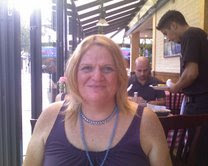
It looks like someone was smiling on the Pride celebration:

She stands in the courtyard of St. Luke in the Fields parish and school. The Pride March ended only a block away.

Today the Pride March makes its way down Manhattan's Fifth Avenue to Washington Square Park. From there, marchers will turn on to Christopher Street and pass the Stonewall Inn. On this date forty-five years ago, patrons fought police officers who tried to raid the bar. This clash, first labelled as the Stonewall Riot and later the Stonewall Rebellion, is usually cited as the beginning of the modern LGBT equality movement.
As always, there will be some bicycles in the procession. Of course, nobody will ride very fast, and some of the bikes as well as cyclists will no doubt serve mainly as props for signs or floats.
I admire the spirit of these marchers in Vietnam, who are pushing for marriage equality in one of Asia's most repressive regimes:
We all know that such struggles are important. But we can't forget that sometimes the battle is won and lost with, and on, accessories:
Imagine finding the body of a gunshot victim in the middle of a street at 8 o'clock in the morning.
That is the gruesome discovery a Cincinnati sanitation driver made the other morning by coming upon the corpse of twenty-eight-year-old Tiffany Edwards. Police are looking for a suspect named Quamar Edwards, who is not related to Tiffany.
What did Ms. Edwards have in common with Cemia "CeCe" Dove, Betty Skinner and Nicole Kidd Stergis? Because you're reading this blog, you've probably guessed that they were all transgender women. And they were all killed in Ohio during the past eighteen months.
Oh, and all except Skinner were trans women of color. The risks trans people face--We are sixteen times as likely to be murdered as anyone else--are magnified for trans people, especially trans women, of color.
The state that calls itself The Mother of Presidents has its share of capable community leaders, such as Shane Morgan, the founder and chair of TransOhio, and Vicky Blum, the outreach director at Crossport. However, they are working in a particularly difficult environment: Ohio's hate-crimes laws do not cover crimes based on sexual orientation, or gender identity or expression.
That, perhaps, is not surprising when one considers that the Buckeye State is one of five (Idaho, Kansas, Oklahoma and Tennessee being the others) that do not alter the sex on a transsexual's birth certificate, even after he or she has had gender-reassignment surgery.
Thanks again to Kelli Busey of "Planetransgender" for making me aware of a story not covered in the local news media.
If you are my age, or a little older, you can clearly remember a time when most of the world--and, probably, you--didn't know about AIDS.
The "beginning" of the epidemic is often placed on the 5th of June in 1981. On that day, the Center for Disease Control released its report documenting five young gay men who were treated for pneumocystis carinii pneumonia in Los Angeles hospitals between October 1980 and May 1981. On the day the report was released, two of the men were dead.
The reason why this mini-outbreak of pneumocyctis carinii was seen as so significant, even unusual, at the time, is that nearly every recorded case of PC developed in people with compromised immune system. That meant most of those afflicted with it had been, up to that time, elderly, suffering from some condition that compromised the immune system or were taking medications--or abusing substances--that weakened them. The patients in the report were described as "previously healthy"; the oldest of them was 36 while the youngest was 29. So they did not come close to fitting the profile of previous PC sufferers.
At that time, I was living some semblance of a straight male's life. By that time, I'd had relations with two males; the rest of my romantic/sexual life, such as it was, involved females. So, not many people would have described me as being part of the gay (nobody was calling it LGBT) community. Still, I knew more gay men and lesbians than most other people I knew and had heard stories about the "gay cancer" before the CDC report was released.
Still, I didn't think much about it. Part of it was that I wasn't really gay--which, by my definition, meant that I had nowhere near the number of male partners as some gay men I knew. Also, I suppose I had some of the arrogance of the young: I didn't think it would happen to me or, by extension, anyone I knew.
Well, a couple of weeks after that report was released, I went to a party held at the house my closest friend (a woman) at the time shared with another woman and two gay men. We were all students or recent graduates of Rutgers and some of our friends and classmates attended this party.
It would be the last time I would see most of them. Of course, some of us simply drifted apart, as people often do after graduating or leaving school. But four other people--including my first roommate at Rutgers-- would die within the following decade--from HIV, of course.
But none of us were thinking about it then. Nor were very many other people
This weekend, there will be Pride celebrations all over the world.
Here in New York, the Pride March always passes the Stonewall Inn, where patrons--including transgenders and drag queens--fought back against a police raid on a hot night forty-five years ago this Sunday.
I marched last year, and on the 40th anniversary of the Stonewall Rebellion--just a few days before my surgery.
Three years after the Rebellion, Toronto witnessed its first Pride event. For years after that, the police continued to raid bathouses and the city denied organizers permissin to march down Yonge Street. Every mayor beginning with Barbara Hall in 1995--and ending with, ahem, current mayor Rob Ford three years ago--has attended the march, though it wasn't officially recognized by the municipal government until 1998.
This year, Toronto is hosting World Pride.
A few days ago, the Huffington Post ran a fine article and even better selection of photos from the 1974 event. It's worth looking at for the hairstyles, cars, bikes and clothes. In other words, even if you don't care about LGBT history, it's a history lesson or time capsule, depending on how old you are.
Check out the photo near the end in which a young bespectacled lesbian is sitting on the front steps of what appears to be City Hall. Check out her lace-up, open-back clogs: Can you get any more '70's than that? (I wore a pair when I was in college!)
George Orwell would've had a field day with this: Putting someone in prison can be therapeutic.
Someone actually said that. Not in those words, of course: After all, the person who gave us that pearl of wisdom is a bureaucrat. That means that if she ever had the ability to speak forthrightly, it was beaten out of her or she gave it up willingly in order to preserve her lifestyle.
The "someone" in question is Joette Katz, Commissioner of the Connecticut Department of Children and Families. Before becoming Commissioner, she was a judge. That experience, it seems, honed the skills she's using in her current position, especially when it comes to cases like that of a 16-year-old transgender identified only as "Jane Doe".
Granted, she assaulted staff members at juvenile facilities in which she's been housed. But staffers in such places are used to such things, and there's no indication that her attacks--if she indeed perpetrated them--were any more intense than others they've experienced. And, it could be argued that with the proper care, Ms. Doe won't attack anybody again.
However, Ms. Katz is accused of overstating Ms. Doe's offenses--and of not mentioning that one of the staffers involved in one of the incidents has been terminated. Worse, Katz never mentioned that Ms. Doe has been a ward of the state through most of her life, during which she has suffered beatings, been raped and denied food. Moreover, she has been homeless and trafficked for sex. If she isn't suffering from even the mildest form of PTSD, Ms. Doe must be one of the most resilient (or emotionally numb) human beings ever to walk the face of the Earth.
Now tell me: How would putting her in a male prison for adults--and keeping her in solitary confinement, to boot--help her to recover from the trauma she no doubt carries? And how would such incarceration make her less likely to assault others (if, indeed, she actually did such a thing), especially given that she has never been charged with a crime.
Think about that: a sixteen-year-old who was removed from her mother's custody at age four, locked up--no, worse, placed in isolation--without having committed any indictable offense. Could such a young person end up becoming a criminal simply from the anger issues she'd develop over such an ordeal. D'ya think?
But Joette Katz, the former judge, somehow believes that prison personnel--and fellow inmates of a gender different from hers--will accomplish what psychiatrists, nurses, counselors and other employees of the juvenile facilities in which she's spent much of her life couldn't do for her.
In other words, this estimable Ms. Katz believes that prison will give a young, vulnerable trans person the therapy she needs.
Oh, you're accusing me of sarcasm now, are you? All right, I'll lay off and let you tell me whether, instead of looking out for Ms. Doe's best interests, the high commissioner is using her as a bargaining chip to placate state legislators who oversee her budget.
Could it be that Ms. Doe has gone from being pimped on the streets to being pimped by a megalomaniacal state official?
Nothing a little time alone among men won't cure, right?


 Posts