07 November 2010

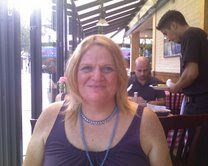
Ending With Daylight Savings: R.I.P Roni

Daylight Savings Time ended today.  It really made the day go by quicker than I expected.  Too quickly, in fact. The coming days will go by even more quickly, at least in the way that something goes by quickly when it's going by you.  That will be the case for the next few weeks, as the days grow shorter.


Some people grow very depressed at this time of year.  A few years ago, I learned of something called Seasonal Affective Disorder.  Unfortunately for me--and someone else--I didn't learn about it from reading.  

Right around the end of Daylight Savings Time six years ago, Roni overdosed on pills.  Millie told me that she suffered from SAD (what an appropriate acronym!).  I also knew, from talking to Roni herself, that she was not a happy person.  She had no living relatives, or at least none with whom she was still in contact.  And, it seemed to me, her life was full of all sorts of other regrets.


I found out about one of her deepest regrets when I started living full-time as Justine.  At first, she denigrated and taunted me for it and spread rumors about me.  For months after that, I wouldn't acknowledge her on the street.  But, one day, she approached me and apologized.  "I acted as I did because I envy you," she said.


"What do you mean?"


She explained that she felt that she was a man in mind and spirit, but had to live in the body of a woman--in other words, the inverse of me. Making a transition, she said, was out of the question for her because of various medical problems, some of which were induced by her drug and alcohol abuse.  She was sober and had not abused prescription, or used non-prescription, drugs for several years when she met me, but she was still on anti-depressants and painkillers mandated by her doctors.  


Even if she hadn't had such a history, she said  "there's no point to starting a transition now" at her age--about fifteen years older than I was.  In fact, she killed herself just after turning sixty.


Although I can't say that her despair over her gender identity was the sole or main reason for her despondency--or the thing that pushed her over the edge-- I can't help but to think that it was a factor.  And it would loom larger in the chiaroscuro of the lengthening nights of this time of year.

06 November 2010

Moving On At The End Of Daylight Savings Time

Tonight--or, more precisely, at two o'clock tomorrow morning--Daylight Savings Time ends.  That means the clocks are turned back an hour.


That is particularly ironic for me.  As I have described in earlier posts, various parts of my life are moving forward, whether or not as a result of my doing.  And, as I have also described, I do not have the option of going back, even if I wanted to do such a thing.


My working life, if nothing else, is making that abundantly clear.  I am teaching in two places where nobody --at least, nobody who had any authority to interview or schedule me--knew me.  And, save for one prof at the technical institute who knew me from long ago, I have not talked about my past with anyone.  And I didn't talk about my transition with him:  He seemed to know more or less what I did, and he has only a vague memory of the person who once shared a desk with him at John Jay College, where I taught just after I finished graduate school.  So much has passed since then!


Meanwhile, something even stranger is happening at my main job.  It's as if people are moving forward in my life--my previous life, that is--without me in it.  What's even stranger is that I'm not upset with them because, really, I don't have the choice--no, the luxury--of doing so.   Yes, I did suggest that the college could use an LGBT organization (The college is part of a university that includes twenty other colleges and is the only college among them that doesn't have an LGBT organization.)  and volunteered to do the work to organize, and enlist support, for it.  The college's administration thought it "too controversial" (What city are we in?  What century?) and not only nixed the idea, but cast aspersions on me for suggesting it.  Now they're willing to support other profs in doing it, and I really am not interested in it now.  I don't know what I'd say if those profs approached me to work with them on it.  


It's not a matter of "sour grapes."  Rather, I have come to realize that the college is so decidedly un-progressive in its attitude toward LGBT people, and much else.  So, I have to wonder just how much the college administration is willing to support those profs who are talking about starting an organization.  And, quite frankly, my interests and energies are moving in other directions.  I'm finding that there's not much, if anything, I can do about that.


The same holds true about a hip-hop institute I suggested while I was teaching a course in the poetics and rhetoric of that art-form.  Other profs are probably going to run with it; they can have it because, even though I suggested it, I feel that the idea is not mine anymore.  Or, at least, I don't feel as if I have a place in it.


On the other hand, at the technical institute and at the other college, I really don't feel any compulsion--for now, anyway--to do more than to teach and be a supportive presence for whoever may need or want it.  I don't yet know whether there are any "in" or "out" groups in either place, and if there are, I may not need to know, at least not yet.  In contrast, I now realize that at my main job, even though I have been involved in two committees and a number of other activities, and gained respect for my teaching, I was never one of the "cool kids," if you will.  And, what I learned is that it's the sort of place in which that's exactly what you have to be, or become.  You know whether or not that has happened if you are part of a clique.  I'm not, and that's why I actually feel more like an outsider at that college than I did on the day I started there almost six years ago.


As I describe all of those things, they already feel like part of the past and are unchangeable in the same way. You don't grow up by trying to change your childhood; you use what you can from it to help you move forward.  There are times when that college feels like as much a part of my past as junior high school, to which I have compared the college.  (I've also compared it to a juvenile detention center, as the power relationships operate in almost exactly the same way as those among detained adolescents.)  Some people there are proceeding without me; I am moving in the direction in which I need to move.


They say the fall is a time of change.  Indeed it is.  The end of Daylight Savings Time is part of it.

05 November 2010

They're Doing What I Said They Should...Without Me.

At my regular job, I bumped into a prof I used to see regularly but hadn't seen in some time.  Neither of us was avoiding the other (At least, I wasn't avoiding him); we merely have been on incompatible schedules.


As far as I know, he's straight.  However, he is very interested in LGBT issues.  He teaches a class in human sexuality, in which I have guest-lectured.  (Yes, I really am an expert on the subject! ;-) )  His students revere him; I think I would, too, if I were in one of his classes.


We caught up on one thing and another when he mentioned that the college is "throwing its support behind" a group of profs who want to start an LGBT group which would include students as well as faculty members.  


When I proposed the same a while back, the college president said that it would be "too controversial."  And the provost simply didn't want to hear about it.  When I mentioned this to the college's legal and compliance officer (what used to be known as the "affirmative action officer"), she said, with a straight face, "You or anyone else is free to start any organization you wish on this campus."


In the meantime, three professors--two of them long tenured--"came out" to me.  Their identities were not news to me--after all, trannies have "gaydar," too--but I was disturbed when they swore me to secrecy.  Not that I'd want to tell everyone.  Rather, I was disturbed that they all said they "didn't feel safe."  


I wonder if any of those profs are behind the effort to start the new organization.  


Ironically enough, I'm less interested now in starting such an organization.  One reason is that I'm not happy about the way I found out about the initiative, even if the news came from a prof I like and respect.  Another, and perhaps more important reason, is that I simply feel less like I want to become involved in such things.  Maybe I'm falling into a mentality I've seen other trans women fall into after they have their surgeries and settle into their new lives.  That mentality is one borne of a feeling of no longer having such a strong common bond with the L's, the G's, the B's or even the T's who haven't come as far along in their transitions.


Someone warned me that a day like this would come.  On one hand, I cannot deny what I've experienced, especially those ways in which my past differs from that of most women with XX chromosomes.  On the other, I remind myself that I took hormones, had the surgery and made all of the other changes I've made so that I could live as a woman--not as a transgender.

04 November 2010

Drownsiness In The Rain

Today everybody looked sleepy.  I could just barely keep my students awake, probably because I could just barely keep myself awake. About the only thing any of them will remember is a bad joke I made in one class:  As I was leaving my apartment, I saw the weather outside the window.  Then, I saw Charlie and Max curled up on my sofa , and wondered, "Which is the more intelligent species?"


Now they're curled up with me.  And I've been nodding in and out of sleep.  So if this post ends abruptly, you'll know

02 November 2010

Election Day

Well, the election results are coming in.  None of them are surprising.  While people are unhappy with what's going on in this country and who's running it, they didn't vote for some of the scarier candidates.  Yes, they voted for some of the so-called Tea Party candidates, but not as many of them won--and those that won didn't have as large margins--as some of the experts predicted.


Although I have my doubts about whether equality can be achieved through legislation, and about just how friendly some of the so-called LGBT-friendly candidates actually are, I'm glad that at least one homophobe didn't win.  I'm taking about Carl Palladino, who ran for governor against Andrew Cuomo.  While I'm never thrilled about the prospect of a dynasty, Cuomo actually does seem to be the better alternative.  


As the saying goes, time will tell.

01 November 2010

The Elections: I Have No Expectations

Tomorrow's Election Day.


It seems that actual and would-be voters can be more or less divided into the following categories:


  • the ones who aren't happy with the way things are but don't blame the incumbents
  • the ones who aren't happy with the way things are and blame certain incumbents, e.g., Obama
  • the ones who aren't happy with the way things are and blame the incumbents
  • the ones who aren't happy, period.
Now, I can't blame anyone for not being happy about the state of the economy and international relations.  I feel the same way.  I also can't blame anyone who isn't happy with whoever's in power.  That's how I've felt almost continuously since I knew who was in power, or knew what it meant to be in power.

But, I'm also not disappointed.  How could I be, when I had such low expectations.  That's not hard to do when the Presidents under whose rule you lived during your adult life are Carter, Reagan, Bush pere, Clinton, Bush fil and Obama--and the other two Presidents of whom you have any clear memory are Nixon and Ford.  

Clinton was probably the last President--or elected official of any sort--for whom I had any real hope.  Of course, almost anybody looked good after Reagan and Bush I.  But at the time, it seemed that this country just might have a chance at a less invasive and interventionist foreign policy.  And civil liberties might just become part of the public discourse once again, I thought.  Then again, in those days I was still confusing civil rights with civil liberties.  In my own defense, I'll say that most people still confuse the two.

Some people say that Clinton wasn't as effective a President as he might've been because Republicans took over Congress midway through his first term.  If being effective means passing one's own agenda, I think the mid-term election was only so much of an excuse for Clinton's record.  Then again, I'm not sure that anyone knows what Clinton's agenda actually was.  After all, he did support "Don't Ask, Don't Tell" and the so-called Defense of Marriage Act before the Republican takeover.

But apres lui, la deluge.  After him, we got Bush the Younger.  If you're reading this, you know how that went.  

The only candidates for whom I had any flicker of enthusiasm in the 2008 election were Hillary, Obama and--as much of a contradiction as this may seem--Ron Paul.  Of them, the latter was the only one who seemed to understand that we were headed for economic trouble that couldn't be headed off or ameliorated by government policy.  And, while he wasn't the most LGBT-friendly candidate, at least he opposed marriage--for everyone.  At least, he didn't think that marriage should be defined by the government.  What that would amount to, in practice, is that every couple, straight or gay, could have a civil union.  And those who wanted their unions sanctioned by whatever God they believed in could find a clergyperson and institution who would wed them.  Finally, he has always endorsed a "humble" foreign policy in which the US wouldn't have military bases all over the globe.

Some of his supporters could be pretty scary, though.

Once he was no longer on the ballot, there were nothing but establishment candidates left.  Hillary is very smart, but I still felt she cared more about her own personal ambitions than about the causes she  claimed to espouse.  And, while I ultimately voted for Obama, the change that I really expected was that he would be in the White House and Bush The Second wouldn't be.

Nearly two years into his administration, about all we ever knew about him was that he was, or was supposed,   to represent "change."  And change he has:  namely, his positions on gay marriage as well as other issues.

The thing is, I don't know what any non-incumbent candidate can offer besides the fact that they're not the incumbents.  Yet that will get more than a few of the so-called "Tea Party" candidates elected to Congress and to a few governorships.  While I'm glad that Carl Palladino has about the same chance of winning as a mango tree has of surviving a Buffalo winter, I have no enthusiasm for Cuomo, much less the minor candidates.


31 October 2010

Halloween: Not In Costume

Happy Halloween!


It's odd for me to say that.  Halloween doesn't seem like one of those holidays on which you wish someone happiness, as you would on, say, Christmas or Hanukkah.  It's more of a day for just having fun, if your idea of fun consists of what people do on this day.


I'm not saying it's not fun, or that one should treat this as "just another day."  I enjoy, as much as anyone does, seeing kids--and adults--in costume, and I don't get annoyed, as I once did, over kids (or adults) yelling "Trick or Treat!" in my face.  


But I don't partake of the festivities.  Sometimes people who know that I'm trans  will assume that I'm going to the parade in some outrageous or clever costume.  The irony is that I marched (Can you march when you're dressed like a ballerina, as I once was?) down Sixth Avenue in the Village on several All Hallows' Eves--before my transition.


The first time I marched was my second Halloween after moving back to New York.  That was when I went as a ballerina:  I saw the tutu in the window of an old, pre-gentrification, Lower East Side store.  Surprisingly, it fit me well.  Perhaps even more surprisingly, that store had a pair of pink ballet slippers that fit me and matched the tutu. 


After marching, I went bar-hopping in the Village with a couple of marchers.  On Seventh Avenue, a couple of doors from the old Vanguard, I came face-to-face with a Rutgers classmate whom I hadn't seen since our graduation four years earlier, if I remember correctly.


Fortunately for me, he and his buddies were drinking at least as much as the marchers and I.  Even more fortunately, neither he nor his mates were violent drunks.  "Hey Nick," he howled mirthfully.  

"Uh-hello."


"Don't worry.  Tonight's about having fun," he yelled.  Then, he introduced me to his friends--about whom I cannot recall their names, or much else--and slurred, "Nick here, he's cool."  He wrapped his arm around my shoulder. "I know.  I love him like my son. I raised him!"


"And look how I turned out."


His friends laughed.  He squeezed me.  "You're great.  I admire you."


Until tonight, I hadn't thought about that night.  Twenty-six years have passed since then.  That's how many years I'd lived up to that night.  


I have no idea of where he is now, or what he'd think of me--or I of him--if we were to meet again.  All I know is that it would be the first time he'd be seeing me when I wasn't in costume.  


There are lots of people who only knew me in costume.  I'm not talking only about vestments, of course.  But Halloween celebrations are about them--about "dressing up," as some people say.


I like to wear nice clothes.  Some days I really try to look good.  But it all feels authentic to me, so I don't feel as if I'm "dressing up."  And I certainly am not putting on a costume, or have any desire to do so.  That is the reason why I don't celebrate Halloween as some other people do.  Perhaps some year I will join in the festivities.  But, right now, wearing a costume doesn't interest me: My own skin is just beginning to fit me.

30 October 2010

Names That Popped Into My Head

Every once in a while, the name of someone I haven't seen or heard from in a long time will pop into my head.  Time was, not so long ago, when I would quickly forget the name mainly because, really, there was no other choice.  But now with Google and all those other marvels of technology, we can look up the names of those people, if we want to.


I was doing just that before I started writing tonight.  Whose names came to mind?  A long-ago---and I mean really long-ago--girlfriend.  A prof I had at Rutgers.  A boyfriend from a time long before I would ever admit to having had one.  And a former co-worker with whom I socialized in part because I actually enjoyed her company and in part to quell some gossip, if only by starting gossip of another kind.


As I've probably mentioned in previous entries, sometimes I get curious about people even if I'm not interested in seeing them again.  I want to know where they are even if I don't care to go there myself.  I guess I really do value stories over almost anything else.


Anyway, it seems that the long-ago girlfriend settled into life in a small town somewhere between the Potomac and Savannah rivers.  Does that mean she has a Southern accent?  If she does, and she still has her looks, she could be quite a distraction for lots of men!


The former co-worker is a lawyer in or around Chicago.  That surprises me and it doesn't:  She didn't seem to have the mind, or the mindset, for law school or law.  But, as I recall, her father and brother, and other relatives of hers, were lawyers.  Following in the footsteps of family members is not unusual; nor is wanting an upper middle-class lifestyle.  For all of her surface style (All those years ago, I knew I wanted to dress like her!), and for all of her ability to talk about Kirkegaard and Wittgenstein, she is an utterly conventional person, at least by the standards of the milieu in which she was raised.  At the time I knew her, I was only dimly, if at all, aware of that.


I couldn't find anything useful about the former boyfriend.  He has a common name, at least by the standards of Middle America, though he's black.  And he was a lot older--twice as old as I was when I dated him--so he may not even be alive.


As for the prof, with whom I took two French classes:  I think his name popped into my head because the prof with whom I had the conversation the other day reminds me, at least somewhat, of him.  Both are rather diminutive in stature and had to be, in one way or another, the toughest kids (if not physically) on the block simply to survive.  That alone makes them smarter than most others one meets inside the Ivory Tower.


That prof, it seems, has been writing crime novels under a pseudonym.  His wife--who, it seems, died within the past year or two--also wrote under a nom de plume and they co-wrote a book under yet another name.  And it looks as if he lived in Hawaii or still has a place there, and is now living in Arizona.


After finding out those last couple of bits of information, I realized this:  Transition or no transition, probably none of those people would recognize me now.  And I might not recognize them, but not only because they've aged.  (The French prof was in his thirties when I had him; now he's at or near Medicare age.)  


The kinds of people we were back in the day, and the contexts in which we met each other, made possible the relationships we had.  And those people, and those conditions, are no more.  So I have absolutely no idea of what I'd say to any of them, whether in an e-mail, letter or phone call, if I had any inclination to contact them again. 


Plus, I've found that, in the one memorable phrase of Thomas Wolfe, you can't go home again.  Or at least you can't return to anything you've left, or that has left you.  I learned that in my attempt to rekindle an old friendship early in my transition.  She was really the first friend I had, unless you count my mother and grandmother.  And, for many years, she was my closest friend.  Until recently, there were things that only she, or only she and my mother, knew about me.  


I mentioned that the people I thought about today might have changed beyond all recognition.  On the other hand, the friend with whom I reunited had not changed at all.  She even looked as she did when we were Rutgers students!  


That is exactly what I had hoped for:  to reconnect with the friend I first met all of those years ago, when we were about the same age as the students in my afternoon class.  And, ironically, we couldn't remain friends for exactly that reason.  We were having exactly the same conversations, in our forties, as we had before we turned twenty. And she was getting involved with the same kinds of men, and playing them and getting hurt by them, as she was back in the day.  As I listened to her, I could predict practically every word of her complaints.  And now she resents anyone who has moved on with his or her life, much less gotten what he or she wants. 


Oh well.  She's become what she's become (even if it is what she always was) and there's nothing I, or anyone else, can do about it.  I guess I can say the same thing about those long-lost names who popped into my head tonight.


29 October 2010

Not A Good Cultural Fit

Yesterday I was talking with an adjunct instructor at my main job.  He's a few years older than I am and completed his PhD several years ago after spending decades as a labor journalist.


If he knew then what he knew now, he says, he wouldn't have invested the time and money he spent in pursuit of that degree.  He knew the market for PhDs in English was tight even before the current depression hit; what he didn't realize, he laments, was just how competitive it is.


What makes things more difficult still for him is, in addition to his age, his race.  He's a fair-skinned black man and finds that he experiences prejudice, not only from whites, but from blacks who don't think he's "black enough."  


He said something I hadn't expected to hear from him:  that the so-called Affirmative Action laws aren't necessarily making things better for members of the groups they're supposed to protect.  It's almost a cliche to say that charges of discrimination are difficult to prove, as the interviewer or supervisor who commits the offense is most likely to do so in the absence of witnesses.  But what's even more pernicious is the "coded language" would-be employers employ.  They use terms like "cultural fit" , or say that someone "wouldn't fit into the culture" of the organizartion when they can't come up for another legal way to exclude someone who looks, or is in some other way, different from what they expected to see.


When you get past a certain age, it becomes more difficult to fit into the culture, whatever that means, of any organization. And having certain life experiences--like the ones that so often accompany being a person of color or a member of the LGBT community.  


It's not that we don't want to learn or adapt.  We don't even get the chance to do that because some would-be employers are convinced, or convince themselves, that we ca't do those things.  Or they don't want to know that we're capable, possibly because it might challenge that upon which they have based their careers and lives.


Now, as for which culture I or my colleage would fit into...

28 October 2010

Sick to Busy

Sick to busy.   Whenever I get sick--which isn't  often--that seems to be the trajectory because I have to catch up on whatever I couldn't or didn't do when I wasn't well.


And over the last couple of days I had another complication, albeit a welcome one:  I started to teach another class at  a technical institute.


A while back, I'd sent them a resume.  They said they'd "get back to" me.   I'd assumed they'd forgotten or "forgotten."  Then again, there didn't seem to be anything on my resume or in my communication with them that could have "outed" me, so I guess they really didn't "forget" me.  Last month, a dean called and asked whether I could do a class in January.  I agreed, and he said he'd keep me in mind in case a course came up in October.


The institute's semesters are eight weeks long, and commence throughout the year.   The dean thought the October courses were already filled and he had just begun to do the January schedule when he called me.  But he had a last-minute cancellation, so he sent me an e-mail asking whether I could teach a technical writing class, starting this week.  I agreed, and that's where I was yesterday.


Naturally, one of the reasons I took the course was to make some money.  But I think that it will help me to develop some new contacts.  That's a lot of fun when you're still a little woozy after spending a week in your house, unable to do much of anything.

25 October 2010

Critical Lasses In Edmonton

Now I have to take a trip to Edmonton.

No, I'm not going there to take in an Oilers' game.  And, while the idea of biking or hiking in the Rockies and taking in the Edmonton night life appeals to me, I've never made going there one of my goals.  

Lately, as a result of Sarah Chan's Girls and Bicycles blog, I've been reading about Edmonton's bicycle scene.  Until I came across her blog, I thought that cycling in Edmonton looked something like this:


You might accuse me of New York Provincialism.  You've seen an example of it on that famous New Yorker cover:


Since I started reading Girls and Bicycles, Edmonton Bicycle Commuters and other sites, I've formed an impression of an active--velocipedically as well as politically--cycling community.  And it seems to embrace diversity--and, yes, there's more of it than I, the jaded New Yorker, expected--in ways not commonly seen.

How can you not love a place that has a "Critical Lass" ride?

But the thing that really got my attention was a practice of Bike Works, the bicycle cooperative EBC operates.  On the first, third and fifth Sundays of every month,  BikeWorks is open only to women and transgenders.

Now that was an eye-opener for me.  I didn't think that there were enough transgenders, let alone transgendered cyclists, in Edmonton for them to be so recognized.  There's my NYP at work again!

If I ever were in Edmonton, of course I would check out BikeWorks on a women's/transgenders' Sunday.  However--and, as someone who hasn't been there, my view is admittedly limited--I have mixed feelings about  such a practice.

On one hand, I'm glad that a bike shop or cooperative wants to make its facility female- and trans-friendly and give us a "space."  In a sense, they're acknowledging that there aren't enough such spaces and hours.   And I know that sometimes (actually, often) I want to be around other women only, not out of any animosity toward men, but because of our particular ways of seeing and experiencing things. 

On the other, I have to wonder whether that will help or impede our acceptance by the larger cycling culture, and the culture generally.  I feel the same way about other gender-segregated institutions such as schools, and ones that are dedicated to LGBT people.  Some educators and psychologists raised the same concern when the Harvey Milk School was opened in New York.

Don't get me wrong:  I'm happy that the folks at BikeWorks recognize that there are indeed transgendered cyclists and that we, like other female cyclists, sometimes feel alienated and excluded from the larger cycling culture.  I don't doubt that they are trying to make us feel more welcome and to counter some of the condescension and hostility female cyclists have long complained about in cycle shops and clubs.

Still, I find it interesting that such a thing is happening in Edmonton and not in New York, at least to my knowledge.

24 October 2010

Momentoes and Memories

Last night, my mother told me she'd found a couple of things and was going to send them to me.  But she decided to ask me first.  "I didn't know how you'd feel about them," she explained.


One of those items is an envelope that contains a lock of my hair.  However, it's not just any lock of my hair:  It came from my very first haircut.  


The other item is a crochet bootie from a pair my great-grandmother, who died just before I turned seven, made for me. I remember the other bootie of the pair:  It was attached, along with a similar bootie for my brother Mike, to a frame around a photo of the two of us.  That photo was taken not long after Mike was born, which means I was about three and a half years old.  In that image, I am "holding" him in my arms:  In reality, he was propped on something and I wrapped my arms around him.


Funny, how I can remember that photo even if I haven't seen it in at least thirty years.  Even funnier is that I can remember, albeit dimly, posing--or, more precisely, being posed--for that photo.  That is certainly one of my earliest memories, if not my earliest. 


Today I was talking to my cousin--who was born a couple of months before I turned thirty--and, in the context of something entirely unrelated to this blog, he said that he could remember when he was two years old.  One memory of that time, he said, was when his mother--actually, my cousin; I refer to him as my cousin because, well, what do you call the child of a cousin?--took him to see The Little Mermaid.


She died when he was four years old; from then on he was brought up by my aunt and her sister.  But he still has vivid memories, which he's shared with me, of his mother.


I suppose that if I were to clear my mind, I could remember to when I was two years old, perhaps even earlier.  If I did, how would that change the way I see myself--or other people?


Anyway, my answer to my mother's question:  "Of course!"  Just as there's no denying who I am, there's no denying who I was.  

23 October 2010

Pedalling To A Dream, Twenty Years Later

The other day I pedalled to and from work--my regular and side jobs.  And during my ride home, I took of my favorite detours.


I took this photo from Fort Totten, on the North Shore.  I think it's the first time I rode inside the former base after sunset, much less by the light of the full moon we had the other night.  


Once, when the Fort was still an active military facility, I took a moonlight ride through the park just outside the gates.  Then, as now, a path skirted the edge of the water and passed underneath the Throgs Neck Bridge. That path and park were as lovely then as they are now.  


That night--more than a lifetime ago, at least for me--I coasted down Bell Boulevard, from St. Mary's Hospital, where I was doing poetry and creative writing workshops with handicapped and chronically ill kids.  The wonderful thing about doing poetry with kids of that age--especially those who have never gotten out of their wheelchairs or beds-- is that you don't have to tell them to dream.  For them, their unconscious and conscious lives are one.  Even if they cannot escape the constraints of their bodies, they aren't simply imagining that they are running, flying, jumping or dancing because their minds and are actually in moving in a jeu d'esprit with the light of their own stars.


I remember pedalling on that cold, windy night with a moon as full as the one I saw the other night and wishing that I could have brought those kids there with me.  After all, if I could be so moved, I could only imagine what kind of effect such a night in such a place would have on them.


Then I got very angry--at myself, because there was no one else there that night, and at that place for stirring up such passions in me--when I realized that all I was wishing for them was my own experience which, by definition, they never could have, any more than I could have lived their lives.  And the crisp clarity of that night's sky--which was reflected, again, the other night--was, in reality, as chimeric as the lights seen in the mist.


They might have enjoyed being in that place as much as I did, but they didn't need it--or, at least, they didn't need it as much as I did--in order to dream.  In fact, the crisp, almost brittle, moonlit chill seemed like the clearest sort of reality the way any sort of shock or trauma does the moment after you experience it.  It seems so real precisely because it's the only reality you have at that moment.  But that is exactly the reason not to trust whatever perceptions or sensations you have at such a time--though, of course, you cannot trust anything else. There is no past or future, there is only the present--not even the Eternal Present-- just the moment, repeated a million times every second until there is no other moment to repeat.  Repetition does not generate clarity; it merely breeds familiarity.  


And so I pedalled home that night.  And some of those kids where wheeled back to the homes of their biological or other families, while others stayed in their beds in the hospital.


What I didn't realize, at least consciously, was that I was dreaming of the ride I took the other night.  Heck, I didn't even want to know, much less admit, that I could still dream that way.  


I was very tired the other night:  Some would say that I probably shouldn't have ridden.  But, somehow, even though I was pedalling at about half my normal number of RPMs, I felt as if I were levitating on bay water rippling between the surface of the path and the moonlight that was reflecting off it.  That is not to say that it was all effortless; I was very, very tired.  But I was not exhausted; I was not beaten:  I couldn't help but to ride, to keep on riding, as the light of that moment filled me.  


In other words, I was in a dream.  I hadn't gone in pursuit of it, at least not the other night.  But I really never had any choice but to follow it, even when I didn't know that I still could still dream it.


I fell asleep not long after getting home.

20 October 2010

Inadvertent Commemoration

Today, without thinking, I wore a purple overshirt atop a magenta blouse that coordinated with a like color in the print of the skirt I wore.  And I covered myself with a shawl in a sort of burgundish purple.  A couple of people told me I looked nice, but one woman--a stranger--said, "So you're wearing purple for this day?"


"What?"


She explained that it was Domestic Violence Awareness Day.  Also, she said, people were wearing purple to commemorate the victims of anti-gay violence.  It turns out that there has  been an epidemic of both lately.


I've read a few reports in which social workers and researchers attribute an increase in domestic violence to the recession.  People are spending more time at home, they explain, in relationships they may no longer want to be in because they can't afford to go anywhere else.  And people--men, mainly--are frustrated over losing jobs and, in some cases, being supported by the very wives and girlfriends they're beating.


Purple has long been my favorite color, but today that woman I met confirmed something that I've always suspected: it's a color of survivors:  of people who've had to be creative simply to survive, much less to live life on their own terms.  It's certainly not a color of the status quo.


As I was going home tonight, I saw that the Empire State Building was lit in dark red and purple.  You can't get a much clearer sign than that!

18 October 2010

Galloping Against Their Bodies

What is it about October?


I know that it's fall and leaves are dying and, oh, they look so beautiful doing it.  And I'll admit that I've taken trips just to see vast tableaux of that happening.  Well, I did other things, too--like biking and, um, visiting Ben and Jerry's and Chabot's.


Those of you who know me well might say that the way I feel about October is my personal reaction to the deaths I've experienced during this month:  my grandmother and an uncle.  And a few other things have ended for me in October.  


On the other hand, I feel energized, even if I get sick or some other inconvenience or a tragedy befalls me.  There must be some weird dialectic (I hate that word, but it's apt.) between death and creative energy.  I can't think of things that have begun for me in October, but there were times when, in October, I realized that I was into, or on my way to, something I'd wanted.  Seven years ago, I was a month into living full-time as Justine.  There was something about that milestone; I guess a month is a fairly significant amount of time.  Plus, it represents a cycle of the moon.   According to much in religion, mysticism and even some more empirical pursuits, the moon is a source of creative energy.  And, of course, the tides--and, for some of us, the cycles of our bodies--are tied to the lunar waxings and wanings.


The flip side of creative energy is whatever causes people to do stupid, crazy or terrible things.  Why else do young men risk their futures and lives to play a game?  I really hope Eric LeGrand recovers and lives a wonderful life.  But, really:   Why risk one's self in such a way for...what?...the glory of your team?  Your college?  Your country?


I think James Wright put it best at the end of his poem Autumn Begins In Martin's Ferry, Ohio:  "Their sons grow suicidally beautiful / At the beginning of October / And gallop terribly against each other's bodies."


I know, I'm un-American (and, as some of my peers and colleagues used to tell me, not "one of the guys") because I just don't get what's so entertaining about guys hitting each other as hard as they can to move a ball a few yards down a field.   


Anyway...Could it be that a certain kind of guy really has to "prove" himself at this time of year.  Everything around him says "fall;" that's exactly what he doesn't want to do.  He wants to show he can stand tall; that he is indeed "the man."  But even if he is, he won't be forever.  So he needs something to assert himself.


Maybe that's the reason why there's so much violence against LGBT people at this time of year, and why the perpetrators of them seem to be trying to outdo each other in viciousness and brutality.  I've mentioned some of those crimes--Even those few I've mentioned are too many!--in previous posts.  And, it seems, there's a new one, if not every day, at least every other day.  


One result is that, even with anti-discrimination laws and even with workplaces and other settings where people make the effort to understand people who are different from themselves, there are still unspoken, unwritten versions of the "Don't Ask, Don't Tell" policy, as "Diana" relates on her blog.  And for everyone who is silenced by such practices, many more--especially young people-- will silence themselves out of fear.  After all, if you saw your teacher or some other adult in your life lose his or her livelihood--and suffer other kinds of grief-- simply for being honest, what would you do?


I can tell you this:  It does nothing to stop the cycle of hate and violence.  After all, we know that people gallop most violently against the bodies of the enemies they find within themselves.

17 October 2010

I Wanna Get Better Already!

I can't believe I've been home, not working, for a whole week.  Not that my "time off" has been fun and games, or whatever cliche you care to use.  


At times like this, I understand why doctors refer to us as "patients":  They're just as prone to wishful thinking, or simply being unrealistic, as the rest of us.  We have to wait until we're better to do all of the things we normally do; some of us are better than others at waiting.  Me, I'm not so good at it.


The funny thing is that I don't recall being this impatient when I was recovering from my surgery. Then, I couldn't stretch too far, lift anything more than a few pounds or, of course, ride my bike.  But I could take walks, at least, and I could spend lots of time reading and writing.  During those first three months, I had to dilate three times a day and soak twice.  That limited my travels a bit, but I hadn't expected to be a globetrotter during that time anyway.


Also, it was actually easy to see the progress of my healing.  It was exciting, too:  After all, I was healing to complete a process that gave me something I always wanted.  On the other hand, I didn't ask for this eye infection.  And, even though my eyes look better than they did the other day or a few days before that, they still have a pink hue.  Now, I have nothing against the color per se, but I didn't want it in my eyeballs.  Besides, there are other shades of pink on other parts of my body that look a whole lot better!


At least my eyes aren't as irritated as they were.  They're still not entirely comfortable:  Reading or writing for more than a few minutes at a time is still difficult. But they don't feel like they've been sandpapered and torched.  


I have said that I was beginning my life over again--or beginning it, period--with my transition and surgery.  I hope it doesn't mean that I'm going to get all of the childhood ailments now, at my advanced age.  (From what I've seen and read, it's usually kids who get "pink eye." )  What next?  Measles?  Does that mean I'll get acne in a few years?  Or is it like those other childhood diseases to which you're immune if you've had them before?


Hmm...I haven't been depressed since I started my transition.  I still experience temporary bouts of sadness--who doesn't?--but nothing like the decades-long trough I had to trod through. Maybe all those years immesed in the abyss have given me immunity.  

16 October 2010

Growing Old As We're Starting To Live


I've been asked to co-facilitate a transgender forum on aging at a conference for LGBT older adults next month.  I've agreed to do it, knowing that my qualifications to do it consist of the following:
  • I am trangendered
  • I am aging.  (Then again, I guess we all are.)
The invitation got me to thinking, though, about what aging means for us in the LGBT community, and for transgenders in particular.

So far, the most trenchant thought that has emenated from my pretty little head (ha!) is this:  Aging in the LGBT community has everything to do with its youth-centeredness.  In fact, the way we age is the very reason why the LGBT world is as youth-centered as it is.  It's not so much that we're trying to avoid or fight back our aging; it's the fact that we--most of us, anyway--only get to live as who and what we are at a realtively late age that causes us to live in such a youth-centered milieu.

Even with the increased acceptance of LGBT people (the recent hate crimes notwithstanding), very few bisexuals, fewer gays and lesbians , and even fewer transgenders, have the opportunity to spend our adolescence and early adulthood as the people we actually are.   Most gays and lesbians live closeted lives until they are old enough to move out of their families' homes, and some continue to deny their need to love and be loved in their own ways long after they have become independent of the families, communities  and schools that gave birth to and reared them and inculcated them with their communities' and cultures' values about families and other sorts of relationships--including the kinds of relationships people should have with themselves.  

Even gays and lesbians raised in the most loving of families and in the most accepting communities face hostility somewhere, some time. The result is something I've seen in those students of mine who grew up with violence, whether it was physical, verbal, mental, emotional or spiritual, and whether it came from their peers, members of their families or communities, or their governments and their agencies of enforcement.  Some people come out of those experiences shell-shocked; others are very canny or what people would call "street-smart", and still others are formed or deformed by their anger and resentments.  But nearly all of them do not have the opportunity to learn how to develop or maintain relationships in ways that their peers from more secure and stable environments learn.  And, because so many of them also come from homes that are dysfunctional in one way or another, they may know that they want something different but have not had any models from whom they can learn how to build it in their own lives.

Most gays and lesbians don't grow up with any models of how they can build their relationships and their lives.  All most of them see when they're growing up are heterosexual relationships, and some of those aren't very nurturing of the spirits of the people in them.  And, of course, nearly all of the love and familial relationships depicted in popular, and even higher, culture, are of that variety.

What happens, then, is that gays and lesbians start to learn how to express love and build relationships that suit them later--sometimes much later--than heterosexuals do those things.  Most teenagers have some experience of dating members of the other gender; many (I won't venture a guess as to how many) have sex and some actually learn what it means to love, and be loved, in an intimate way by a member of the "opposite" gender.  Most gay teens and adolescents don't have those experiences; those who do almost never have the opportunity to have those experiences publicly.  If you are a boy dating a girl or vice-versa, even if your family, friends and others in your community don't like whomever you're dating, they still support your urge to date members of the "opposite" gender, mainly because they're seen as stepping stones to marriage and family.

So, what a straight sixteen-year-old experiences is not a part of a gay person's life until he or she is in her twenties, thirties or even later.  And for transgenders--and, interestingly enough, bisexuals--that sort of experience may come later still.  I began to live as the woman I am in middle age, and I have been living my life only for seven years now.  That means I am just beginning to learn how to relate to people, and express love (which includes, but is not limited to, sexuality) as a woman, rather than as a female who had to channel herself through a filter of maleness.  

That, by the way, is the reason--I think--why one can't predict the sexuality of a person who transitions.  One of the reasons, along with finances, why I didn't start my transition earlier in my life was that I thought, as most people thought, that a true male-to-female transsexual was attracted to men.  It happened that the first male-to-females who had sexual reassignment surgery did indeed date, and in some cases married, men.  Christine Jorgensen comes immediately to mind, and it's hard to imagine how she, not to mention society, might have been different if she didn't fit into the roles that were considered acceptable for women in the 1950's, when she made her transition.

So I had to spend  a lot of years, not only alienated from my own sense of who I am, but also of how to relate to anyone else, whether in a sexual or more platonic way.  The sense of myself I could and would have formed in my teen years, and the kinds of relationships I might have developed as a result, are parts of my life I'm only beginning to discover--at an age when my parents were already grandparents.  

Of course, there are many other issues involved in aging for LGBT people, and transgenders in particular.  But I never realized until now that the youth-orientedness of our community was really a manifestation of the fact that we, in essence, start our lives later than straight people and cisgenders.