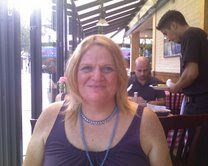
16 January 2010

Resisting a Temptation to Revise


Dina, who teaches at the college, told me about a vacancy that was recently listed at a college in which I used to teach. The job is, in some ways, attractive: It would entail a lighter teaching load and possibly give me an opportunity to develop and teach new courses. Plus, the college has developed a "gay-friendly" relationship.

For the reasons I've mentioned, I thought, for a moment, about applying for that job. But I think I'll pass.

For one thing, "gay-friendly" doesn't always translate into tolerance for, much less acceptance of, transgender people. Also, if I take a new job, I'm not so sure of how much I want my identity to be a factor in getting, taking or staying on the job--unless, of course, I were to work with an LGBT organization.

One nice thing about working this semester has been that my identity, though it is known to most people at the college, has been far less of a factor in my dealings with people there than it had been before. At the beginning of the semester, a few colleagues who knew that I'd had my operation asked about it. Some were very supportive. As the semester wore on, most of the faculty and students treated me well. There was one exception: I've managed, for the most part, to steer clear of that faculty member since her shenanigans. And I've talked about who I am just once, with the class I'm teaching now. I felt that it was an appropriate time and the students appreciated my candor and the fact that, as a result of my experiences, I could understand some of theirs.

The odd thing is that the college in which I teach has the reputation as the most "gay-hostile" campus in the city. I've had gay students for freshman and sophomore courses who didn't return for their junior or senior years and others who "came out" to me and swore me to secrecy. Yet, apart from a couple of incidents like the one I mentioned earlier, I really haven't had any difficulties this semester. Some of my former students have come to my office or sent me e-mails to wish me well; so have some faculty members from my department and others. Save for the one who made the false accusations against me, I haven't encountered hostility or other negativity from other faculty members.

So my current situation, while not ideal, is tenable. Or, at least, I've found my way around it, more or less.

Plus, while my colleagues met me early in my life as Justine, they don't have any memory of me as Nick. In contrast, there are several profs at the other college, where I taught for five years, who would probably remember me from my days in boy-drag. I wasn't happy in those days, so I'm not so sure whether their memories of me would be pleasant.

It's not that I'm afraid of seeing them again or that I feel any shame about who I am or have become. It's more like I want to move forward rather than to revise my past, or anyone's perception of it.

Perhaps most important of all, I've lost the desire I once had to meet people who knew me as Nick and try to show them my real self. I've even lost the curiosity I once had about what it might be like to have relationships, as Justine, with people who knew me as Nick but who last saw me some time before I started my transition. To be sure, I've had pleasant reunions with my cousin and aunt, and with Sheldon. On the other hand, hooking up with Elizabeth after being out of touch for a number of years didn't turn out so well. Fate or circumstance or whatever you want to call it may well bring other people from my past back into my life, as happened with my cousin and aunt. But I'm not so sure I want to purposely revisit past relationships, whether they were friendships or work partnerships.

The one other temptation about applying for the job at my old school is the fact that the old chairman has retired. The new chair started teaching there around the same time I did; she was working on her PhD. I don't know how or whether she remembers me, but I don't recall any negativity between us. So I may be able to start on a good note, or at least with a clean slate, at least as far as she's concerned.

However, the old chair is listed as a professor emeritus, which may mean that I'll see him again. About a year into living full-time as a woman, I found out that he was hiring adjunct instructors and asked whether he'd consider me. He declined, claiming that my reviews were "inconsistent" (They were all excellent.) and that I was "erratic." (He used to praise my consistency.) There were "problems," when I worked there, he said.

"Why didn't I hear about them then?"

"I can't talk about that."

Of course he couldn't: How can anyone who revises someone else's history talk about it with the person whose history has been revised?

So, I think I will leave that school in the past, and not try to revise it.

15 January 2010

Through My Skin


For the past few days, I've had a rather heavy cold. That, of course, has left me tired, which is one reason why I didn't post yesterday. It was the first time in a few weeks that I hadn't written an entry and I felt a little sad about it.

Today I realized that something I've been unable to describe--until now--has changed since, if not as a result of, my surgery. I don't have a name for it (Does one exist?), so I'll describe a manifestation of it.

Sometimes I feel as if I can sense something essential, or at least basic, about a person through and on my skin. You've probably said that someone or another made your skin crawl. Well, sometimes I feel as if some people have that effect on me. Or they make my skin tingle or burn or feel as if it's going to float, and I'm not sure of whether it will remove itself from my body or take the rest of me with it.


I felt something like what I just described--in a much less intense way--after I had been taking hormones for a couple of months. I used to say that I felt as if a layer of skin had been stripped away. Now, sometimes I feel as if I'm a mass of nerve endings. Sometimes that's wonderful: I experience joy like I've never known before. But at other times, I can feel the warning lights flashing without being sure of why.

The weird thing is that I feel as if I'm learning for the first time about people I've known for some time. Sometimes that's a felicitous, or at least a good, thing to experience. However, it can also leave me feeling unsafe around, or annoyed with, someone I once liked. That's how I feel about someone whom I considered to be a good friend not long ago.

Or, sometimes, I just feel no particular reason to talk to someone with whom I once conversed, sometimes at length. Maybe it's because I realize that I no longer have, or have never had, anything in common with that person. That's how I feel about a few people at the college. It's not that I dislike them; I just don't feel any particular connection to them apart from being a co-worker.

On the other hand, I also feel that I have something to talk about--or at least a friendlier "vibe" from people who seemed not to like me before, or whom I didn't think I liked. I'm thinking in particular of one colleague in my department. She started teaching at the college three years ago; from that time until this year, I thought she was rather snobbish or at least aloof. But we have become rather friendly. It may just be that she felt insecure as "the new kid in town": after all, she is young and had just recently finished her PhD. She had a couple of fellowships but, if I'm not mistaken, this is her first full-time faculty position.

But she's been friendly to me ever since I "broke the ice" early in the fall. Maybe she realizes that I'm not a competitor: We may both be in an English department, but the work we do is very different. And, I don't begrudge her that she's way more attractive than I ever was, am or will be. If nothing else, she has a very appealing smile, which I hadn't seen before this year.

Somehow I have the feeling she was intimidated by me. My first encounter with her came when she gave a sample lecture after being interviewed for the job. I was in the audience, among other faculty members and administrators. And I asked her a question--I forget about what, exactly, except that it had to do with the role of gender in a novel she mentioned--and it seemed to make her nervous. I wasn't trying to put her "on the spot;" it was simply a question that came to my mind.

I guess that if I were in her position, I might've been caught off-guard, too. But what she may not have realized at the time was that I was asking the question out of a complete lack of familiarity about the works she was discussing. And, of course, I didn't understand how or why she would be intimidated, at least a little, by that. If that's the reason why she kept her distance from me, I can understand.

Or, it just may be that she knew I'm transgendered: if she couldn't see it at first, she may have realized it from the question I asked. And, she may not have known what to make of that. She could very well been one of the many women who worried about what I'd do in a women's bathroom. (The funny thing is that I try to spend as little time in them as I can; I'm usually not noticing much else besides the cleanliness, or lack thereof, and I'm thinking about what I have to do at that moment and the moment after it.) By now, she's heard that I've had my operation, and she may feel less worried about me as a result of that. And I'm sure that even though she knows that I see her as an attractive woman--I've told her as much, as I'm sure many other people have--she knows by now that I'm not seeing her as a potential sexual partner. Maybe she knows, too, that I see she's really an OK, and rather interesting, person to talk to.

Now, these changes I've experienced don't mean that I'm getting rid of all of my old friends, as some trans people do when they transition. I've thought about making some changes in my life, to be sure--and, in fact, I've had to make one that I'd thought about making. But it will be interesting, at least to me, to see whether the way I feel about other people and things changes during the next six months, year, or few years. I know that happened a few months after I started taking hormones and as I started to live full-time as a woman.


13 January 2010

Aftershocks

If you had been in New York on one of the Sundays just after 9.11.01, you might've felt a sense of deja vu if you were at the college today.

On Sundays, the city--at least in some parts--can seem oddly bucolic. I often cycle through the Wall Street area and the industrial zones because, most Sundays, there's practically no traffic. The quiet in those areas is somehow even more transformative than the calm of the countryside because it's unexpected, especially if you've never been in those areas on a previous Sunday.


The other day, Matthew, a colleague, compared the atmosphere at the college to what I've described. Only a few courses are offered during the winter intercession, and fewer students take each of those courses. So, even in the middle of the day, the hallways and even the atrium and cafeteria can seem almost deserted.


What's nice about that is that everyone's more relaxed, or at least less intense, than they are during the regular academic term. And there aren't any lines to use the women's bathrooms!


But today the quiet seemed almost sepulchral. People were shell-shocked: at once too numb for grief yet on the verge of tears. And, in fact, when I left the campus today, I saw two people crying as I passed underneath the Long Island Rail Road trestle to Archer Avenue.


The somber mood is a result of yesterday's earthquake in Haiti. Many of the students, and a few faculty and staff members, are Haitian. So are a number of residents of the neighborhood surrounding the college. Many more people in the college and neighborhood come from other Caribbean countries, and I've noticed that, particularly in times of crisis, people from that part of the world bond with each other, even if their cultures and languages are different.


It seemed that some people were reacting to the tragedy as if it had happened on Parsons Boulevard rather than in front of le Palais National. That's because, in a sense, it did happen here: I don't think I'm exaggerating when I say nearly all Haitians in this city have immediate or secondary family back on the island. The first generation of Haitian-Americans is still being born: just about all young Haitian-Americans have parents who were born in Haiti. So there is still a seemingly- unbroken chain between neighborhoods like the one in which the college is located and the ones that were leveled by the quake.


That such a powerful earthquake struck in such a desperately poor country reminds me of something Primo Levi said in Se Questo E Un'Uomo: To the man who has, God gives; from the man who has not, God takes away.


Levi could as well have been sitting next to me during my subway ride home when he wrote that. A woman whose peasant-like earthiness has been weathered by working too long for too little in a sometimes-frantic, sometimes-hostile city far from home sat across the aisle from me. She was reading snatches of Amy Tan's The Kitchen God's Wife. I could see that she was just barely keeping her tears at bay for the first part of the ride. Then they sprouted from the corners of her eyes like streams from a fountain. I surmised that she was dealing with a loss, or the fear that she might've experienced one: After all, I never thought Tan was such a moving writer.


Anyway: When I return to the college tomorrow, I won't be surprised to find a similar atmosphere to what I encountered today.

12 January 2010

Some Thoughts on Amanda Simpson's Appointment


You don't have to be a rocket scientist to be true to yourself. But it can't hurt. Or can it?

That might be the underlying message of
Amanda Simpson's appointment as a Senior Technical Advisor to the Department of Commerce's Bureau of Industry and Security. As best as I can tell, you pretty much have to be a rocket scientist to understand what that job is!

Obama appointed her to the post. Some are saying she's the token "T" (sounds like something that might've been used on Boston's mass transit system) on his cabinet. It could be that Obama is trying to make nice with the LGBT community after refusing to support gay marriage during his campaign.

I have very mixed feelings about this appointment, to say the least. From what I've read about her, I have no doubt that Ms. Simpson is qualified for the job. And it may just lead to greater acceptance of transgendered people among the general public. After all, she is the first openly transgendered Presidential appointee, and now is arguably the highest-ranking, or at least the most visible, transgendered person in a public office.

And she seems eager to do the job. I can't help but to be happy for her.

But I also can't help to be disturbed by one aspect of the appointment--or, more precisely, its implications. It reminds me, in a way, of Harry Truman's racial integration of the Armed Forces in 1948, and how much African-American leaders advocated for it.

Ms. Simpson spent most of her career at Raytheon, a defense contractor. I guess most rocket scientists are working for the military (Yes, NASA is an arm of the military. Don't let anybody tell you any different!) directly or indirectly. I suppose one cannot fault someone for working wherever one can find employment in whatever he or she does best. That's pretty much what 99 percent of all humanities faculty members (including yours truly) are doing.

So I can't fault Ms. Simpson for working a company whose business model is often said to be "blowing shit up." But her extensive background in such endeavors could be a double-edged sword, both for her and transgendered people generally.

One of the reasons why African-Americans fought for the integration of the Armed Forces is that some of them fought in Europe during World War II and were not segregated when they entered cafes or other public venues in England, France and other countries as they were in fighting for their own country. But another reason that may have seemed even more important at the time was that leaders of the then-nascent Civil Rights movement realized that being integrated in the military would make integration--and, they hoped, acceptance--faster and more complete in the civilian world. In other words, if you were good enough to fight alongside your countrymen for your country, you had to be their equal. Or so the thinking went.

But, as much as this country makes grand gestures of honoring veterans, the truth is that most people who haven't been in the military don't want to be in contact with it. In a way, I can't blame them: After all, soldiers are reminders of war, and who wants to think about that? But there is also a hypocrisy involved: For all that this country's leaders like to make a show of honoring veterans, it also conscripts, de facto, many who are too poor or dark or uneducated to have other options. And, it also diverts technological and scientific talent and skill away from uses which might be of greater benefit to people: Amanda Simpson is a case in point.

Plus, the military and its contractors are not nearly as egalitarian, never mind progressive, as they like to portray themselves to the public. Most of the enlistees are people of color or poor whites from rural areas and the Rust Belt; most of the officers are not. And there is the military's odious "Don't Ask, Don't Tell" policy. I fail to see how anyone can use membership in such an institution to help whatever group ones belongs to.

What the appointment of Amanda Simpson accomplishes is to have a transgendered person in a high position in this country's military-industrial-corporate welfare system. While that, like the integration of the Armed Forces, may show that members of another group are just as up to their eyeballs in the muck as everyone else is. Maybe that's what we have to be in order to gain equality; if that's the case, it's not a good sign.

Plus, it--like everything else Obama has done so far--is ultimately about his image. Obama, I believe, is every bit as dedicated to creating and maintaining his image, whatever that may be, as Ronald Reagan was. His appointment of Ms. Simpson might make him look good to some in the LGBT community and may convince others that he's really trying to be inclusive.

But, whatever may come of this, I still have great respect for Ms. Simpson's intelligence--and the fact that she transitioned where and when she did. That probably took more courage than my own transition, and the transitions of many other people.


11 January 2010

In Front Of The Wife


On my way home from work, I stopped in the Duane-Reade store near the Jamaica Terminal of the Long Island Rail Road. (Yes, they spell Rail Road as two words.) I had to buy one of those, you know, things a girl needs (!) and had a coupon from D-R.

Anyway, having found what I needed, I walked down the chocolates aisle. (I went from what a girl needs to what a girl craves, I guess.) There, one of those swarthy, eternally handsome men with a moustache was with a woman who was quite obviously his wife. The woman was looking at something and talking to him in what I somehow knew to be Arabic even though I don't know any Arabic. As he made the gesture of listening to her, he rocked back and brushed against me.

"Excuse me, Miss."

"That's all right," I simpered.

He paused and looked in my eyes. "You're beautiful."

While I felt flattered, I felt badly for his wife. I mean, I don't think I'd want my husband flirting with some sorta blonde stranger. In any event, I was at a loss I exhaled, "Your lady is quite lovely."

"But you are beautiful!"

"Well, I have a boyfriend," I lied. "And you have a very beautiful wife." Which, by the way, she was.

"But it is not wrong to admire how beautiful you are."

"Well, I appreciate the compliment. But, please, appreciate what you have."

"Yes, she is beautiful. But so are you."

"Thank you. And I hope you both have a nice day."

After I paid for the box of needs and package of wants, I was walking out to the street when, from the corner of my eye, I saw the man looking at me.

Now, I must say, when I got dressed this morning, I could swear that there were a few pounds around my midsection that weren't there before. And it was one of those days when every mirror and every window I passed drew attention to my seeming newly-acquired adiposity. (So why did I buy chocolate?, you ask.) But people, out of the blue, told me that I looked good. And then I bumped into that guy. Or, more accurately, he bumped into me.

I'm still thinking about his wife, though. I don't know anything about her, but I don't think she deserved that. Then again, for all I know, that's written into their marriage contract, or some kind of contract that they have.

In any event, it got me to wondering if I was anything like that guy. Of course, I never looked as good as he did. But I couldn't help but to wonder whether I was a little friendlier with some stranger or another than I should have been when I was with whoever was in my life at the time. I never consciously flirted with anyone else when I was out for the day or night with one of my now-exes. Not to brag, but I was flirted with a few times on such occasions, particularly when I was in really good shape.

I actually used to dread those situations because they always led to a fight with whomever I was hooked up with at the time. That used to happen whenever I went to an office party or other event with Tammy and her co-workers or when I would go with Eva to something or another that one of her Sarah Lawrence classmates hosted. At the office parties, it seemed like everyone was ignoring me (which I didn't mind so much) or hitting on me. And sometimes the ones hitting on me were the wives of the traders, accountants, lawyers and other executives. (Tammy worked for a Wall Street firm.) She used to say that they were interested in me because it was obvious that I wasn't in or of that realm of work. That seems plausible enough. But I don't think I'll ever figure out what any of Eva's classmates saw in me--except, perhaps, that I was with Eva.

Maybe that guy who bumped into me today was flirting for no other reason than I'm not his wife. I'm guessing that she was about my age. But other than that, we couldn't be more different: She was one of those classically beautiful Eastern Mediterranean women you could easily picture in a Greek statue or Byzantine mosaic. I guess a guy can get bored with filet mignon if he has it every night; a cheeseburger (if not a cheesecake) provides a little variety, if nothing else.

Then again, maybe he flirted with me, in front of his wife, for the same reason that Donald Trump trades in his wife every five years for a newer model: because he can.

I hope I was never like that guy or that I don't become like that woman. But, if that sort of arrangement makes them happy, I wish them well.

10 January 2010

Plenty of Fluids


I'm a bit under the weather. Actually, I have been for a couple of days. I've had a cold that, I hope, won't turn into something worse. So I've made a pot of chicken soup and am living on that and tortillas with salsa. Now, I don't think anyone has ever recommended the latter as a cold remedy, but I figure whole-grain corn (unsalted) and hot peppers can't hurt.

At least the chicken soup counts as part of the "plenty of fluids" prescription my doctor gave me. I can remember when "drink plenty of fluids" meant "party hard." If that's what "drink plenty of fluids" meant, then "carb loading" must have been a code phrase for "drinking beer."

As you might expect, I slept late today. I won't have a chance to do that through the week, or the coming semester. I've been teaching a winter break class that begins early in the morning; I will be doing the same next semsester. But I won't be teaching late-night classes, as I have been for the past few semesters.

I think this cold may have been the result of the re-adjustment my body is making to my new schedule, as well as to the sub-freezing temperatures and high winds. I guess I shouldn't complain: After all, I have been healthy through my surgery, recovery and what has followed. I've experienced nothing more than the fatigue as well as the loss of strength that follows major surgeries. I had been warned about those results of surgery, so I am not complaining. And I have experienced no pain in the parts of my body on which I'd been operated, or anywhere else--not even in my mind.

I guess I'm really lucky if I can feel as good as I've felt through as much change as I've experienced. When you experience a sea-change, the tides can hit you with greater force than you'd anticipated, and the results can be surprising, to put it mildly. That, of course, is one of the premises of Shakespeare's The Tempest, where the expression "sea-change" was first used. (It and A Doll's House are my two favorite plays.)

I guess if a cold is the worst physical problem I've had (apart from being struck by that door: something from which I seem to have recovered), I have no reason to complain.

I'll just prepare myself for tomorrow and get some rest, as per doctor's orders. And, yes, I'm drinking plenty of fluids.

09 January 2010

On Same-Sex Marriage And New Jersey


While I was enjoying my time with Dwayne the other day, something that disturbed him, me and many other people we know was happening on the other side of the Hudson River.

As many of you know by now, the so-called gay marriage bill was defeated in New Jersey. In many ways, that's a disappointment, but in still other ways, it's not a surprise.

Let me clarify something: I don't necessarily think that a law that gives a person the right to marry someone of his or her gender is itself a solution to the problem of inequality, simply because I don't think governments should be in the business of defining or sanctifying marriages. I don't understand how, in a country whose constitution specifies a separation of church and state, clergypeople have, in essence, the power to decide who is and isn't married. I mean, if two people are married by their priest or rabbi or whomever, those two newly-married people have over a thousand legal rights that non-married people don't have--all because of a clergy member's say-so.

In that sense, clergypeople not only decide who is married; in doing so, they decide on which people are first- and second-class citizens. That is to say, they're helping, wittingly or not, to administer a form of apartheid.

On the other hand, given the legal, political, social and economic systems we have, so-called "gay marriage laws" may be the best we can hope for.

One of the reasons why voters in several states and state legislatures in others have voted against laws to give someone the right to marry someone of his or her own gender is that the laws are written, and presented to the public, as gay marriage laws. Thus, some people think that gays are getting "special treatment" with a law that defines their right to marry. The reality is that gays who want to marry are simply looking for the same rights as those enjoyed by married heterosexual people.

So, even though laws defining the right to same-sex marriage may be the better alternative in this society, the drafting, voting on and passing or defeating such legislation is premised on a major flaw in the current marriage laws, and the way people think about them.

As I said earlier, current laws give undue power to clergy people. That, in turn, amplifies the power government has over a segment of people's lives: marriage. I, for one, happen to think that governments should have no power to decide who is and isn't married. Furthermore, I don't think any government should give people special privileges simply for being married.

The very same people who think that gays are asking for "privilege" are the ones who themselves enjoy over a thousand privileges the government bestows upon them for being married. A good number of those privileges are financial, courtesy of tax laws and such.

If governments are going to have any power at all over unions between people, it should be limited to the equivalent of civil unions. If two people want to hook up, that should be their right. But they shouldn't get any tax breaks or preferences for tying the knot or for having kids. After all, that is a choice. (Funny, how some of the people who take those privileges for granted claim that homosexuality--or transgenderism--is a "lifestyle choice.")

Of course, in order to realize the vision I have just described, an entire legal and economic order will have to be dramatically re-structured. And, until that re-structuring takes place, LGBT people will still be second-class citizens. So, perhaps, having laws that allow gays to marry is the best we can do until that change comes about.

Now, I want to offer some of my own thoughts as to why the bill was defeated in New Jersey.

My family moved to New Jersey from Brooklyn in 1971. I spent my high-school years in Middletown and went to Rutgers University in New Brunswick. My parents lived in 'Jersey for more than two decades before moving to Florida; one of my brothers lives in the so-called Garden State now. So I can say that I don't have the condescending, snobbish view that many New Yorkers have of the place.

People who aren't familiar with the state think that it's all part of the New York Metropolitan Area and therefore shares the Big Apple's social diversity and the social tolerance they attribute to the city. New Jersey does indeed have quite a few gay people. But most of them live in a few neighborhoods of Hoboken, Jersey City and Plainfield, and some spend weekends or holidays in Asbury Park. Even in those enclaves, gay people don't live as openly as they do in Chelsea or even in Jackson Heights. Part of that has to do with the fact that most of the gay residents of New Jersey are male and living in couples: People tend to live quieter lives under such circumstances. But there is also a largely unspoken and almost entirely unwritten expectation that they will live that way.

This expectation stems, in part, from the fact that New Jersey is, for the most part, a suburban state. People move there to get a little more space than they would have in the city and, very often, to stake out a part of the American Dream for themselves. The price of admission consists of their down payments and mortagages on their homes.

A large part of homeowners' time and energies--not to mention their incomes--is directed to their stake in the dream. For most, that is the sum total of their net worth. Such circumstances make people fearfully protective of not only their properties and investments themselves, but also of anything they fear will devalue that investment or encroach upon the status they have attained by building a middle-class family and home life.

Such a way of thinking can very easily, and often does, turn into a siege mentality: I worked for this. Nobody gave me any special consideration. Why should anyone else get it (I can't begin to tell you how many times I've heard that, almost verbatim.) In New Jersey, such fears and resentments are exacerbated by the fact that New Jersey homeowners pay the highest property taxes in the nation. Plus, there is the relatively high cost of living and, for many, the high cost of commuting to their jobs (and paying an additional tax if that job happens to be in New York). And, finally, if they have kids--which nearly all of them do--there is that cost.

People in that situation feel that they're working harder and paying more than anyone else, and are not getting any special consideration for it. So they look at gay people, most of whom don't have kids, and feel resentment. That homeowner who's raising kids somehow feels that his or her taxes are subsidizing the life of libertine privilege they imagine that gays live, just as those same suburban homeowners feel (rightly so, I might say) that they are financing the incompetence and corruption for which New Jersey's largest cities are famous.

In brief, they feel--with at least some justification--that they're paying for people who don't pay their share. To see anyone else share the privilege they enjoy is, to their minds, an affront to their hard-working, law-abiding ways.

In addition to the large swaths of suburbia, there's a part of rural southern New Jersey that actually falls below the Mason-Dixon line. The Ku Klux Klan had active chapters there and in other parts of the state before World War II, and New Jersey was believed to have the largest Klan membership of any state north of the Potomac. The Klan has had a resurgence there in recent years, and in recent elections has supported various candidates, mainly those who oppose immigration.

This isn't to say that New Jersey is Alabama North. But it isn't Massachusetts South, either. So, at least to me, it's not such a surprise that the state allows civil unions for same-sex couples, but not same-sex marriages. So, as is typical of governments, the New Jersey State Legislature applied the right idea (civil unions) for the wrong reasons to one group of people and, as a result, merely elevated them from third- to second-class citizens rather than to equality. And they voted against the solution that, in a corrupt and cumbersome system, was the best chance at achieving equality.

08 January 2010

Healing And Wellness: How To Be A Spiritual Subversive


Another trip to the doctor--this time, Dr. Tran (who insists that I call him Richie), my primary-care doctor. I think I've spent more time with doctors during the past year than I did in my entire life before then.

Dr. Tran, like Dr. Jennifer Johnson, is part of the Callen Lorde Community Health Collective. I've been using their services ever since I "came out" to Dwayne more than seven years ago. Michael Callen was a composer and singer who, after learning that he had AIDS, started one of the first organizations for those stricken with the disease. That was at a time when all of the known victims--according to official reports, anyway--were gay men.

I never met Michael Lorde or, frankly, knew much about him before I started going to C-L. That probably says more about me than about him. On the other hand, I met Audre Lorde once. Ironically, it was during the early days of my sobriety: some time not long after my 90th day, if I recall correctly.

I had gone to one of her readings at Hunter College. The odd thing was that in my sobriety, when I was following the Twelve Steps, I was more taken with the militancy of her poetry--and her militancy, period--than I was when I was abusing alcohol and drugs. I say this newfound appreciation at that time in my life was odd, or at least ironic, because the Steps directed people like me to, in effect, surrender our selves to a power greater than ourselves. On the other hand, Lorde, in her poetry and her work as an activist, exhorted people--especially women, people of color and lesbians--to know as much about themselves as possible and to take charge of what they learned.

But what I was responding to about her poetry and rhetoric, and what I was responding to in The Twelve Steps were, in some way, not so incongruous. At that point in my life, I never would have become clean and sober on my own. Yet somehow I knew I needed to do that. And, in much the same way most of us need someone to teach us the fundamentals of the languages we speak and of computation as well as any number of life skills before we can construct our own lives, I needed help to start my process of recovery. When I told Kevin, who would become my first sponsor, that the "power greater than ourselves"--at least as I heard it decribed in the meetings I attended--sounded suspiciously like the Judeo-Christian God, he implored--in his old-school Bronx Irish-meets-Hell's Angels way, "Well, let them describe Higher Power that way. You know what it is for you; go with it." And so I did.

Anyway...after her reading, I had Ms. Lorde autograph my copy of "Our Dead Behind Us." I was the very last person for whom she signed a book that day, and we talked a bit. When I thought about that moment later, it seemed more surprising than it did at the time. After all, you can't find someone much whiter than I am, and I was living as a male--and doing everything I could to seem the part. On top of that, I was clinging desperately--although I could not know, at the time, just how desperately--to the idea that I was some sort of straight guy.

You might say that I had stepped up to a battle but didn't know that a war lay ahead of me.

But somehow she seemed to know that. And, from the expression in her face and, more important, in her eyes, I knew that she knew what I needed to do--and she expected me to do it.

Many years later, I would see exactly the same expression from another poet who, if she didn't know Audre Lorde, surely had read her works. During my second year of living as Justine, I attended a reading by Grace Paley. After she finished, she signed copies of two of her books for me.

Before I could say anything to her, Ms. Paley told me, "Write that book!" And Ms. Lorde told me, "Always tell your truths!"

What I learned from both of them--from meeting them and reading their work--is that a woman has a moral and political obligation to herself--and to other women, and to everyone else--to learn everything she can about her body, her mind, her spirit and the world she lives in, and to never, ever stop telling whatever truths she finds--even if they fly in the face of whatever notions were previously inculcated into her. Or, as Lorde said, "If I didn't define myself for myself, I would be crunched into other people's fantasies of me and eaten alive."

In other words, choosing her own survival is the most spiritually wholesome, and the most subversive thing, she could have done. I'm sure Paley could have identified with that. I know that I can.

07 January 2010

Six Months: The Paradoxes of Coming Home


Exactly six months ago today, I had my surgery.

I'm thinking now of that conversation I had with Marilynne's daughter just after Christmas. We agreed that on one hand, it seems that the time has passed very quickly, but on the other, it seems like a very long time has passed. Somehow that paradox seems to relate to another: That we lived the vast majority of our lives pre-op-- and even pre-transition-- and now so much of my previous life is fading, or has already faded, into the background.

And there is yet another paradox: Knowing that there are things I did because I lived as a guy named Nick, yet realizing that while I was doing them, I was Justine. As an example, I had relationships with women who were attracted to that guy. Yet I know now that even though I was repressing myself, I was--at least in some way--just as much a woman as I am now. And that is exactly the reason I felt the need to make my transition and have my surgery.

Some day relatively soon, Marilynne's daughter will have lived the majority of her life post-op. Given my age, that day is not likely to come for me. Still, there are times when it feels like this part of my life is the longer and greater part--that, in fact, I feel somehow as if I have always been post-op, or at least the woman who entered new stages in her life with her transition and operation.


Spending time with Dwayne after work accented the feelings I've described. For me, that makes sense, as he is the very first person to whom I "came out." He has never called me anything but Justine or used any pronouns but female ones in reference to me. In other words, he knows about my previous life but never saw it. So, even though that part of my life was much longer than my current life, he knows only a summary of it, if you will, and it is the point that came before the starting point of my current life. You can say that, I suspect, about anyone who meets and develops a relationship with you in the middle of your biological life.

When Dwayne and I embraced upon meeting, I felt in some way as if I'd "come home." I told him that, and he said he felt the same way. Oddly, that's what I felt the first time I met him, which is the reason I was able to "come out" to him.

Then, I knew I'd come home but had practically no idea of what that meant. Now, I am learning about my surroundings, if you will, but everything I learn--whether it's about my body, or about the ways I experience what's outside my body or within my mind and soul--feels inevitable and organic, if not predictable.

What I'm learning makes complete sense even if it's not what I expected. And that's the reason I'm learning it. That can make time go very quickly and make the past seem even further in the past.


06 January 2010

Leaving and Becoming, Again


Today is the twelfth day of Christmas. In some countries, it's celebrated as Christmas. In the church in which I was raised, this is called the day of the Epiphany.

Today I can't honestly say I've had any epiphanies. I guess we're not supposed to have them every day. I'm not sure I could handle that, anyway.

Around this time last year, I was teaching the same course I'm teaching now, during the winter intercession. It was a larger class, and it was in the evening. It was an odd time, really: I'd write or ride or do something else during the day--the afternoon, really--before going to class. The course I took--good mainly in the sense that it confirmed that taking more like it is not something I want to do--hadn't yet begun. What I had begun to do, however, was to count the number of days until my surgery.

It all seems oddly distant to me now. It feels a bit like looking at a fading black-and-white photo of myself and other people---family members, perhaps, or classmates--in poses, clothing or settings you can't recall as they're shown in the photo. If you're a child in such a photo, you seem more serene or simply cuter (or not as cute as) you recall yourself, or more precisely, the way you look in that photo.

It's like one of those memories you carry that somehow doesn't seem like one of yours, or a story that you've remembered, and possibly even told, in the way you heard it from someone else because you didn't yet have your own way of describing it to yourself.

That, by the way is, as near I can tell, the only way to gain knowledge or memories that are relevant to your own life: by describing, in your own way, your own experience to your own self. And that becomes possible when you are the subject and not the object of your own narrative.

Oh, no. I hope I don't sound like one of those dreadful texts I read in that course I took last year. If it does, I guess I had to start somewhere. Right?

I know this much: You become that subject only when you do. That is the only way to become, to learn: by doing.

And I guess there isn't a whole lot you can do with those memories frozen in amber...or sepia.

05 January 2010

What Did I Teach Today?


During this Winter Recess at the college, I am teaching a business writing class. There are fourteen students. Two took other classes with me during the fall and another was in a class of mine two years ago. Then there's another student who, while he has never taken a class with me, seems as if he's one of my students. And I'm not the only faculty member who feels that way about him. Now, as he's about to embark on his final semester at the college, I'm actually teaching him.

So far I'm liking the class: It's small, the students seem receptive and the course will be an intense experience. I know that because I've taught winter session and short summer session courses. Each lasts about three and a half weeks, so every day is like a week of the regular semester.

Anyway...Today we were discussing some of the "do's and don't's" of writing a cover letter for a job application. Somehow the subject of whether to mention church memberships came up. I told students they should mention such things in a resume or cover letter only if they're relevant to the position or the organization. The same thing for organizations that have to do with race, ethnicity or politics: You don't mention them unless they have to do with the requirements of the job or organization. "And they're not allowed to ask about those things in an interview," I said.

A few jaws slackened. I could tell that one woman had been asked about such things during an interview; the others came from other countries where laws against such questioning don't exist. I turned to one student, a Bengali woman, and said, "You don't want to announce that you're Muslim unless you're applying for a job in a mosque."

"A lot of people assume that I'm one," responded a male Hindu student from India. Then I talked a bit about some of the things that happened in the days just after 9/11/01, when people were harassed and beaten because someone thought they were Muslim or Middle Eastern. That happened to a taxi driver just three blocks from where I was living at the time: A group of men surrounded his cab when he stopped for a traffic light, pulled him out of the car, and beat him on the pavement. As it turned out, the driver was a Filipino Catholic, if I remember correctly.

"So there's really prejudice out there," commented one student, who works in the college's day care center.

"Yes," I said.

"What do you think, prof?" a young man wondered.

"I know it exists because I've experienced it firsthand."

I could hear that same man breathing. Everyone in the class stared at me. I figured that at least half of that class knew my story, so I told them about the time I went to an old supervisor of mine, who had become the department chair in another college, to ask about working there. It was just before the beginning of the semester, and the department was hiring adjuncts to teach a few newly-opened sections.

When that department chair was a coordinator at the college in which I used to teach, I had nothing but excellent reviews and he praised my work and professionalism. However, when I saw him again, about a year after I'd started living full-time as a woman, he somehow recalled that "there were problems" with me. He said I was "erratic" and that there had been complaints about me.

"Well, I never heard about them then. Why are you bringing them up now? And, as coordinator, you wouldn't have dealt with them."

"And your reviews were very inconsistent."

"Who told you that?"

"I can't talk about that."

When I finished telling the story, I could feel the eyes upon me. Then, one of the students I had last semester said, "Well, at least we have you here."

For a moment, I couldn't say anything. Then, after the student who works in the day care center gave me a "thumbs-up," I implored the students to remember, if nothing else, that trying to "fit in" or imitate those who have power does not work if you do not have the privilege they have. "All you can do is to be your absolute best self, whatever that is. Know what you are, and be the best of that you can be."

Don't ask me where that came from, much less whether it was the right thing to tell them. But, really, it was all I could say. I'm not sure what, if anything, I taught the students in that exchange. But it was all I could offer before we got on to the business of the rest of the day's class session.

04 January 2010

What Is The Wind Bringing To Life?


So far, this probably hasn't been the coldest winter we've had in these parts. But people seem to think, and sometimes it feels as if, it has been. The cold has been accompanied by wind or wetness. The last couple of days it's been the wind; before that we had snow.

What has that meant? That I haven't been riding and everyone's been bundled up. You can see why people get depressed: They're closed off from each other, literally and figuratively. One is less likely to be seen by, much less have contact with, someone else. (The fact that there's less daylight at this time of year doesn't lift some people's moods, either.) On the other hand, they're also less likely, for exactly the same reasons to commit violence on each other. Then again, some people are more likely to commit violence on themselves.


Anyway...All of the wind that's blown this way makes me think of a Navajo creation story. It begins something like this:

It was the wind that gave them life. It is the wind that comes out of our mouths now that gives us life. When this ceases to blow, we die. In the skin at the tips of our fingers, we see the the train of the wind; it shows us where the wind blew when our ancestors were created.

This story goes on to say that in the autumn, four beings appeared: White body, Blue body, Black body and a Yellow body. They told the people they would return in twelve days. In preparation for the gods' return, on the twelfth day, the people washed themselves thoroughly. The women dried their skin with yellow cornmeal; the men with white cornmeal.

(It seems that cornmeal has a similar role in Navajo and other Native American cultures to what rice plays in many Asian cultures.)

Soon the people heard the shouts of the approaching gods. Blue Body and Black Body each carried a buckskin; White Body carried two ears of corn, one white and the other yellow.

The gods laid one skin on the ground, with its head facing the west. Over it they placed the two ears of corn, with their tips facing the east. Atop the ears of corn, they spread another buckskin, with its head to the east. Under the white ear of corn, they slid a white eagle's feather; under the yellow ear, a feather from a yellow eagle.

Then the gods told the people to stand back and allow the wind to enter between the buckskins. White wind blew in from the east and yellow wind came from the west. As the wind blew, eight gods called the Mirage People walked around the assembled objects four times. As the gods walked, the feathers, whose tips stuck out from the buckskins, were seen to move.

When the Mirage People finished their walk, the upper buckskin was removed. The ears of corn were gone; in their place lay a man and a woman. The white ear of corn had become a man; the yellow ear, a woman. They were the First Man and the First Woman.

It was the wind that gave them life, and it is the wind that comes out of our mouths now that gives us life. When this ceases to blow, we die.


I love the story. What makes it even more interesting, at least to me, is that in Navajo culture an implicit understanding that the wind, the life-giving force, is a kind of primordial mother: a creatrix, if you will. So that which gives us life, according to Navajo tradition, is female, and the Great Spirit, which is male, is the witness to the creation.

Hmm...It's just a little ironic, to me, that we've had the most prolonged stretch of windy weather I can recall at the beginning of my first winter in my life as a woman. I won't claim any cause and effect: I'm not that narcissitic!

I wonder, though, what the Navajos would make of the weather we're having. Could it be that a creative, chaotic, tumultuous and powerful time is beginning now? Or am I just seeing the world through the mirrors and prisms of my own life at this moment?