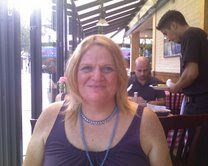
20 June 2009

The Face Of A Woman With An Umbrella

Today my dry-cleaner made the same joke my friends have been making: that she's moving to Seattle for the weather. Well, there's a silver lining in that: She speaks English, which is her third language, well enough to tell the joke convincingly.

Even if she'd botched the joke, it would have been charming because she is so cute and sweet. I know of at least a couple of guys who've expressed disappointment that she's married.

Yes, it rained again today. I guess I'm getting my feminine umbrella-holding technique down pretty well. Actually, it's more or less the same as holding or carrying a lot of things: I hold it with my fingertips and make it seem as if I could twirl it at any moment. I try to make it as lithe as my middle-aged-guy-body-with-pubescent-girl-boobs can make it.

It seemed to be working. I was walking up 21st Street, toward the dry-cleaner when, I passed an auto repair shop staffed by South Asian men. They were all staring at me; one of them yelled, "Come here, honey." And another said, "Can I see you tonight? Can I have your phone number?" Mind you, a much younger and prettier young woman passed before me, and they didn't give her the kind of attention they gave me.

The funny thing is that, aside from the way I was carrying my umbrella (which is printed with a reproduction of one of Monet's water lilies paintings), I was pretty frumpy, or is it dumpy? What's the difference? I tossed my clothes, which were from hunger, onto my body, which certainly isn't showing any signs of recent hunger. As I walked out of the house, I felt too fat, old, and anything else negative you can think of, although my face in the mirror, if not pretty, at least reminded me of why I have been making my changes: It reflected vulnerability, and even a kind of tenderness, along with a certain kind of radiance which, people tell me, I cannot suppress even if I want to.

In other words, at the risk of seeming vain, I can say that I now have a face I am not ashamed to show. All I have to do now is work on the body.

But, let me tell you, there's something about being a woman with an umbrella. It seems that men are always looking at you when you're holding one. I was also carrying a handbag with me; there's something about the combination of it and an umbrella that seems to get attention. Maybe they think of Pariseiennes or London girls strolling the boulevards on a showery or drizzly spring day.

Now I'm recalling a photograph: one of the few I took that I liked. In it, a woman is standing under an umbrella at a bus station. As I recall, I shot that photo from the rear, and the woman's backside is visible all the way up to her shoulder blades, onto which her brown hair cascaded. Someone suggested that I enter it in a competition; I have no idea of whether or not I still have the print, or even the negative. Any time I have looked for photos I've taken, I'm surprised at which ones I still have and which ones I don't.

What's even odder is which ones I remember, and how I remember them. If I ever do find that photo, I wonder if it will look anything like the what I've described now, which is to say the way I remember it. Maybe if it wasn't impressionistic, I made it so by describing it.

Then again, even if I had their talents, I don't think I could have made anything like the paintings Monet and others created. Or even a film. Well, maybe that. What would I call it? Les Demoiselles d'Avignon Sous Les Parapluies de Cherbourg? Well, I've been called a putain, but I'm certainly not one of Picassos Demoiselles. And I ain't in Cherbourg. All I am is a woman with an umbrella. At least I think, if nothing else, I'm carrying it with some grace.


19 June 2009

Memory and Nervousness, Or Lack Thereof

Tonight I was talking with Aunt Nanette. Actually, she's my mother's aunt, but I have always referred to her as my own aunt. My father had no siblings and my mother had three brothers (one of whom, Joe, is still living), so I didn't have a lot of aunts to choose from. Uncle Joe is still married to Gen; Uncle Sonny divorced Aunt Pat (whom I still call "Aunt") when I was in high school and Uncle Nick split with his wife before I could develop any memory of her. And, as much as I love my uncles, being who I am, I always wanted more female relatives. Aunt Nanette does fine.

Anyway, she turned 85 yesterday. She'd called the other day to thank me for the card I sent her. "That was very thoughtful of you," she said. "I'm touched." I've never known her to be sarcastic, so I accept what she says at face value.

Although we've talked often, we still haven't sat face-to-face since I began my transition--or well before it. In fact, now that I think of it, I don't recall having seen her since Uncle Nick's funeral. That was almost twenty years ago. And my most vivid memories of her are a good bit earlier than that--from my Rutgers years and earlier. So the image I have of her is of a woman who wasn't much older than I am now. And the picture of me that's affixed inside her mind is most likely of a young man with a beard and a scowl.

Elizabeth used to refer to me as Homo Scowlien: Scowling Man. Other people had similar impressions of me. Maybe Aunt Nanette does, too--although she never fails to call me "Justine" or use feminine pronouns when referring to me. On the other hand, I think Elizabeth preferred Homo Scowlien. (OK, so her Latin wasn't so great in those days. Mine never was.)

Anyway...Enough about Elizabeth. Aunt Nanette is much more relevant and interesting than she'll ever be. Tonight Aunt Nanette was asking about my upcoming surgery. I talked about the doctor, the things I've been doing to prepare for it, and the things (like the course I'm teaching) I'm doing so that I don't think about it 24/7: After all, I think being so occupied with anything, no matter how good, is unhealthy. At least it's never been good for me.

She asked me a question other people have asked: Are you nervous about it? I replied, honestly, that I'm not. I've always had the feeling that the closer I came to the date of my surgery, the more uneasy I'd feel about it. Hmm, maybe eighteen days isn't near enough.

I explained that I've done a lot to prepare myself mentally for that day, between all the time (and money!) I've spent on therapists and such, and the exchanges, in person and on-line, I've had with other transgendered people. I've been in good hands, I've said, and I feel that I'll be in good with Dr. Bowers and her staff. And, of course, Mom and other people have been supportive.

She didn't express surprise over my explanation. However, I must confess that I'm surprised that I'm not nervous about this. I mean, I'm glad that I'm not. But does that make me well-prepared, or simply insane? Maybe both, and a bunch of other things.

It's really strange: I've been absolutely terrified of asking people for dates or help with anything. And of job interviews. And of starting new jobs. And, strangest of all, I was more scared as I embarked on the last bike tour I took in France than I was on my first. Then again, I had a premonition that I wouldn't come back from it. In a sense, I didn't--at least, I didn't come back as quite the same person who left, and I knew it that day when I hugged Tammy so desperately when she met me in the airport.

I know that, in some sense, I will be a different person after my operation. But somehow it doesn't scare me: I've been envisioning it for many, many years. I also know that there's still much that, no matter how much I've prepared, I can't anticipate. That's true of any change we make in our lives. The difference is, I know that now; when I made other major changes, I didn't understand that.

Still...I wonder why I was nervous about such things as job interviews or asking someone on a date. The potential outcomes were--at least, after I reached a certain age--more predictable than what I could experience. When you ask for a job or date, or almost anything else, the worst thing you can envision is that the person says "no." Most of the time, that's where it ends. And, even after having more rejection than I ever wanted to experience--although, most likely, about as much as most people encounter--the prospect of facing it again still struck fear in me.

Now I'm facing a future--both immediate and distant--that is potentially far more complex and complicated than the outcome of simply asking another person for something. And I am not nervous. At least, not yet: I still have eighteen more days to go.


18 June 2009

The Weight of a Secret

Rain again today. We had a reprieve for all of two days, during which it was overcast. People I know are thinking of moving to Seattle--or London--for the weather.

Or maybe it'll be better in Trinidad. Only seventeen more days until I go there; nineteen until the surgery.

Another week has ended in the class I'm teaching; it resumes on Monday and finishes on Wednesday. Robin, who is Dr. Bowers' office manager was right: The time is moving even more quickly than I ever imagined it would. It's odd: In the class I'm teaching, I feel that I've gotten to know the students rather well over the course of only three weeks. I guess that's what happens when you meet four nights a week instead of two, and for three hours a class instead of one or two. And I feel that I learned even more about the students who are in this class and took the composition class with me during the spring semester than I did during that semester.

I may have some of those students again in other classes, but I already feel as if I will miss them. In spite of my resolution to myself that I would not make more of that class or this time than I would of any other class or time, I am developing a particular attachment to them. Maybe it has to do with the fact that they're my last class before my surgery, and next week's class sessions will be the last ones until I return from the procedure.

And I have talked with them about it, and about some aspects of my life up to this point. Some of it is funny, even though I'm not trying to make it so. I mean, how else can it be when you've been an altar boy, Boy Scout, soldier and husband? If nothing else, I think Theatre of the Absurd has nothing on my life. The difference between me and the ones who wrote those plays is that I have something like a sense of humor about it.

If I were to meet any of those students again, say, five years from now, I wonder what we would say to each other? Would they want to talk to me again? Or will I be just another terrible English prof who traumatized them?

Now I'm wondering again about what my younger self and I would say to each other were we to meet. I'm thinking about that day--on this date, if I remember correctly--just after my penultimate semsester of graduate school ended. That would be in 1992. I was teaching college freshmen on a graduate assistantship. I supplemented that by doing poetry workshops with kids in public schools, as I had done during the previous five years, with the Teachers and Writers Collaborative.

If I recall correctly, I was doing my very last residency, in an elementary school in the South Bronx. I had been working with very young children: second graders, as I remember. Well, one of them--a girl with big brown eyes who was all circles and ovals--asked if she could talk to me "alone" while the other kids were having lunch. Of course, I agreed.

I should have known what was coming next. Other kids in other schools made that very same request. And they all talked about the same thing: Sexual abuse from a family member. Of course, they didn't use those words to describe it. But, even though they may not have known that what their family members were doing to them was a crime, they felt uneasy about it, and obviously needed to talk to someone. I always wondered why those kids came to me.

Until that day, that is. As Maritza told me that her two older brothers and father followed her whenever she went to the bathroom--which didn't have a door--I felt a mudslide of my own blood and of something else--a kind of gooey fire--descending through me. I don't think I said anything to Maritza, and I just barely made it through the two workshops and the conference I had with two teachers and an assistant principal after lunch.

Then, in spite of the driving rain and the unusual cold for that time of year, I shuffled almost aimlessly to the subway station. And, for no reason I could discern at that moment, I boarded a train headed in the opposite direction from the way home. Yet somehow I felt I couldn't do anything about it: Something beyond my own volition was commanding my steps.

The train rattled and rumbled through tunnels and a couple of underground station before clattering up a sharply curved ramp of track to a series of above-ground stations. Then it descended to tracks that were just below ground level yet open to the sky above them.

Those open-air tracks were punctuated by wide, cavernous stations. At one, Morris Park, a dark-haired white teenaged girl and an older woman who might have been her mother or grandmother disembarked the train. Somehow I took that as a signal that I was supposed to exit there, too. But I could not. Cold air rushed in; the train closed its doors; somehow I felt even colder than before. And I knew somehow that I wouldn't be getting off at the next stop, or the one after it. In fact, I knew that I would be on that train for a long, long time. Yet I could do nothing about it: I could not even lift my hands or move my lips to speak.

The next morning, I woke up on a park bench near Gracie Mansion--about halfway between that school and my place. The last thing I could recall was those train doors closing at Morris Park. A woman asked me if I was OK; I stared at her.

"Can I get you anything? A cup of coffee?"

I shook my head. That was the first voluntary motion I boarded the train. She looked at me, pursed her lips as if a question were going to come out, then thought better of it. Then, after a long pause: "Can I call somebody for you?"

Again, I shook my head. I wasn't even thinking of how I looked or how long since I'd eaten or showered, but I knew I wanted to go home. She said, "Can I get a taxi for you?" I nodded.

She hailed a yellow cab and asked where I was going. Finally, my first words since I left that school in the South Bronx: my address in Brooklyn.

Inside my apartment, I dialed Bruce's number and described, as best I could, what I'd just experienced. I assured him, even though he already knew, that I hadn't been drinking or taken any drugs: It had been several years since I did either. He listened patiently and asked whether I wanted to meet him. I said I would, after I made one more call:

"I need to come down and talk to you. It's something I've got to talk about in person."

"When?," my mother asked.

It was a Friday afternoon. By the end of that weekend, she, Bruce and Elizabeth would hear about something that I hadn't talked about , because I couldn't, since I expereinced it when I was nine years old: molestation by Mike Spinnato, a close family friend.

About twenty-five years later, my body felt like a mass of nerve endings with a cold wind strafing me from the front and something immolating me from within. On the day Mike unzipped his pants in front of my face in a bathroom stall of a White Tower restaurant near the Bronx Zoo--and, I realized later, the Morris Park station-- I had no words to describe what he'd done, much less what I felt about it, and I feared talking about him in the same way I feared talking about any other adult to my parents, or to any other adult. Somehow I felt that even if I was wronged, I would be blamed.

That girl in the South Bronx school probably felt something like that, too. So, most likely, did a few other girls before her who told me similar stories. I would love to know where they are now, and to give them what I couldn't when they wanted to talk to me. Maybe they are all right now; whether or not they are, they understand that nothing is heavier than a secret--at least, that kind of secret.

I would say something like that to the person I was that day. And now I remind myself of that.


16 June 2009

The Future, As Justine

Three more weeks until my surgery. Exactly three weeks from today...

Pretty much everything I need to do in preparation for the surgery is done: I've had the necessary medical checkups and sent the results to Dr. Bowers. I've sent all of my payments, bought my plane tickets and made arrangements for my transportation from the airport and my first night in Trinidad, CO.

And I have just received the prescription for my new dosage of hormones, which I will begin to take next week. And it is the same dose I will take after my surgery.

For the past six years, I've been taking 200 mg. of Spironolactone and 5 mg. of Premarin every day. The Spironolactone is an anti-androgen, meant to counter my testosterone production. I won't need it after my surgery. As for the Premarin, I'll be taking only .625 mg of that every day starting next week. My current dosage requires me to take two 125mg pills twice a day; my new dosage calls for the equivalent of half of one of those pills, once a day.

Before I started taking my current dosage, I spent three months on about half of it. That is standard procedure so that the doctor can see how well (or whether) your body tolerates the hormones and anti-androgen. Because I'm tough--because I'm a woman!;-)--my body took to them; my mind practically screamed, "I want more!"

Lemme tellya, I wasn't craving them for the taste. I call Premarin the "pee pill" because it comes from pregnant mare urine (hence the name) and, well, tastes like it--a sugar-coated version, anyway.

Now, if this sounds like drug addiction, let me explain. I'm not really craving the substances themselves, or even the good feeling they give me. (Decades worth of depression and anger disappeared practically overnight once I stared to take them.) Rather, I wanted them so much for the same reason I want the surgery: They are building blocks for the rest of my life, as I want to live it.

When I started on the road to my transition, I was thinking about the rest of my life for the first time. In fact, it was really the first time I envisioned having a "rest of my life." Until then, I never really expected to have much of a future, and if I did, I figured it would suck no matter what I did. So I didn't do much to prepare for it. Sure, I went to school and got degrees. But I attended college and, later, graduate school for a lack of anything better to do; it was almost by accident that I found myself doing the sort of work I do now.

I had some vague ideas as to what I might do with my education; I had some equally vague notion that I wanted to be a writer. But no future I could discuss with anyone seemed in any way plausible to me, and it would never, ever be mine. How could it be, if I were forced to be some person I never wanted to be?

But the day I met with Jay, the intake counselor at Center Care, and bared my soul--that of a woman--to her, I could, for the first time, imagine myself having a future of my own, much less caring about the quality of it. I felt that for the first time in my entire life I was completely honest with somebody about something.

That is not to say that my future was, at that moment, certain or secure. I had no way of predicting what the next day, much less the next few years, would bring. But at least I finally had reason to work toward, with and on it: at least it would be mine, not someone else's expectation of it.

I would not be married, or alone, because I was trying to fit into someone's or some culture's expectation that I should be a husband and father or that I should lead a solitary life until I became a "family man." I would not try to fit myself into careers for which I was unsuited or had no interest.

In other words, I had my own life, as my own person--whatever those things might mean--to look forward to. That alone is reason to do what I've been doing.

That alone is reason enough to spend all the time and money I've spent on counseling and therapy, on prescriptions and the surgery. That alone makes what I have sacrificed--the relationships and the security, all of the certainties--seem less and less consequential as time passes.

And that alone has been--happily for me--reason to continue what I've begun, and not to return to what I've left behind: Forty years of fear and shame, of hiding and lying, of mendacity and despair, of fear and anger, of alienation and isolation. And more than anything else, pain and grief. And to whatever I might've gained, however tenuously and temporarily, through those years.

All of that, all of the work and accomplishment of the past few years, have brought me to this: three weeks from my surgery.

We never really know what getting what we've always wanted will bring us. But, three weeks from new, I'll start to learn. And now I have reason go to that future, to learn those lessons: They will belong to me, to Justine.


15 June 2009

Tranny Serendipity

Is there such a thing as Tranny Serendipity?

If there is, I expereinced it today.

Getting dressed for work...I'd just pulled a jewel-necked top over my teenaged-girl breasts and middle-aged woman's body. Its hue--a cross between magenta and fuschia--brought out the violet zags and shapes in a jigsaw-printed tiered ruffle skirt that was a kaleidoscope in purple, coral, brown and a sort of dove-gray color. I've worn it before and gotten compliments on it. I was deciding what to wear over the top.

A knock at my door. The landlady: She said she'd bought a shirt that didn't really fit her, but it was too late to return it. Would I like to try it on? Certainly.

I don't know whether she'd intended to wear it as a regular shirt, but it fit me perfectly as an overshirt. Its purple crinkled silk-like fabric brought the outfit together! And, it changed my mind about the shoes I would wear: Instead of my gold faux-lizard wedge sandals, I slid my feet into my purple peep-toe bowtie pumps--and perfectly balanced the shirt my landlady had just given me.

On my way to work, I went for a badly-needed manicure. (My nails were starting to look like driftwood.) I chose a shade of mauve that had a tint of lilac. Two strangers, as well as two of my students, complimented me. And my landlady said, "Wow! When you get dressed, you look better than I do."

Some landlady, huh? First she completes my outfit. Then she makes me blush. And she didn't even raise my rent. Hmm....

She has two young sons. Did she want a daughter? Is that why she was dressing me up? Well, I must say, she does have taste.

Today I really wanted to look good--or at least as good as I can look. In class, we were talking about gender in relation to some of the poetry and stories we've been reading. Teaching that class has been a very emotional experience for me, and it seems that every night, at least one of the students strikes some nerve of mine with a comment about one or another of the readings.

Tonight I wrote the words "Male," "Female," "Masculine," "Feminine," "Boy," "Girl," "Man" and "Woman" on the blackboard, and asked students to spend a few minutes writing about what those words evoke for them. Some of the responses were what I expected: "masculine" and the other male words evoked strength and dominance; the ones about femininity evoked emotion and nurturing.

One student, Angie, said that to her, "woman" made her think of expectations, roles, sacrifice and submission. And, "asking for permission," she added.

On the other hand, men are allowed to feel a certain confidence that allows them simply to proceed, she said. An example of this can be found in Shakespeare's Sonnet 116 (the one that begins with, Let not to the marriage of true minds). According to Angie, only a man could have written the poem's final couplet: If this be error and upon me proved/I have never writ, nor no man ever loved.

As great a poet as he is, those lines proved that he was still thinking like a man, Angie said.

One thing that makes all of this so interesting to me, aside from my own life experiences and interest in poetry, is the exchange she and I last week. Yes, she's the one who winked conspiratorially as she said that if her husband, who was waiting for her, found out she was hanging out with me, he'd accuse her of being a lesbian.

Here's a conversation I'd love to have with her: How does she reconcile her religious beliefs with views that are even more feminist than those of a lot of women who call themselves feminists? And, I'd like to hear more about something she mentioned to me: She's trying to keep her daughter, who's in her early adolescence, away from cosmetic formulae and procedures. When her daughter was about to shave her legs, Angie talked her out of it--for the time being, anyway. Angie herself doesn't wear make-up--not that she needs to. I wonder how her husband feels about that, and how she reconciles it with the notion of being submissive to the man's wishes.

Is there some sort of intellectual serendipity that brings you, when you least expect them, the answers to vexing questions ?

Like this: Charlie's licking my arm. Should I stop writing this and play with him? OK, that's not so vexing. I know what I'm going to do. And I don't know what will turn up next. Will it come at an opportune moment?

A little serendipity of any kind is a good and helpful thing. I think the fact that I am about to have my surgery is the result of a whole series of bigger and smaller serendipities.


14 June 2009

Younger, Skinnier, Prettier

It finally stopped raining this afternoon. We'll see how long the good weather holds up.

I took a short bike ride to Forest Park, which is a few miles from my place, and through Dominick's neighborhood, except that he wasn't there.

It seemed that every female I saw was younger, skinnier and prettier than I am. The weird thing is that when I look at my face in my mirror--say, when I'm brushing my hair or applying makeup--I actually like what I see. Perhaps most people wouldn't say I'm beautiful, or even pretty. But I have been told that my face is "inviting" and that it expresses "tenderness" and "vulnerability."

Well...I certainly don't make any effort to be aloof or haughty. And I suppose I can empathise with a pretty fair number of people, some of whom would seem to have little in common with me. If I am exuding those qualities, I'm happy. And I know that people respond to happiness.

OK, so maybe I have Angelina Jolie's soul. But I wouldn't mind having her body.

So, instead of all of those young, skinny and pretty girls, all of you guys can have a dowdy, flabby middle-aged woman. You'd all make such a trade. Right? Of course you would. And you know why: If girls wanna have fun, all of you guys want a girl who's having fun.

Take it from me: When I was a young man, I dated women like the one I am now. OK, I'll clarify that. I've never dated a trans woman--at least, not to my knowledge. But I've dated a few women who were at least ten years older than I was. None were skinny, though none were fat. Two of them had nice legs; all of them had beautiful eyes. All except one were divorced and all of them raised kids, whether while or before I knew them.

Take it from someone who dated older women and is now the older woman: We're more fun. We're more interesting. We know how to do all kinds of things you haven't yet imagined. But we can teach you, if you're interested.

Here I am, bags and all. I invite you.

13 June 2009

With or Without TV

Three weeks from today, I plan to board the flight that will take me from LaGuardia to Denver International. Then another to Colorado Springs, where I'll spend the night before I'm picked up by the hospital's escort service.

I'll be entering that plane at LaGuardia on my birthday: the 4th. Some people have told me that the 7th, the date of my surgery, will be my new birthday. I will return home on the 15th. The day before that is, of course, Bastille Day. But it's also the anniversary of my name change, my first day clean and sober and my discharge from the military.

Maybe I should just make the month of July my birthday. Or something.

Now I wonder if I might be making another new beginning. Yesterday, analogue TV signals in the US were turned off; now there are only digital signals. My TV set is not equipped to receive digital transmissions, and I didn't buy one of those converter boxes. Furthermore, I don't subscribe to cable or satellite TV, and don't plan to.

So...that means I can't watch TV. Will it affect my life?

At the moment, I'm rather enjoying the hissing swish of rainwater plumes kicked back by car tires nearly gliding on the drizzle-slickened street just outside my window. I wish it would stop drizzling, raining, pouring or otherwise precipitating (Is that a word?): It seems that's what kind of weather we've had for the past three or four months. The skies have been gray and the air's been so moist that I have difficulty pulling my front door shut so that I can lock it. Of course, that might also be a consequence of my diminished upper body strength: Do I blame the hormones or my relatively sedentary lifestyle?

But if we must have precipitation, it's nice to hear its echoes. And, Charlie and Max seem to be purring even louder and more deeply than they usually do. Perhaps their voices echo in the rain and mist; maybe it's just easier to hear them when there's no TV blaring.

But they seem even louder than they did on other nights when I didn't have the TV on. Something about this place just seems to have become quieter. I don't mind it. Being distracted is overrated; at least, it's not as good as being busy. And, when there are no distractions and the business of the day is done, then I will busy myself with living.

Last night, I told my brother Mike that one of the reasons I chose to teach a short course this month was to keep myself busy. "Are you having second thoughts about the surgery?," he wondered.

"No. I just don't want to be thinking about it during my every waking hour."

"Mmm.."

"Obsessing about anything isn't healthy."

"I guess you're right about that."

"Sure. Look at Dad."

"Yeah, that's all he does."

Not to pick on him, but I must also say that my father spends most of his days in front of the television set. For a few weeks, when he was in the deepest part of his depression, he wasn't even doing that. Imagine: Spending twelve hours a day with The O'Reilly Factor and Faux, I mean Fox, News actually is an improvement in his condition from what it was a couple of weeks ago. I can just see the ads now.

Now, of course I didn't watch those shows. In fact, if you don't count Law and Order, Cold Case and Prison Break, most people would say that my TV-watching habits were in middle-to high-brow territory: Healthy doeses of PBS programming interspersed with Sixty Minutes and other news-magazine programs, leavened by the occasional movie and sports event. No reality TV shows (Whose reality do they show?), no Desperate Housewives, no Entertainment Tonight. The only game show I watched was Jeopardy.

Of course, I didn't watch any of those programs faithfully. I wasn't always home when they aired, and I never could be bothered to tape them. I never felt any real sense of loss over missing an episode of any program.

As for cable and satellite TV: I've subscribed to them, only to find myself watching the same two or three channels (out of 500!) and to find the same programs repeated. I don't suspect the situation has changed much, so I have no wish to start a new subscription. Plus, some of the worst customer service in the world comes from cable and satellite TV companies.

I am free of all of that. I'm wondering how I'll feel about this decision when I'm recovering from my surgery. I do plan to read and write a lot. And, of course, when I get home, I'll be spending lots of time with Charlie and Max and, hopefully, with my human friends.

There was a time in my life when I lived without a television. For about two years after I returned from France, I moved a few times and lived mainly in single rooms. I would say that I was content not to have the tube, but I wasn't really content about anything. Mainly, not watching TV made me feel superior to other people and helped me to create a rationale for my alienation and anger. It was true that I wasn't participating in the deceptions and lies practiced and accepted by the ruling classes and, well, just about everybody else. But of course I was living in my own delusions about what it meant to be well-informed and -educated and, well, simply to be.

Now all I want is to create some serenity for myself and whoever happens to spend time with me.

Now raindrops are plonking against the roofs of parked cars. Charlie and Max are sleeping. Soon, I will be, too.


12 June 2009

Homecoming?

Twenty-five more days until the surgery. Twenty-two until I leave for it. I teach English; I'm not supposed to be this good at counting!

I'm still thinking about that student's question: Who's homeless? And my response to it: What is a home?

Now I am at the desk in the house where I have lived for four years and on the block where I have lived for seven. This is probably the closest thing I've had to a home in a very, very long time--if indeed I ever had one.

Now I am recalling the day a couple of months ago, during spring break, when Dominick and I went to the Brooklyn Botanical Gardens. Afterward, we stopped by the house on Dahill Road where I lived from the time I was eight until I turned thirteen. From there, we went to El Viejo Yayo, a restaurant around the corner from the Bergen Street apartment in which I lived for seven years before I moved in with Tammy.

Perhaps the house on Dahill Road was a home for me at one time. I had no choice but to be there, and Mom and Dad had no choice but to have me there. It wasn't bad, really: If anything, having a bedroom with a window that opened out to the length and expanse of Brooklyn, all the way to the Verrazano Bridge, probably helped to develop my imagination, or at least my mind as I know it, whatever it is.

My brothers and I walked four blocks to school every morning. We'd walk those same blocks home at lunchtime, and back to school after lunch. Then, depending on how much energy or homework we had--or whether or not we were facing punishments--we looped or bolted back to the house after the last school bell rang. A couple of hours later, we'd eat supper with us; Dad would also be at the table, unless he was working overtime. He almost never spoke at the table; we didn't say much, either. Still, we did have a sort of bond at that table.

Did that make that house or my family a home? Probably. Then again, Eva and I used to eat dinner together just about every night, but I hardly think of us now as a real couple, any more than I think of the place in which I lived as a home. We ate at the same table; sometimes, we worked in the same kitchen on preparing the same meal. But now I recall that we never shared those experiences. We were more like people who happened to land in the same place for a period of time, much like the farmhouse in the no-man's land between the Allied and Axis lines in which Adam spent a winter with local peasants, the local Nazi constables and resistance fighters. They were all inside that house for one reason: to survive the brutual and seemingly endless winter that gripped the Vosges that year. Once spring broke, they all parted ways and never heard from, or about, each other again.

Adam once told me that no matter how much clothing he wore, no matter how big and intense the flames in the fireplace, no matter how much tea or soup they sipped or gulped, he and the other men in that house were cold. And hungry. Those were really the things he and they were trying to escape; you can cope with an odious political ideology, he said. We do not die from darkness; we die from cold. I would not know until many years later that Federico Garcia-Lorca wrote that; later yet, I would begin to understand what he meant.

Survival is not about defeating the forces of darkness; it's about coming in from the cold. As near as I can tell, it's the purpose of having and entering a home.

What do you do when your own body is not a home? That's what I was thinking when I nearly burst into tears in front of the class. If they were to ask me, I'd've told them it's the reason why I undertook my transition and why I'm about to undergo the surgery.

No matter what I did with and for other males--or what they did with and for with them--I never felt their gender was my home. I always knew I didn't belong there; the more intimately and intensely I understood that, the more desperately I tried to fit into it. And, as you probably know, my efforts failed miserably, and at times I failed pathetically.

I sense that the female gender is a home for me. At least, since I've started to live in it, I haven't felt that insatiable, gnawing emotional hunger and the endless spiritual cold I experienced for so much of my life.

Would my students have understood any of that? Does Dominick? Do you, Dear Reader? Can anyone?

Oh, that was quaint as all hell: Dear Reader. But what the hell.

I really feel I've been on my way home. But I'm not sure of which is more difficult: Remaining in a place in which has never been home, returning to a home in which you've always lived, or coming to one for the first time, having never seen it but knowing full well that it's where you've always belonged.


11 June 2009

No Choice But From the Heart

It's funny how when you don't think you're doing anything particularly well, you get praise. Or thanks.

I'm having fun teaching the class I have now. Night classes in the summer attract committed, dedicated students. And they're adults: I don't have to tell them to come to class on time and such. They're working all day, but they somehow manage to come to class and do the work.

With students like that, I don't have to work terribly hard. I'm still busy, yes. But I don't feel as if I'm trying to make a bridge out of Jell-O, as I sometimes feel when I'm teaching the students who are in school because their parents want them there or because they don't know what else to do.

The class I have now is particularly nice. It's the "Understanding Literature" class everyone in the college, no mattter his or her major, has to take. Every night I have taught it, students came up to me after class to tell me how much they like it. "I took the course during the regular semester with another prof," said one student who explained that she had to withdraw from all of her courses for medical reasons. "But this class is nothing like it." Then, she caught herself: "I mean that in a good way!"

Another student praised my "sincerity" and "genuineness." What I didn't tell that students is that I really don't have any choice but to be so.

Today we read Tess Gallagher's poem The Hug. (http://people.tribe.net/41f12efe-2fed-45eb-bdd5-be0632930532/blog/ced17030-4493-4e6d-ae5c-35ba79519cbc) In it, the speaker hugs an apparently homeless man as her lover watches. That itself was interesting and controversial, but the poem's irony or mystery, depending on how you look at it, is heightened in the last line: "When I try to find some place to go back to."

One student (a young man named Ariel!) could not take his eyes off that line. He made one of the more astute observations I've heard, which he expressed in a question that, coming from someone else in another context, could have been rhetorical: "Who's homeless in this poem?"

"The speaker, maybe," replied Vejai, a Guyanese woman about my own age.

I was ready to burst into tears over that one. A few students noticed; one even commented on it. "Yes, it is a powerful line," I intoned. Or, I should say, weaseled. It was one of those true--almost to the point of being trite--statements I have learned to utter to get myself out of an emotional "close call."

Now, I've always liked the poem. But I never quite thought of it the way Ariel and Vejai seemed to suggest. But, there it was: a woman who quite possibly endangered, if not destroyed, the relationship with her lover with that so-tender hug with a possibly-homeless stranger. Could it mean that "the speaker was about to lose what she knew and felt comfortable with," as Ange, another student put it? Or, perhaps, that she never had a home.

That opened up a can of worms. We got into a discussion of what it meant to be "homeless." I explained something I realized at that moment: "After this class, most of us will return to the places where we eat, sleep, raise our children, watch TV, read or simply relax. But that doesn't mean we're going home."

A few students nodded. A few others seemed baffled. Yet others gazed at me as if I were somehow Promethean, bringing some basic and absolutely necessary truth to them.

And they seemed to want more. "Some of you come from other countries. Perhaps you were at home there. You might be at home here, you might not. There are people who never learn the language of their new country, who never adapt in any other way. "

"That's so true," one student exclaimed.

"And then there are some people who never have any homes but the wombs from which they came." Students' jaws dropped. I wasn't trying to impress them; I was simply expressing a truth that, I realized at that moment, was as much a part of me as my DNA.

In other words, I was giving them something completely from my heart because I could not give from any other place. Because I had no other place from which to give. Because what I could say could only come from my heart. I couldn't have intellectualized it or been glib no matter how much I tried or if I wanted to. Of course, I had no such desire and I had no other means of expressing what that poem, and their reaction to it, meant to me other than the words I used, inelegant as they were and as inarticulate as I was.

They had to have known I was talking about myself. They always seem to know--or at least some student or another figures it out. It's happened when I've talked about Nora in A Doll's House and Caliban in The Tempest; it happened in the hip-hop class last semester when I was comparing The Last Poets' Niggaz Are Scared of Revolution to John Skelton's The Tunning of Eleanor Rumming. And when I or anyone else mentioned Bob Marley's Redemption Song.

Out of place, out of time, out of country, out of body. And, in my case, out of gender. Some of my students may have homes now in this country, or will find them here. Some may have that place to which they can always return, where they will always be taken back, with their families and friends. I realize now that I have that place in the words I write, read and teach, and in my female spirit. Soon, I hope, my body will give my spirit a way to be at home in the universe--or, better yet, be the home for my spirit. And I hope the sheltering and nurturing are mutual.

Then again, can it be any other way--especially if none of my words or actions can come from anywhere but my heart?


09 June 2009

Sidestepping Obsession

I've been keeping busy in an attempt to think as little as possible about my upcoming surgery. Yet today it seemed that everything I did or encountered reminded me of it.

Then again, it seems that everyone who knows I'm scheduled for the surgery expects me to think about it all the time. What's really odd, though, is that in spite of my efforts not to think about it, I don't mind when one of my colleagues or friends asks, or simply wants to talk with me, about it. They've all been encouraging; some, like Celeste, have practically been cheerleading.

Could it be that my efforts not to think about the surgery actually have to do with the kind of encouragement I've been getting? Right now, I'm realizing this: Thinking about the surgery on my own, I could very easily turn obsessive, which would lead to all sorts of things. Would I become a Tranny-zilla? (It doesn't have quite the same ring as "Bridezilla," don't you think?) However, I don't see how one could become obsessive over or becuae of the support one receives from others.

Some might tell me that the fact not every one of my waking thoughts concerns the surgery is the very reason why I can be receptive to the advice, support or pure-and-simple kind words I've been receiving, even from people whom I don't know that well.

I still wish my mother were going with me. Originally, my father had planned to accompany us; now I wonder whether how long he will stay out of his chair and the hospital. He insists that his condition has nothing to do with my transition; my mother concurs. I offered not to do the operation if it would make him happy. He wouldn't hear of it: "You've come so far. You're happy. And none of it will change me." In fact, after he said that, I find myself wondering whether he would actually regress if I were to back away from the operation and revert to living as a man.

I plan to do the operation: I not only want it, I owe it to myself. Now I find myself thinking again of Nora in A Doll's House. In the play's final scene, she tells her husband Torvald that if she doesn't fulfill her "sacred" duties to herself, she cannot be of any use to anyone else. Perhaps Dad realizes that; I'm sure Mom does.

As for living as a man: I'm not sure I could do that now, even if I wanted to. And why would I want to? So I can pee while standing up? That stopped being fun when I couldn't hit targets anymore. And, if you're going to do anything against a wall, you can be so much more creative--and have more fun--with a spray can or a magic marker. Besides, urine has DNA in it, or so I would think. So if some law enforcement agents had nothing better to do, they could trace it and come after you.

All right. You didn't come to this blog to read about peeing. You came to read about Pi Ying, the famous Chinese mathematician. I know what you're thinking: If he was so famous, why didn't I hear about him until now? Well, if it makes you feel any better, I'll have you know that I didn't know anything about him, either, until I started writing about him.

On that note, I'm going to bed. Now I wonder whether I'll dream about the operation.


08 June 2009

Allegro

So tired right now. Kind of giddy, but tired nonetheless.

This giddiness started yesterday, during my bike ride. Part of it came from simply being in the saddle on a perfect late Spring/early summer day.

The fact that the surgery is now less than a month away in more than enough reason to cheer for me. "Believe me, the time is going to go faster the closer you get to the 7th," advised Robin, Dr. Bowers' office manager. I hope so.

My current euphoria started yesterday with the knowledge that my surgery is one month away. In the afternoon, I went for a bike ride down Cross-Bay Boulevard through Howard Beach and across two bridges to the Rockaway Peninsula. There, I pedalled about five miles of boardwalk and a few blocks worth of local streets to the Atlantic Beach Bridge. Then, I zigged and zagged within sight of the ocean from Long Island's South Shore to Point Lookout. It was late in the afternoon, on a Sunday, so the park at Point Lookout would be either full or deserted. The other day, it was the latter: I had the rock formation--and my "chair" in it--all to myself.

Even a flat tire didn't dampen my mood. It got me home a bit later than I'd planned, but that wasn't the worst thing that could have happened.

Along the way, I stopped for pizza in Howard Beach--probably the best neighborhood in New York these days for the universal food. There, you have a choice between New Park Pizza, which is really old-school with its ultra-thin crust pies, and half-dozen others, including Dino's--where I stopped--all within about three or four blocks. Dino's is my second-favorite, but I stopped there mainly because it's on the same side of Cross Bay I was riding, and because I wanted a slice of their eggplant pizza.

Anyway, I was eating at one of the sidewalk tables right in front of Dino's when a one-legged man hopped out of his car. I am sure that he's accustomed to opening doors and such for himself, but I stopped eating for the moment to open the door for me. He insisted he was OK; I insisted it was OK.

A couple of seconds after I grabbed it, a man who came out of another store stepped over to me and grabbed the door. "Are you going in, miss?"

"Oh, no thank you. I'm fine." He intended to hold the door for me, as well as the one-legged man. In his universe, or at least his presence, a woman does not hold a door for a man, no matter how much more physically able she is.

Maybe I was born in the wrong decade: I will never, ever understand some aspects of etiquette. I certainly don't mean to criticize the man who insisted on holding the door: He was brought up that way and, I would guess, naturally sweet and considerate. And, well, why would I want him to un-learn his behaviors?

I was wearing a light brown pair of camper-style shorts and a T-shirt in a shade of green that might be described in a catalogue as "willow." And I wasn't wearing any makeup. Not so long ago, hearing a man call me "miss" when so attired would have been enough to keep me happy for the rest of the day, or even the rest of the week. I was pleased, but it was about as notable as Liz Taylor or Larry King marrying again.

What made me happy after the encounter with the one-legged man and the door-holder was the realization of just how privileged I am right now. I wish my mother were accompanying me, as she'd planned to do. But the fact that I can get the surgery, that it was Sunday afternoon and I could ride my bike and stop for pizza, that I could pedal along the ocean, made me feel very fortunate. The one-legged man has certainly learned how to cope, and from what I could intuit, seems to be leading a happy and fulfilling life. But, tell me: Who ever loses a limb voluntarily? I, on the other hand, now have the option of changing my body so that it more closely manifests my spirit. It may be late in coming, but coming it is--quickly and, it seems, gayly.


07 June 2009

Down to the Last Month

My surgery is scheduled for exactly one month--yes, thirty days--from today.

My final month as...what? A man? I haven't thought of myself that way in a long time. Almost nobody seems to think of me that way anymore. I've been living as a woman, but I am not yet one--at least in the eyes of the Federal government, as well as a lot of other people.

So it's my last month as...what?


I'm thinking now of the time I was given this assignment: To write as if I had one hour left to live.

Marc Crawford, who had some brief fame when he won awards while covering the Civil Rights marches and urban riots of the 1960's, gave the assignment to me and some fellow students in a class he taught. One of my classmates recommended him; the first time I saw him, I wondered what in the world I was getting myself into. So did a lot of other students: After he gave that assignment on the first day of class, about half of them never came back. Of course, that was how Marc wanted it: Those of us who remained were committed (Well, one or two may have ended up in asyla, but I never heard of it!) or at least stubborn. As for me, I knew I wanted to take the class--and to prove Marc, who didn't think I'd return for the second class session, wrong.

I think he never expected to get tenure at Rutgers, so he taught and started and edited a literary magazine his way. At times, I've been tempted to teach his way. But I don't think I could pull it off, and if I did, I'm sure I wouldn't be re-hired--or hired anyplace else.

Sometimes I try to write the way he did, or at least the way he wanted us to write. If Hemingway weren't so testosterone-besotted, he might've written like Marc. And if Marc hadn't been so, well, besotted for so much of his life, he might have lived longer and written more. Or would he?

I, too, spent a large portion of my life besotted. And drugged. And trying to hold in the storm of my gender identity conflict--which may have been caused by a hormonal imbalance. I did not write about any of those things in my "One Hour Left to Live" story. However, it may have been the first time that I so much as intimated that I had feelings for men, and feelings for women that were very different from those experienced by most heterosexual men.

Those feelings were, of course, why I drank so much. That was my mother's first question when I "came out" to her many years later. My conflict was a major cause of my drinking, which I accepted as part of the course of becoming a writer like Marc--or, even better, Dostoevski. Honestly, I never liked Dostoevski so much as a writer--I still don't--as I liked the idea of him: the raging depressed alcoholic jabbing his quill into an inkwell and stabbing his plume against the blank white sheet in the darkness of a Russian winter. To me, that was to Romanticism as Romeo and Juliet was to love stories. I mean, how can you beat Dostoevski as a solitary alienated figure in opposition to--What? The very Russian upper classes who were his potential audience, mainly because at the time they were the only ones in their country who could read?--as a Romantic archetype? Drinking, gambling, womanizing (Does anyone ever manize?): those were the hallmarks of the writer bearing the existential burden of life. Someone like me, in other words.

Well, I got the drinking down. I was never much of a gambler. And I was a bisexual serial monogamist, although hardly what anyone would call a woman- or man-izer. But at least the drinking drowned my sorrows until they learned how to swim. Actually, they knew how to swim all along: They just bobbed under the surface of the water and held their breaths until the tide receded. And, in my infinite writerly wisdom, I figured that if whatever amount I wasn't drinking wasn't enough to drown them, then I had to hit them with a storm surge. No one who gets caught in it survives, right?

As you know, I found my way into Twelve-Step programs and a few self-help workshops. However, even after I got rid of the booze and drugs, and no matter what else I did, I still felt an isolated, misunderstood figure, albeit one who doesn't have the talents of someone like Dostoevski--or Marc.

And now, here I am, starting my "last" month. The difference is, I know I can't do this month in the same ways other people have done it, just as I can't have the same therapeutical or surgical experiences--much less events--as other trans women, not to mention other women--or men. Whatever comes, in spite of all the advice of gotten, I'm still entering a new and (at least for me) unchartered region.

At least I'm not alienated, depressed--or drinking or using illicit drugs.

06 June 2009

Meeting During the Last and First Days

Yesterday I mailed cashier's checks for my balances with Dr. Bowers and the hospital in which she practices, Mount San Rafael. After what I did the day before! I hope I don't have any other mishaps between now and my surgery date.

After sending off those checks, I picked up two twenty-pound bags of Iams Light cat food. I have been buying one bag every two months or so since I moved into this neighborhood almost seven years ago. Al, the balding and tatooed proprietor, looks like someone you would expect to see fishing for marlins off Key West. But he's always been sweet and helpful, and commented on my buying two bags: "Stocking up for tough times?"

"I hope not."

"These'll last you a while."

"I know. I'm going to be away for awhile, and I want to make sure my cat-sitter has enough food on hand."

"Where are you going?"

"Colorado."

"Really? What are you going to do there?"

I don't know whether he expected me to say "mountain bike," "hike," "smoke herbs" or something else. But he met me as Nick, so I figured the truth was safe with him: "I'm getting my operation."

He paused, and looked at me. "You mean, you haven't had it yet?"

"Oh, no. I've been living as I am in preparation for it."

He looked at me again. "Wow! You must be really happy. You look it. Congratulations!"

"Thank you. "

He carried the bags to the door and asked how I was going home. "I was going to take a cab or car service." He then hailed a gray Lincoln Town Car driven by a man from India.

"Good luck."

"Thank you."

People who met me at the very end of my life as Nick have been some of the most interesting people of all to observe. Millie is one of them; so are most of the other people I know in this neighborhood. Millie has been about as good a friend as anybody could be to me; the man who owns the pet store is another. And I met another, whom I hadn't seen in a couple of years, today.

Lorna is a very funny--in a New York Jewish way--curly-haired administrator and part-time instructor at LaGuardia Community College. I worked there for three years--the first as Nick. I know I met her during those last days as a boy because she ran the college's English as a Second Language (ESL) Center, and anyone who teaches English, as I did, in a college like LaGuardia, where the majority of the students are ESL, deals with the ESL office or program.

When I saw Lorna again today, we caught up on what we've been doing: She got married; I got my current position at my current college. She talked about some of my former colleagues, some of whom I'd like to see again. And I mentioned my upcoming surgery.

She actually looked surprised. That surprised me, because I literally made my transition right before her eyes, and those of the colleagues she mentioned. Since I talked to practically all of my colleagues, and many of my students, about my change, they knew that I hadn't yet had my surgery, for I hadn't taken hormones or lived as a woman long enough to be approved for the procedure--not to mention that I didn't have the money.

Maybe she just assumed that I had the surgery during the time I didn't see her. But what I found even more surprising is that neither of us talked about those days. It's as if she never knew me any other way but how I am now. And that may have been the reason why I didn't feel nostalgia or bitterness when I walked up and down the corridors at LaGuardia.

So what was I doing there?, you ask. Well, a dance recital was held there today to commemorate the 100th birthday of the Queensboro (a.k.a. 59th Street) Bridge. Yes, it's the bridge in Simon and Garfunkel's song, and it's steps away from the college. Anyway, the majority of the program consisted of dances choreographed by Michio Taminaka, a neighbor and friend whom I met through Millie. She insists that we call her Tami.

The think I like so much about Tami's dances is that they are expressions of the spirit that inspires movement rather than bodily movements made to express some idea or another. If I remember correctly, Rodin once said that he was expressing reves au pierre--dreams of stone. Likewise, Tami seems to bring to life dreams in movement. Although it is very emotional and reflects a certain kind of romanticism, it is not of the sort that borders on--or tilts into--ephemerality and sentimentality that one finds in the works of someone like Balanchine.

And so her choice of dancers is something Balanchine would never have dared. He once said, in essence, that he wanted his ballerinas to be like the core of an apple: the whiter and thinner, the better. On the other hand, Tami casts people of just about every skin tone and body type you can imagine. In fact, my favorite of her dancers is someone who I believe is Latina and rather diminutive and even a bit stocky, though not a porker. The way she expresses her spirit reminds me of those rather husky-voiced jazz chanteuses whose singing can give you more of an education in love, loss and human nature than any PhD program or seminary ever could. What they were doing, of course, was channeling their own sometimes-harrowing lives. I suspect the dancer I'm talking about has survived a few things herself.

Tami and I have talked about collaborating on a dance: She wants me to write because she likes my work and that being a transgender woman has given me a particular kind of insight to what we plan to base our work on. That's as much as I'm going to say about it for now.

Tami didn't know me as Nick. In fact, she says she didn't even know that I ever lived as male until I mentioned that part of my life. "I simply cannot imagine you that way!," she claimed.

Other people have said that, too. One of them is a student who's in the class I'm teaching now. She was also in the composition class I taught last spring. That is where I first met her. I would guess that she's in her mid to late 30's and I know that she comes from one of the Caribbean islands, has kids, works as a paraprofessional in an elementary school and is active in her church. She is one of the best students I've had so far; she says I am the best prof. Someone who's such a good student doesn't need to say things like that! ;-)

This was her reaction when she learned that I am transgendered: "God made you, too. You are equal to everyone else he created, so I cannot and will not judge you."

Turns out that some of the students in the class I'm teaching this month are there because she told them about me. And she wants to take another class with me. Of course I'd be happy to work with her again.

The other night, she stayed for a couple of minutes after class to talk about the assignment I'd returned. Then we started to talk about other things, when her cell phone signalled. "That's my husband. He's picking me up."

"Good man!"

"I've told him all about you."

"He's not worried?"

"He worries about everything."

"Did you tell him you're talking to a female prof?"

"Then he'll accuse me of being a lesbian," she intoned with a conspiratorial wink.

"Who to better understand what a woman wants?" We giggled as she walked out the door.

I was not expecting that exchange, especially not from her. Even more unexpected, for me, was the ease of her banter. Looks like I have to give up another stereotype: this one about religious people.


Now, the kinds of people I've been meeting in my last days, so to speak, have me wondering what kinds of relationships I'll have with the people I meet for the first time after my surgery.


04 June 2009

The Doctor's Not Getting Paid Today

Today I went to the bank so I could buy a cashier's check for the remainder of my surgery cost. Well, I was feeling excited, and my heart skipped a beat (To my doctor: I am speaking figuratively!) as I walked up to the counter and told the teller, a nice young man, that I wanted to pay for the check from my savings account. "I can't remember the account number."

"Do you have your ATM card and an ID?"

"Yes, I do." I scooped into my handbag: cellphone, keys, cosmetics bag, work ID--but no wallet.

I shook the bag. Still no luck. Then I probed my tote bag, in which I was carrying a book, an umbrella and a folder full of my students' papers. Still no luck.


"Uh...Let me check one more time." Another shake of the bags. Still no wallet. I looked up at him, sheepishly.

"Miss, Do you have your ID?"

"I left it home." I could feel my face growing flush. "At least, I hope I did." Even though I knew, or was almost entirely certain, that I had indeed forgotten my wallet--something I don't recall having done, at least not in a long time--I still panicked. The young teller could see it.

"It's OK, Miss. Just come back whenever you're ready."

Three other tellers were working alongside him. It seemed that they all saw, or at least heard, our exchange. I felt as if the eyes of everyone in that bank, everyone along the Steinway Street strip; everyone, everywhere was watching me.

But the teller's tone was not mocking or condescending. Actually, his voice was soothingly sympathetic. Maybe he took pity on me. If he did, what did he see? A middle-aged or older woman slipping into senility or dementia? Or just a basic dumb blonde?

Of course, I had no choice but to return home, where I indeed had left my wallet. But by that time, it was too late to return to the bank: I had to go to work. So, I guess I will return to the bank tomorrow. Maybe I'll have the same teller. Then again, the others will probably be there.

I hope I don't forget my wallet, or do something equally ditzy, when I'm leaving for my surgery!